
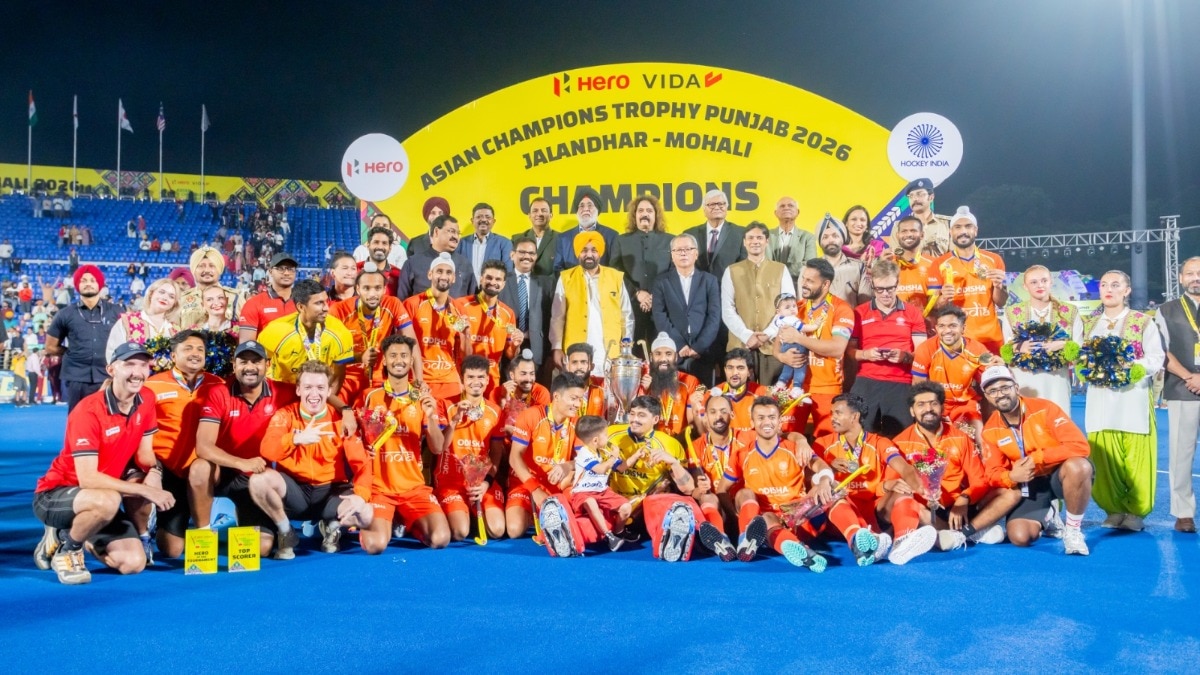
India claimed their sixth Asian Champions Trophy crown on Thursday, November 5, after beating Japan. Coach Craig Fulton said, "We've won the ACT three times in a row, and that's never been done before." While India dominated the continent, the team now faces tougher tests ahead of LA 2028.
India have conquered Asia once again, but the Asian Champions Trophy triumph is only the beginning. With transition, tougher tests against the world's best and the road to LA 2028 ahead, the Indian men's hockey team cannot afford to rest on its laurels.
"We've won the ACT three times in a row, and that's never been done before."
India coach Craig Fulton's words after India's Asian Champions Trophy title win on Thursday, November 5, reflected the satisfaction of a job well done. His side had gone unbeaten throughout the tournament and, even when faced with adversity, stood together to get the job done.
The final was perhaps the perfect example of that resilience. India were left chasing the game until the 42nd minute, when Shilanand Lakra finally opened the door. It was a performance that mirrored their group-stage clash against Japan, with the 4-1 scoreline also making a repeat appearance.
India vs Japan, Asian Champions Trophy Final: HIGHLIGHTS
India claimed their sixth Asian Champions Trophy crown and a third consecutive title, underlining their dominance over the continent. Once again, they had established themselves as Asia's undisputed kings.
But was their title triumph ever really in doubt? The answer is no.
India arrived at the tournament on the back of their Asian Games gold medal triumph. Apart from a tricky semi-final against Pakistan, they were rarely pushed to their limits. They also secured direct qualification for the 2028 Olympics, giving themselves ample time to prepare for Los Angeles.
But that is where the real challenge begins.
Indian hockey now needs to rethink how it prepares for the biggest tournaments. The disappointing World Cup campaign earlier this year was a stark reminder of where India stand in the global pecking order. They might be kings in Asia, but against the world's heavyweight teams, there is still plenty of ground to cover.
So, what's next for the Indian men's hockey team? What needs to change as they enter a crucial phase in their Olympic preparations?
OUTGROWING COMPETITION IN ASIA
It is no secret that India have little competition left in Asia. Their dominance has reached a stage where the gap between them and the rest of the continent is becoming increasingly difficult to ignore.
It is almost reminiscent of a period in French football when Paris Saint-Germain had so thoroughly dominated Ligue 1 that many felt they needed a different challenge altogether.
PSG were eventually judged by how they performed in the UEFA Champions League, where the competition was considerably tougher. Indian hockey is beginning to face a similar situation.
Just look at their numbers at the ACT 2026. India scored 46 goals, the first time they had crossed the 40-goal mark in the competition's history. It comfortably surpassed their previous best of 30 goals, achieved in 2016 and 2018.
They conceded just seven goals throughout the tournament. At the Asian Games in Nagoya, India were even more prolific, scoring 58 goals while conceding only eight.
Now compare those numbers with their World Cup campaign, and the contrast becomes impossible to ignore.
At the tournament in Belgium and the Netherlands, India scored 17 goals in total. That was the same tally managed by Ireland and Pakistan, with both teams failing to make it to the second phase.
India also failed to beat any team ranked above them in the FIH rankings.
The numbers tell a fairly straightforward story. India need to start testing themselves against higher-ranked opposition on a regular basis.
There was a time when Test series, both at home and abroad, were given considerable importance. Three-nation and four-nation tournaments were regular features of the international calendar, giving India opportunities to measure themselves against the best.
That is something Manpreet Singh also stressed after the conclusion of the tournament.
"We are doing quite well against Asian teams, but we need to perform even better against European teams. That will be important for us in the upcoming Pro League. When we go to the Olympics, we should make sure that there isn't any area where we haven't done our work or prepared properly," said Manpreet.
PRO LEAGUE IMPROVEMENT
There may be a school of thought that playing in the FIH Pro League alone will not necessarily transform Indian hockey. After all, the competition has limited consequences, and India's recent performances have done little to suggest that they have made the most of the opportunity.
India finished eighth in the Pro League last season, ahead of only Pakistan. Across 16 matches, they managed just 31 goals. In fact, their best-ever finish in the competition remains third place during the 2021-22 season.
In the last two editions, India have finished eighth in the nine-team competition. That is a record that needs to change.
The next two years, therefore, become particularly important. The 32 matches across the next two Pro League seasons will offer India a crucial opportunity to test themselves against the world's best and identify the areas that need improvement.
These fixtures will effectively serve as India's preparation for the Los Angeles Olympics. More importantly, they will provide the perfect platform to experiment, build combinations and gradually bring in the next generation.
India's Pro League campaign begins in February next year. It will be their first major opportunity to measure themselves against elite opposition while simultaneously beginning the transition towards the next Olympic cycle.
TRANSITION TIME
It almost seems like the players have had enough of hearing the word 'transition'. Perhaps that explains why Harmanpreet Singh cut his interview short on Thursday after the title win when he was asked about the changes expected in the team.
But change is inevitable in sport, and Indian hockey has already witnessed its first major departure. Nilakanta Sharma brought the curtain down on his international career immediately after the ACT.
This could well be the beginning of a larger transition, one that might bring sweeping changes to the national setup.
Several senior players are approaching the twilight of their careers, while some have also seen their performances dip. Hockey India's chairman of selectors, RP Singh, has made it clear that changes are on the cards and that no player is guaranteed a place.
"The country must come first. Everyone has spent 10-12 years together, and it is not easy when someone has to leave the team. It hurts both the person who has to make that decision and the player who is being left out."
"But this is the reality of sport. One player leaves for another to come in. Nothing is permanent, not even life, so how can anything in sport be permanent? Everyone has to leave one day. Those who understand this and step aside at the right time maintain their dignity and respect," said Singh.
If that is indeed the direction Indian hockey is heading in, future selections will need to be ruthless. Sentiment and past contributions cannot come at the cost of building a team capable of challenging the world's best.
There was also an argument that the ACT presented India with an ideal opportunity to experiment with a younger squad. Instead, the team management chose to give several Punjab-based players the opportunity to play in front of their home fans in Mohali and Jalandhar.
It was an understandable call, and one that did not hurt India's campaign. But the same approach might not work when they come up against the bigger teams in international hockey.
For India, the celebrations surrounding the ACT triumph need to be short-lived. The title is another feather in their cap, but it cannot become a distraction from the bigger picture.
Asia might be conquered, but the world remains a different challenge altogether. And with the Los Angeles Olympics now firmly on the horizon, India cannot afford to spend too long basking in the glory of another continental triumph.