
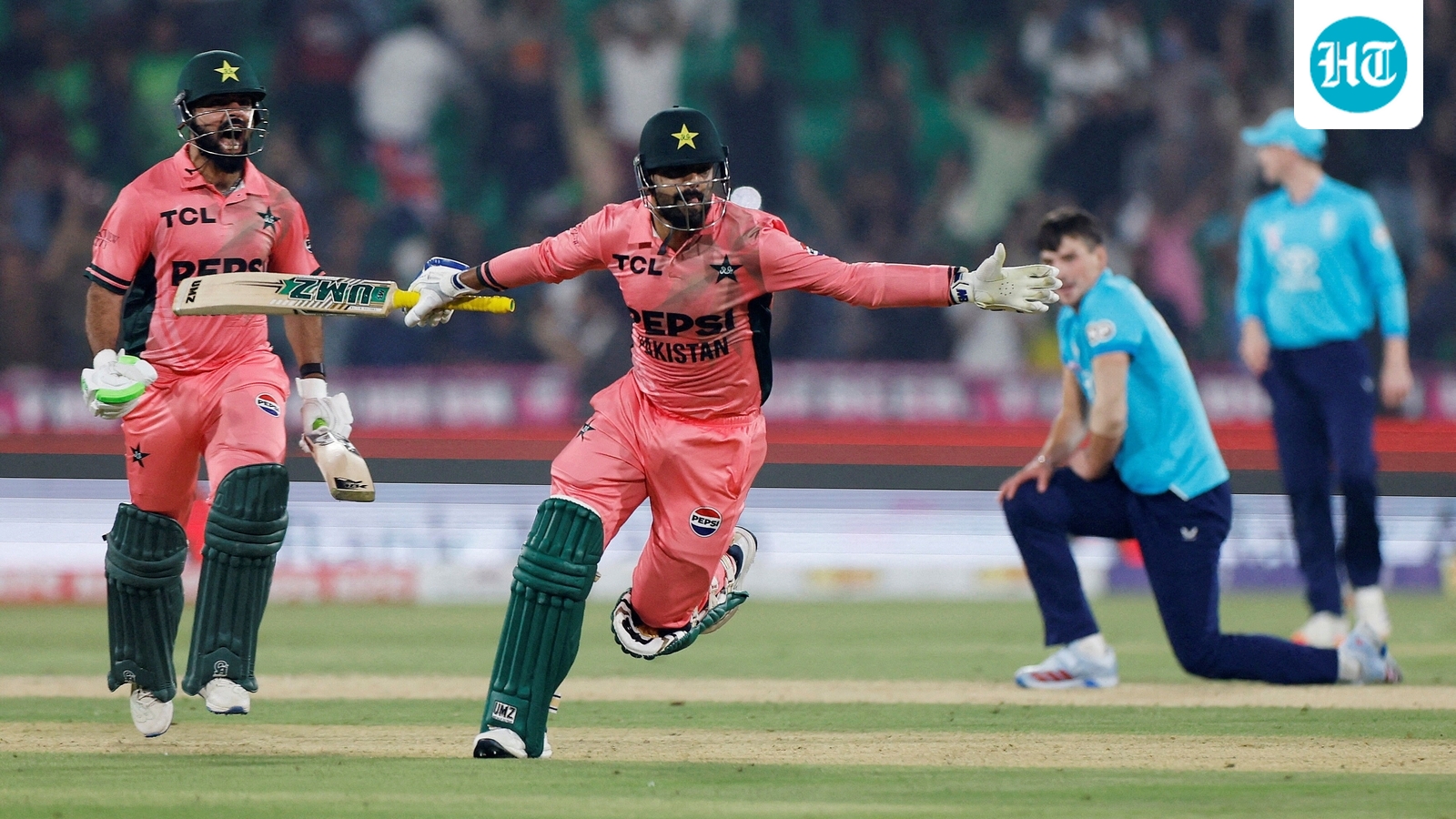
Shadab Khan scored an unbeaten 113 off 96 balls to lead Pakistan to a thrilling win in Lahore. He and Haris Rauf built an unbroken 89-run stand to secure victory with 17 balls to spare. This maiden century brought much-needed joy to a team facing heavy pressure and poor form.
The home team lost the ninth wicket in the 34th over with just 154 runs on the board at Lahore. A win was seemingly out of the question at that stage. But then Shadab and No.11 Haris Rauf put together an unbroken 89-run stand to take Pakistan over the line for their third straight win in the tri-series.
Pakistan won the match with 17 balls to spare, and Shadab reached his maiden century in the 50-overs format during his knock. When the match ended, he was unbeaten on 113 off 96 balls, including 13 fours and five sixes. In the stand with Rauf, which was the fourth highest for the last wicket in ODI history, the 28-year-old scored 81 runs.
Shadab’s innings will be celebrated not just by him but by possibly every senior player in the current team. The likes of Babar Azam, Fakhar Zaman, Shaheen Shah Afridi and Rauf, who were in action on Sunday, and many others who didn’t play but are part of the squad, will all rejoice.
For a while now, the seniors in the Pakistan team have been under pressure. The politics of the Pakistan Cricket Board, combined with poor form, have led to a strange vacuum in one of the most mercurial sides in world cricket.
Since January 2024, including Sunday's game, Babar averages 37.92 in 29 games. Mohammad Rizwan, not part of the tri-series, averages 42.42 in 29 games. Zaman averages 30.38 in 13 games. Shaheen has 49 wickets (economy 5.57 and average 25) in 27 matches, while Haris has 43 wickets in 25 games (economy 5.52 and average 24.72). During this period, Pakistan played 35 games, winning 20 and losing 15. To boot, the wins were often against teams widely perceived to be in the second rung of international cricket.
Backing the proven talents might have helped the players and the team, but that is perhaps too much to expect from a country as fractured as Pakistan.
Earlier this year, ahead of three games against Bangladesh, Babar was dropped. Rizwan was dropped after that series and has been out since. Later in the home series against Australia, Shadab got his first ODI game since the 2023 World Cup. The match against England was, in fact, his first in the tri-series.
Every senior player has been in the firing line over the last few years, and the Pakistani team has not done well across formats either. Their last ICC trophy, the Champions Trophy, came in 2017. Their last T20 World Cup win came in 2009, and their last 50-overs World Cup win came way back in 1992.
Shadab is spin great Saqlain Mushtaq’s son-in-law, and when he doesn’t do well, which has often been the case in recent years, fans and former players invariably bring up nepotism.
Shaheen, who is Shahid Afridi’s son-in-law, has been meted out the same treatment whenever he fails to perform. Social media is replete with memes that ridicule Babar and so many other players. The old guard needed a boost and this just might be it.
In the middle of this growing sentiment against senior players, Shadab’s knock shows that perhaps there is still life in the old legs. Under constant criticism, Pakistani cricketers often look worn out and insecure.
Inspiration can come in many forms and perhaps Shadab's innings could spark something in the rest of the group too. That is the kind of innings it was and that is the kind of impact it could have. But Pakistan cricket operates in strange ways and nothing is ever certain.