
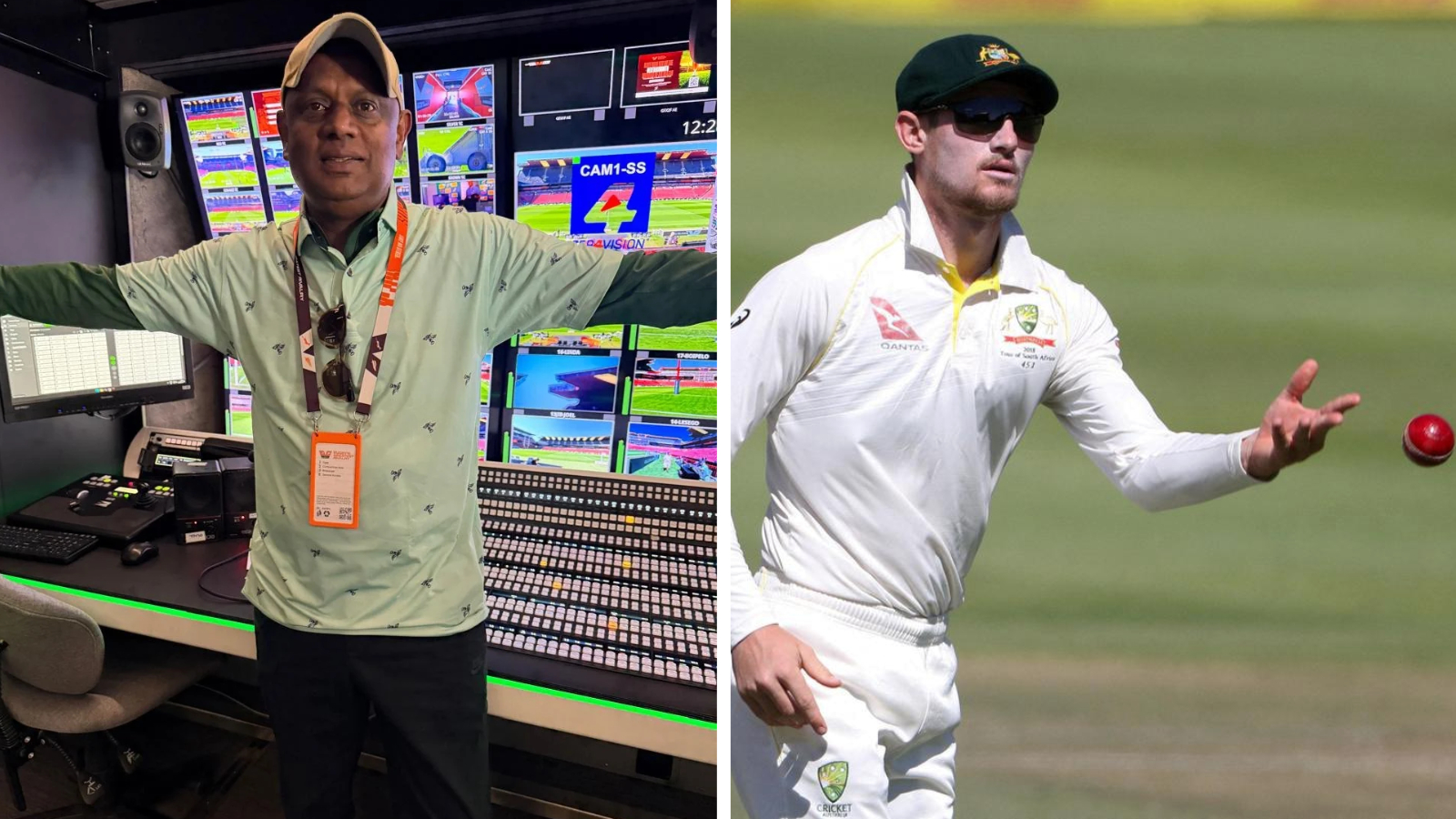
The broadcast production head said he feels sorry for Cameron Bancroft after the 2018 ball-tampering incident. He explained that cameramen spotted the player rubbing the ball strangely. They zoomed in on his pocket using high-definition cameras. He said, "In that moment you’re mainly trying to tell the story."
Q: What were your standing instructions to the cameras that follow the ball that day? I’ve seen it said that there were 30 cameras, with seven on the ball.
A: About 30-plus, yes. If there’s live play you don’t cut to every camera while the ball is in play, but we keep a camera on the ball, mid-on and mid-off, following whoever is working on it. That’s standard. We did the same when India were here.
Q: In Cape Town, who first told you something looked wrong? Ex player turned commentator Fanie de Villiers has said he tipped off the camera crew.
A: In my strongest opinion, no player, no team management and no commentator told us. I was told by the cameraman. The two spin-vision cameramen said the ball was reversing. The cameraman who focused on the ball, the mid-wicket cameraman, stayed on Bancroft. Then the replay guys were looking at it and said, have a look at this, you can see there’s something in his pocket.
The cameraman spoke to the replay guys, the replay guys offered it to me, and I watched it on preview and said, okay, let’s play it in. Nobody else told me anything. Maybe one of the commentators said something to a cameraman. I don’t know.
Officially, I’m not aware of that. For obvious reasons, since they are all working in the same industry, I don’t want to reveal their names as requested by them. It was a team effort, with so many cameras involved, live or replay.
Q: What made it look fishy?
A: Normally the players shine the ball on their pants, and the man working on it isn’t supposed to touch it with the side of the palm. But Bancroft was rubbing the ball on the inside of his palm, and that’s what looked fishy. Then he put his hand in his pocket. The cameraman saw it and slid onto him, and we zoomed into the pocket. These are big, high-definition cameras, so you can see something.
Q: What went through your mind as a director at that moment?
A: Directing live television is always going to be a rush. In that moment you’re mainly trying to tell the story, not worrying about the outcome. We don’t manage the game, we control the broadcast. It’s up to the umpires and the referee to control the game. I don’t think anything we did was deliberate to find them out. I promise you, they got found out.
Q: How long between the replay guys alerting you and it appearing on the big screen? And who made the call?
A: A couple of minutes. It was Mitchell Marsh bowling, the 43rd over or so. I played it in over a few deliveries.
The big screen is controlled by an independent company on behalf of South Africa. We manage them in terms of DRS and when to stay with our pictures. In between deliveries they normally don’t switch to ad breaks, they stay with the live footage, and I’ll tell them to keep our pictures on the big screen. That’s how it got there. And the crowd reacted.
Q: When did you know it was sandpaper and not tape?
A: When he took it out of his pants and put it into his jocks. You can see it’s yellow. The umpires later took something out of his pocket and showed him, and that was black. This was yellow.
Q: Bancroft says the plan began in the second Test at Port Elizabeth. Did your cameras catch anything there?
A: No, because our focus was on David Warner. After Durban there had been a big fight on the stairs between Warner and Quinton de Kock, and from there the emotions of the two teams went to another level. We were showing Warner because of the antagonism with de Kock. Then he started twiddling his fingers behind his back, so the cameraman zoomed in from behind, and we noticed he’d written names on his taped hand (Warner had written the names of his wife, Candice, with a heart, and his daughters, Ivy Rae and Indi Mae, on the strapping tape on his left hand). We tried to read what was written. There was no intention to look for anything else, and we never suspected anything.
Look, at Port Elizabeth, it’s the shortest walk from the change rooms to the middle of any ground I’ve worked on. After tea we’re in an ad break, and when we come out we go straight to the betting card and bowling cards. By the time we’re back they’re ready to start, so we didn’t pick up when the umpires took the ball off. In the huddle they weren’t looking at the ball, and we had a camera right there.
Q: So they’d studied your schedule, as Bancroft suggests now?
A: They’re very smart. Bancroft mentioned it himself. We always look at the fielding side after tea, but the cameramen are coming back from their break, some have gone to the bathroom, and we try not to put them under pressure to come back early. We should have one or two cameras on the fielding side when they come out. The Aussies worked that out.
Q: After the series, did Cricket Australia ask you for the footage?
A: No. We never heard from them. I remember we couldn’t do interviews with the Australians at that time, because their media manager, Kate Hutchison, said so. They were emotionally charged and quite upset with us as a broadcaster, but we just did our jobs.
Q: Tim Paine wrote in his autobiography that after Cape Town, in the next Test, you showed a South African player doing something to the ball and then pulled the shot off the screen. He says the footage “got lost”.
A: Absolute nonsense. I’ve never heard that story before in my life. Somebody should have called us then and asked what happened, because I don’t know what he’s talking about.
Q: Is there anything from that day your footage shows that nobody has asked you about?
A: No, nothing that I know of. In South Africa we’re not scared to show what we show. We show people in the swimming pool, people having a beer, and the only restriction is parental guidance. We do pretty good coverage for both teams in any sport.
Q: That evening, after the press conference, did you and the cameramen get together?
A: No. After the Test I went for dinner with Shane Warne, Allan Border and a Australian journalist. I was quite upset, because I only found out afterwards what had happened at the press conference. I saw the Australian guys crying and it became tough for me, my team, us, because that wasn’t the intention. But in that dinner, Warne, Border all said to me, you’re only doing your job, you’ve done nothing wrong.
Q: Do you think you shouldn’t have shown it?
A: Opinions can be divided. Some people think maybe I shouldn’t have shown it, or been over the top about it. But we showed what was happening in front of us. That’s your job as a journalist. If you see a volcano erupt, you can’t say you didn’t see it. It had to be told.
I’ve got no opinion on the rest, the win-at-all-costs narrative, and I don’t know how true that is. My opinion is only on broadcasting. Even with the South African team, we don’t socialise with the players during games.