
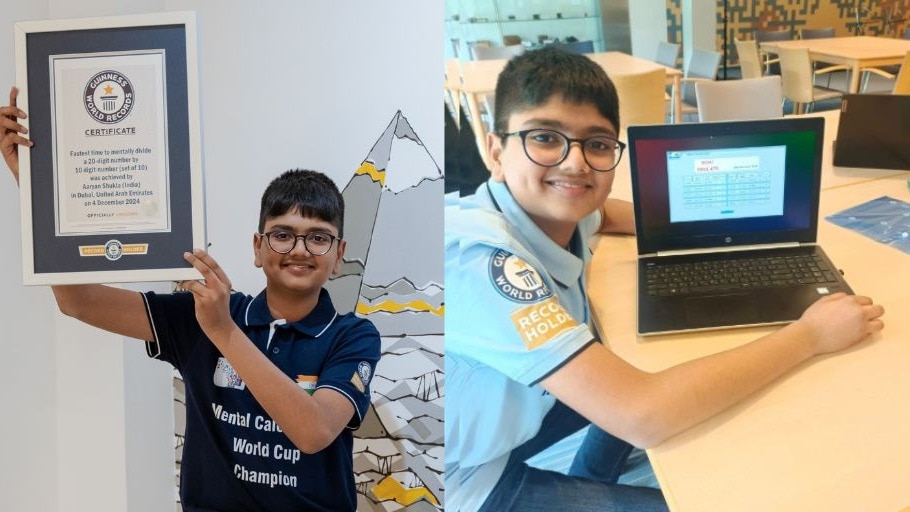
16-year-old Aaryan Shukla from Nashik has earned nine Guinness World Records for his mental calculation skills. He won the Mental Calculation World Cup twice, first at age 12. His father Nitin Shukla said, “What Aaryan was doing was not normal, so we focused on it and started taking him to participate.”
AI can calculate in seconds. 16-year-old Aaryan Shukla does it in his head. The child prodigy from Nashik, Maharashtra, has earned nine Guinness World Records and won the Mental Calculation World Cup twice, first claiming the world title at just 12. Known as India's human calculator, Aaryan showcases the extraordinary potential of the human mind to perform complex calculations with remarkable speed.
Behind these remarkable achievements lies a journey that began with a young boy's fascination with numbers, years of dedicated practice and parents who nurtured his talent without putting him under pressure to succeed.
FROM A SIX-YEAR-OLD's CURIOSITY TO INTERNATIONAL RECOGNITION
Aaryan began practising mental mathematics at just 6. Within a year and a half, his parents realised he had exceptional ability. “After around one year, one and a half years, he started doing something exceptional. His mother and I both observed that what Aaryan was doing was not normal, so we focused on it and started taking him to participate in competitions,” recalls his father, Nitin Shukla.
His first major breakthrough came in 2018, when the eight-year-old represented India at the Memoriad Turkey Open Championship in Istanbul. He returned with 10 medals, including seven gold, one silver and two bronze, and set two children's world records.
The achievement marked the beginning of Aaryan's journey on the international mental mathematics circuit.
HOW DID AARYAN BECOME A WORLD CHAMPION AT 12?
One of the biggest milestones in Aaryan's journey came in July 2022, when he competed in the Mental Calculation World Cup in Paderborn, Germany. At just 12, he emerged as champion in a competition featuring 40 invited participants from across the world.
“Before that, the Japanese team had a lot of dominance. In 2016 and 2018, the Japanese team won both competitions. But at the age of 12, Aaryan won the World Cup,” his father, Nitin Shukla, recalls.
Aaryan returned in September 2024 to defend his title, scoring 819.84 out of 900 points and winning all six trophies: overall ranking, versatility, addition, multiplication, square roots and calendar dates. He also set five world records across different mental calculation disciplines.
NINE GUINNESS WORLD RECORDS: HOW DID HE DO IT?
Aaryan's Guinness World Records journey began in February 2024, when he appeared on the Italian television show Lo Show Dei Record. In the same month, he set his first Guinness World Record by mentally adding 50 five-digit numbers in just 25.19 seconds.
Later that year, he was invited to the Guinness World Records office in Dubai for official record attempts. On December 4, 2024, he set six records in a single day.
The challenges tested different aspects of mental calculation. He mentally added 50 five-digit numbers in 18.71 seconds, added 100 four-digit numbers in 30.9 seconds and added 200 four-digit numbers in 1 minute and 9.68 seconds.
He also set records for mentally dividing a 20-digit number by a 10-digit number and multiplying large numbers.
During his April 2026 visit to Italy, Aaryan set two more Guinness World Records. He calculated the square roots of 10 eight-digit numbers in 71.22 seconds and completed 10 divisions of 10-digit numbers by five-digit numbers in 28.81 seconds.
For Aaryan, each record represents years of preparation, repeated practice and the ability to perform under pressure.
HOW DOES AARYAN BALANCE SUCCESS, SCHOOL AND COMPETITION PRESSURE?
With nine Guinness World Records and two world championship titles, Aaryan's achievements could easily create pressure. However, his parents have chosen to prioritise effort over results.
“As a parent, we don't pressure him. Even if he had done 20 percent of what he has done so far, we would have been happy,” Nitin says.
Although Aaryan gets nervous before competitions, his family encourages him to focus on preparation rather than outcomes. His father says the priority is to put in the effort and not worry if the desired result does not follow.
Alongside his international commitments, Aaryan continues his education in Class 11 at Delhi Public School, Nashik. He scored 97 percent in his Class 10 examinations and is particularly interested in mathematics and physics. He also follows developments in artificial intelligence and technology.
CAN AI REPLACE HUMAN CALCULATORS?
Artificial intelligence is becoming increasingly capable of performing calculations, analysing data and solving mathematical problems. So, does mental calculation still have a meaningful role?
Nitin believes that human skills and technology should not be viewed as competing forces. "Technology will keep on advancing. There must be an upgradation of the human brain. There must be an upgradation of human abilities," he says.
He believes Aaryan's achievements should be understood as a demonstration of human potential rather than simply a contest between people and machines. "If we put our energy, concentration and focus in the right direction, then humans can achieve a few things which look impossible," he says.
Nitin also points to the potential value of mental calculation when technology is unavailable or systems fail, arguing that human skills can serve as a useful backup.
FROM WORLD CHAMPION TO MENTOR: WHAT COMES NEXT?
Having won the Mental Calculation World Cup twice and established multiple records, Aaryan is increasingly focusing on sharing his knowledge with younger learners.
He is a founding board member of the Global Mental Calculators Association (GMCA), which works to promote and strengthen mental calculation internationally. In 2025, he also won Season 3 of the association's Global Mental Calculation League.
His work now includes speaking to students, demonstrating his skills and encouraging children to become more comfortable with arithmetic. Moreover, he conducted a five-week online programme, Magic of Mental Math, for children aged nine to 14 through the Bruhan Maharashtra Mandal of North America.
He has also represented young talent at international events beyond mathematics competitions. In November 2025, he participated as a panellist at the Misk Global Forum in Riyadh, Saudi Arabia, where he demonstrated his skills and discussed the role of mental calculation in education.
Aaryan wants to help children overcome their fear of arithmetic and understand that calculation is a skill that can be developed through practice.
WHAT IS THE BIGGEST LESSON FOR PARENTS?
For Nitin, supporting Aaryan has taught him that parents must distinguish between nurturing a child's interests and imposing their own ambitions. He believes parents sometimes expect their children to follow the same career paths or fulfil dreams they could not pursue themselves.
"We should not put our dreams on our children. We should give our children a good value system. We should make them accountable," he says. He also urges parents not to abandon a child's interests simply because results do not come immediately.
In Aaryan's case, the first year or two did not guarantee that he would become a world champion. His parents continued supporting him because he enjoyed mental calculation and was making progress.
They did not know he would eventually win international titles or set Guinness World Records. They simply chose not to give up on an interest that mattered to their son.
"If he is showing interest, give the child enough time," Nitin explains. He believes children should be allowed to explore their interests, whether in sports, mathematics or another field, without being made to feel that they must fulfil their parents' ambitions.
A HUMAN STORY BEYOND THE NUMBERS
At 16, Aaryan Shukla has nine Guinness World Records, two Mental Calculation World Cup titles and a growing role in mentoring young learners. His achievements have taken him from Nashik to the international stage, but his family's approach to success remains grounded in a simple principle.
Technology may continue to become faster and more powerful, but Aaryan's journey demonstrates the value of curiosity, disciplined practice and the human capacity to learn.
His parents never set out to raise a world champion. They chose to support a child who loved numbers.
And perhaps that is the most inspiring part of Aaryan's story: not simply how quickly he can calculate, but how much a child's potential can grow when parents give it room to flourish.