
India faces a crucial test as their five-match ODI series against New Zealand starts Wednesday in Auckland. With the World Cup approaching, the team needs to fix their bowling issues. Skipper Shubman Gill said, "When the ball gets old, when there is not much seam or swing movement, how do you challenge the batter?"
Take a cue from how India have bowled in T20S, though, and there is unease. Can India’s ODI bowling be as effective as their batting?
There can be no easy answer to this. Partly because India have played only 33 ODIs since the 2023 ODI World Cup final in Ahmedabad, and partly because they have rarely played at full strength in all those matches. Still, some numbers could spook you.
In the 13 ODIs India have batted first since the Ahmedabad final defeat to Australia, they have lost eight. In two of those matches, India lost defending totals of more than 350 — against South Africa in 2025, and West Indies last month. In the other six, the scores ranged from 136 to 284.
The easiest assumption to make from these numbers is that India have been poor at defending, and the only recourse is to either chase or get at least 350 first up. But the thing is, the toss and the conditions aren’t controllable. Case in point was the Guwahati ODI against West Indies in September, where India won after their bowlers conceded 405, on a flat pitch.
This is what makes the five-match ODI series against New Zealand, beginning on Wednesday in Auckland, so important. For a side that has traditionally relied on spin in the middle overs, the World Cup in South Africa late next year demands a different approach. Pitches won’t be slow, outfields won’t always be quick, and it may not be that easy to hit sixes. In short, not the conditions pitches in India offer around the year. Pace, bounce and the ability to extract something from unresponsive surfaces could become considerably more valuable commodities.
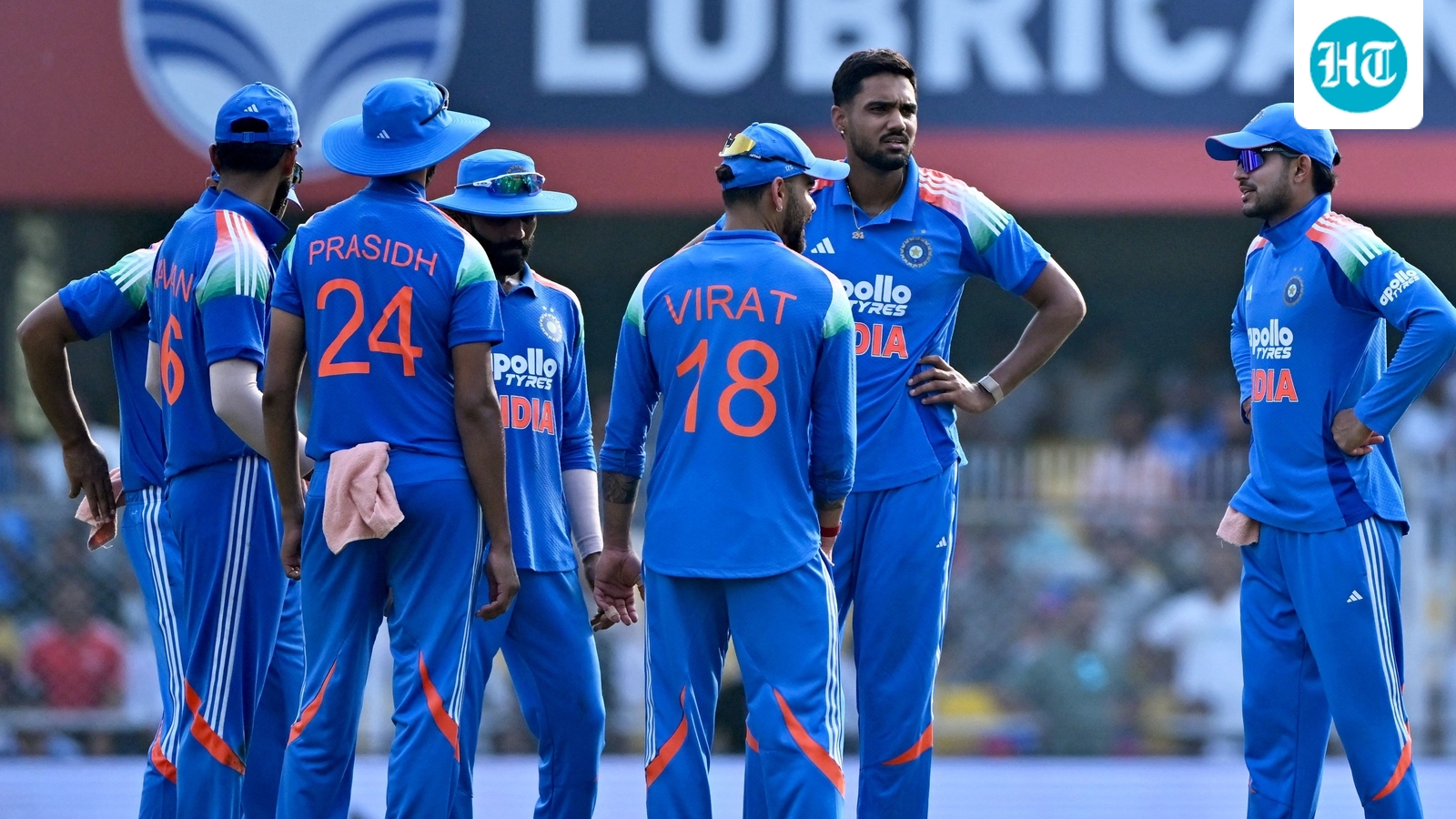
Skipper Shubman Gill seems to understand the problem. India have spent recent months experimenting with taller fast bowlers, including Prasidh Krishna, Harshit Rana and Gurnoor Brar, in the hope of developing an attack that can ask questions of opposition batters even when the ball has lost its shine. Injuries to Prasidh and Harshit — both are unavailable for this series — though have complicated that exercise.
Gill explained the thinking behind the exercise. "When the ball gets old, when there is not much seam or swing movement, how do you challenge the batter?" he asked during the pre-match media conference in Auckland. “You can challenge the batter if there is something in the wicket — if the ball is seaming, it becomes difficult for the batter to score — or you can challenge the batter with pace and bounce.
“So, identifying the kind of bowlers who can make scoring difficult and can give us the best opportunity to take wickets in the middle overs — that has been the thinking around trying someone like Gurnoor or Prasidh, which gives us a bit more than someone who bowls at maybe 135 kph when the wicket is flat.”
It also gets to the heart of India's ODI bowling dilemma. A World Cup campaign can’t be built assuming that the pitch will always cooperate or controlling the middle overs can be left to Kuldeep Yadav and Axar Patel.
Gill believes height and genuine pace creates problems for the batters. “I have played in the middle overs a lot and I have seen, if tall fast bowlers can hit the right areas, it is a lot more difficult to score runs than someone who is bowling at 135, 130 (kph).
"You have to be really on top of your game to be able to score against someone who is 140 (kph)-plus, who is 6'1", 6'2", 6'3". There is a lot more risk when you are trying to score freely (against) that kind of bowler."
The question is whether India can find the personnel and prepare them to execute it consistently. Gurnoor, who offers height and bounce, will be a player to watch. Anshul Kamboj and Auqib Nabi provide further opportunities to assess the country's fast-bowling depth, while Mohammed Siraj and Arshdeep Singh bring experience. Nitish Kumar Reddy, available for the opening match, also offers the possibility of an additional seam-bowling option without compromising batting depth.
“Keeping the World Cup in mind, (we) definitely (need) a strike bowler in the middle,” said Gill. “Whether it is a spinner or a fast bowler, who can give us wickets in those conditions is very important. Otherwise, you only get four fielders in the middle overs. Even if your Powerplay is good, the game keeps coming out of your grip when you don't take wickets in the middle overs. That has definitely been a problem for us in the last 7-8 ODIs. Whenever we did well, we almost had a one-sided match in the middle overs. And when we didn't take wickets, it was challenging for us.”
Hardik Pandya's importance can’t be overstated. A fit Hardik means India will have a genuine pace bowling all-rounder who can operate through the middle overs and provide batting insurance. The others must work on getting the lengths right.
“We have to find out what is important for us in the middle overs, in which length we can get more wickets,” he said. “It would be at the back of our mind, playing in conditions that are going to be a lot similar to South Africa than some of the other countries.”
India can’t afford to enter a World Cup in South Africa hoping that Kuldeep will always find turn and bounce or that the opposition will make mistakes against their batting. They need height, pace, bounce and, just as importantly, accuracy without weakening the batting.