
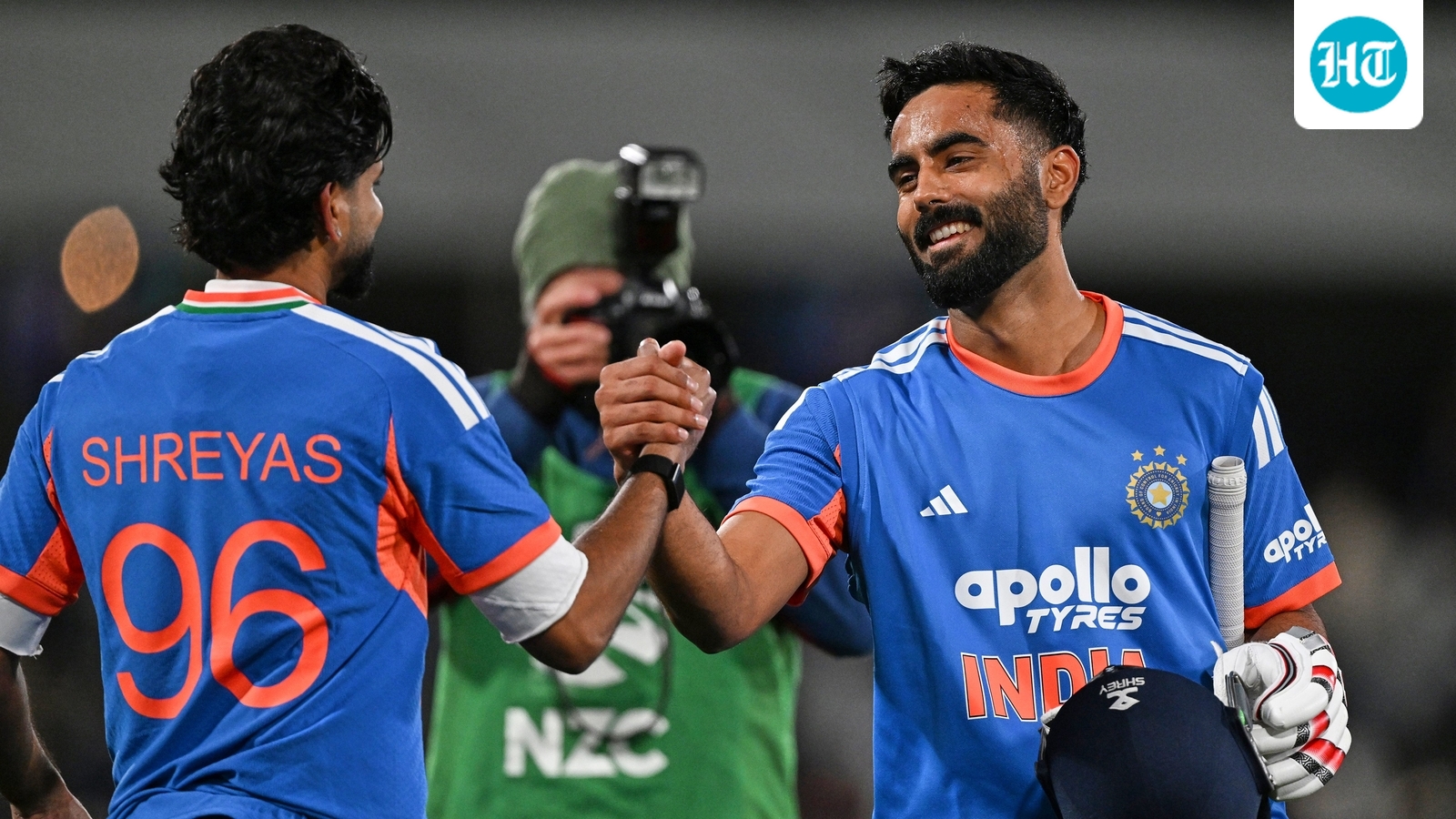
Naman Dhir scored an unbeaten 42 from 15 balls against New Zealand. He used his height and reach to attack early, putting pressure on the bowlers. While he got some luck with dropped catches, his busy approach helped India recover after the team lost a cluster of wickets quite cheaply.
His unbeaten 42 — from just 15 balls — was not an uninterrupted exhibition of clean hitting. That is part of what made it interesting. Dhir cut Mitchell Santner behind square, slog-swept him towards cow corner and watched Nathan Smith's attempt at a catch end in a six.
Against Nathan Smith, an outside edge flew towards short third, where Lockie Ferguson failed to complete a difficult chance. Then, another top edge cleared short fine leg. A strain of luck ran through his innings, helped a bit by New Zealand's poor fielding as well.
But fortune is not the same as passivity. Dhir gave himself opportunities to score, forced the fielders into action and ensured that the situation never became an excuse for hesitation. It was the kind of busy ending that a team ideally seeks to deflect from the fact that they had lost a cluster of wickets cheaply after such a start that should have guaranteed a comfortable win.
There is a distinction worth making here. India possess big hitters of the ball. What they need, particularly in the middle and lower order, are players in the mould of Rinku Singh who can do it without requiring a long introduction. A batter arriving with 30 balls remaining can’t always afford the conventional business of taking a few deliveries to settle in. Dhir seems to understand that exceptionally well.
His brief innings against West Indies in Bengaluru last week offered an even more concentrated illustration. In a match reduced to nine overs per side, India were 88/4 with 17 balls remaining when he came in to hammer 24 from six deliveries, including three sixes and a four. Using his height and high grip, he chose deep square-leg, mid-off and long-off for the three boundary hits off Keemo Paul before thumping Shamar Springer over long-off for another six.
It’s not simply that he swings hard. Dhir’s height and reach give him access to different areas, while his willingness to attack early puts pressure on a bowler who might otherwise spend the first few deliveries establishing control. The risk is obvious—a batter who begins at full throttle can run out of options as quickly as he runs out of deliveries. The reward is that he can make a small opportunity count, which is all that matters in T20.
The numbers support the impression, though they should be handled with some care. In overs 16 to 20 of T20 matches, Dhir has scored 341 runs from 167 balls, with 10 dismissals. His strike rate is 204.19, with 34 fours and 19 sixes. The sample is limited, but the numbers can’t tell us how he will respond when the pitch is slow, when the bowling is disciplined or the target requires calculation rather than assault.
They do, however, tell us that Dhir’s instincts are currently extremely valuable. The next step is to discover how much lies beyond that instinct. For now, Dhir has offered two useful glimpses—at Bengaluru and Christchurch—of a batter who doesn’t appear intimidated by the lack of time. That is reason enough to keep Dhir in the loop.