
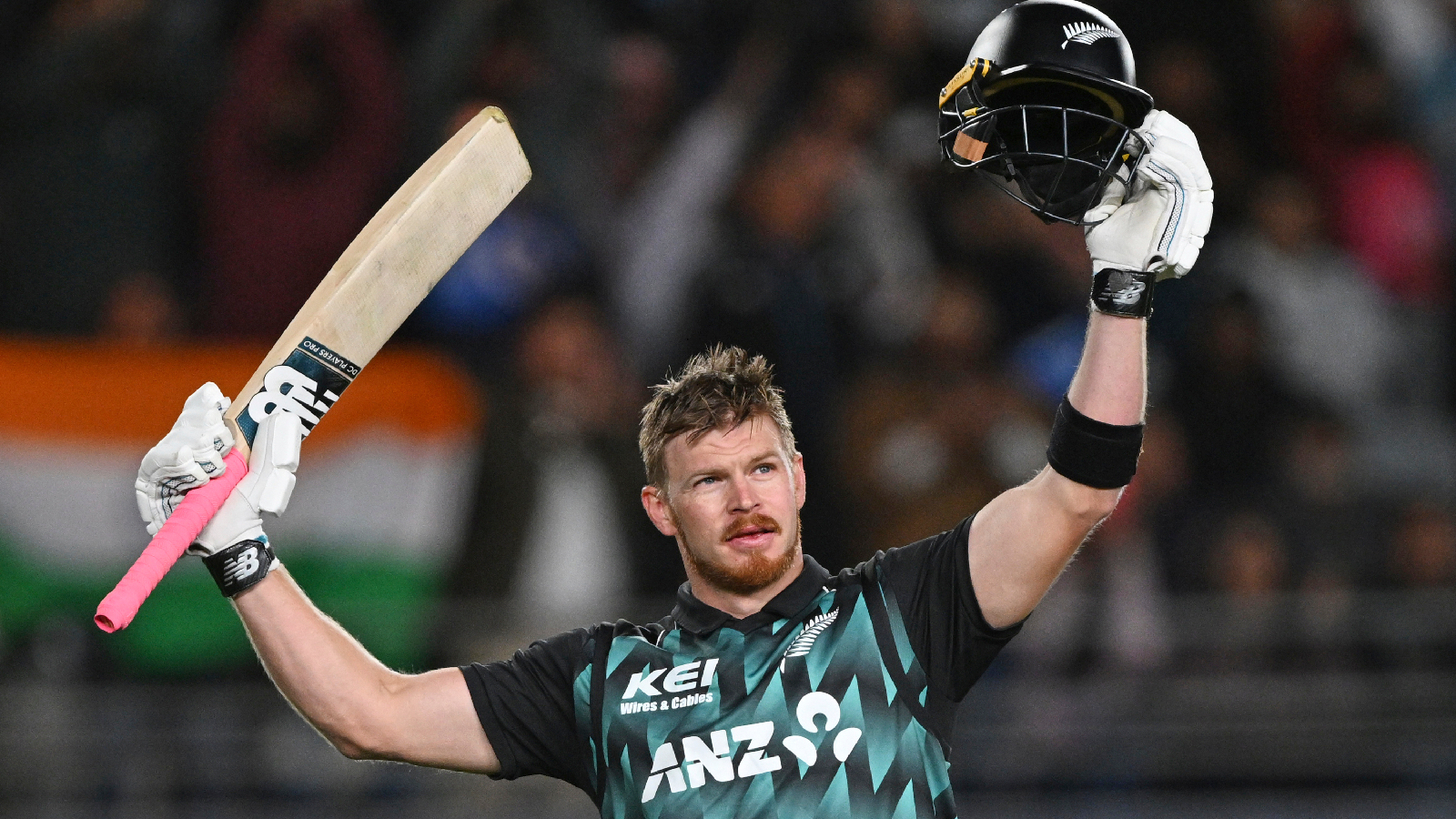
Glenn Phillips hit a blistering century to help New Zealand beat India by 87 runs in their T20I series. India lost early wickets and failed to chase the 260-run target. Captain Shreyas Iyer said, "Everything that could have gone wrong went horribly wrong." The defeat ended India’s recent winning streak.
A blistering century from Glenn Phillips and a stunning assault in the middle-overs allow New Zealand to get off the mark in T20I series
One bad match doesn't define a series, least of all a dead-rubber game. India had already sewn up the series against New Zealand, emphasised their supremacy as the two-time defending world champions, their defiance in pulling games from their brink and their supreme knack of elevating a routine win into a victory march. But the 87-run defeat in the failed pursuit of 260, inconsequential though in the context of the series, was a tear on their cloak of invincibility.
T20s nights are prone to such wild fluctuations, but the manner they unravelled would hurt them. Some passages would stick out like a lurid fever nightmare when the series ends on Sunday. Like their abject helplessness during the assault of Glenn Phillips and Michael Bracewell. Six overs that bled 113 runs, nine sixes and eight overs, was one of the most horrible passages in the country's T20 history. The chase fell apart in the first over itself, when India lost the wickets of Sanju Samson and Ishan Kishan. Jacob Duffy could laugh at the sport's inherent irony. In Wellington, his first over cost 26 runs; in Auckland he grabbed two wickets for five runs and ended the night with commendable figures of 4-0-23-4. That's T20 in a nutshell, but the philosophy-sprinkled lines wouldn't comfort India's captain Shreyas Iyer.
Everything that could have gone wrong went horribly wrong. Bowling was hideous, bowling changes were awry, and field settings were as timid as reactive. Iyer can't be blamed for all, he could only marshal the men he has, but he would agree that his team lacks a genuine middle-over enforcer, the shapeshifting genius that could adapt to varying conditions and still ensure that batsmen remain quiet. The death and power-play overs are anyway bound to leak runs, but tight middle overs could ensure that the runs don't blow out of proportion. Little wonder then that Hardik Pandya and Jasprit Bumrah are missed.
Those six overs reduced the chase into an impossible act, despite the high-grade explosives in India's granary. It began with Bracewell, often wasted down the order but endowed with a sweet swing of the blade, in the twelfth over. He pulled Naman Dhir's second for the first of his two overs. He struck a six and four to hammer 16 runs in the over. Dhir was an injudiciously defensive choice, a ploy to squeeze in an over or two when a new batsman was at the crease. Bracewell had arrived in the previous over, after Mayank Yadav had hustled Bevon Jacobs into a miscued pull shot. The over had cost only four runs and brought India back into the game. But the next over overturned the momentum.
The refuge in Dhir betrayed India's sparse alternatives in the middle overs. Axar Patel is a diminished force; Mayank had already exhausted three of his four overs; Prince Yadav is proficient at the death and start, but still apprenticing the middle-over act. Nonetheless, Iyer dialled Prince to cruel outcome. Eighteen runs ensued. Yadav strove the fuller length, which on a ground with shorter straight boundaries was suicidal. The extra bounce was ideal for hard length, and it was no coincidence that Mayank Yadav was India's most penetrative bowler. But few others found the length comfortable.
The worst was yet to be. Iyer furiously waved at Axar. He is not as precise with his length or shrewd with his designs as he once used to be. Bracewell pillaged him for 18 runs in his four balls. Dhir shelled Phillips's catch to aggravate Axar's angst. Iyer immediately summoned Arshdeep Singh, who momentarily applied the brakes with a seven-run burst. Iyer searched for faces. It fell on the still-callow Nitish Reddy. All Iyer watched were rockets fizzing along the Eden Park skyline. Four sixes flew from Phillips' pounding bat. He skimmed 90 from 42 balls, but had to wait for his hundred until the 19th over.
The free-flowing Bracewell hoarded all the strike in the next over. He ensured he didn't waste it, as he crunched the tearaway for 20 runs, including three monstrous sixes. The first was a gorgeous lapped maximum over long-leg, the second was bunted over the keeper, hunkering down on his knees, and the third was glided past fine-leg in a breathless exhibition on improvised batsmanship. He perished in the next over, but the Kiwis had rocketed to 227 in 17.2 overs.
In moments like these, India missed a group of bowlers with the expertise to bowl into the pitch, slip in the cutters and bowl with a scrambled seam, tricks that New Zealand's seamers employed cleverly. They also pounded out the short-length ball, angling it away from the left-hander or into the body of the right-handers to cramp them for room. Matthew Fisher bowled an excellent heavy ball to induce a spliced slash from Abhishek Sharma, India's last beacon of hope. A clutch of twenties and Tilak Varma's 35 lend some respectability to India's total.
After the hosts wrapped up the game, Iyer dwelled on the need to introspect. "It is important to retrospect. We have to see how to bounce back. We have to go back to the drawing board and execute [our plan]," he said. It could be convenient to brush away the game as an aberration, but in sport there is always a cause and effect. The causes for the defeat would hurt India as much as the effect they produced.
Brief scores: New Zealand 259/7 in 20 ovs (Phillips 107, Bracewell 65, Mayank 3/48) bt India 172/9 in 20 ovs (Tilak 35, Duffy 4/23) by 87 runs.