
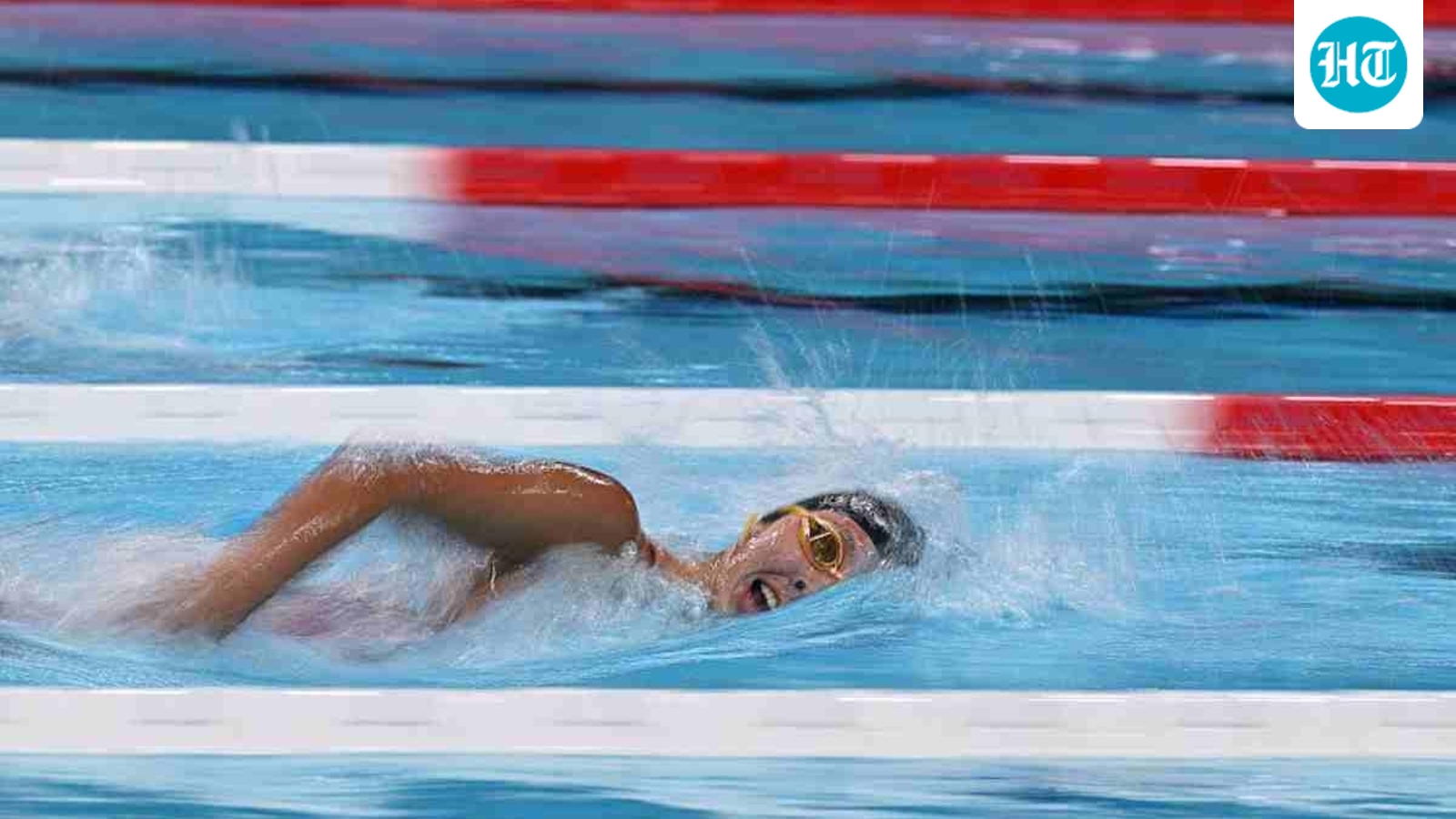
Dhinidhi is preparing for the Dakar Youth Olympics, which will take place between October 31-November 13 in Dakar, Senegal. The 16-year-old swimmer previously competed in Paris at 14. She said, “At the Olympics, I was like a kid at a candy store. The Youth Olympics feels like more pressure.”
“I saw her and I froze,” Dhinidhi recalled. “I couldn't believe that that was actually her. I didn't really tell her anything. I kind of regret that now.”
The card is still at home, lying in wait of a second chance, perhaps.
Paris was full of such moments for the Bengaluru swimmer. There were Olympic champions walking past her in the dining hall, sporting legends travelling on the same bus and the world's finest swimmers going about their routines at the pool, a few feet away. For a teenager who had been swimming competitively for only about seven years, it was an extraordinary introduction to the biggest stage in sport.
“I don't think at that time I really appreciated the magnitude of the event,” she said. “In my head, Los Angeles 2028 was supposed to be my Olympic debut, at the age of 18. Paris happened way too soon.” Dhinidhi travelled to the Olympics through the World Aquatics Universality quota, which allows for representation of countries who don’t achieve qualification.
No Indian swimmer achieved the direct Olympic Qualification Time (OQT, A cut) or the Olympic Selection Time (OST, B cut) for Paris. At 14, she was the youngest member of the Indian contingent.
Two years later, Dhinidhi is preparing for another Olympic experience.
Most athletes go from the Youth Olympics to the Olympics. Dhinidhi is doing it the other way around. Having competed in Paris at 14, she heads to the Dakar Youth Olympics at 16, with considerably more experience, faster times and greater expectations.
The Youth Olympics—which heads to Africa for the first time—will take place between October 31-November 13 in Dakar, Senegal. The irony of her Youth Olympics route was pointed out to her by fellow athletes at the Junior Nationals earlier this year. She hadn't quite thought about it that way until then.
If Paris was about exposure. Dakar, she says, is about performance. She will be racing swimmers her age, many of whom she expects to encounter repeatedly over the coming years. The stakes, naturally, feel higher, so do the expectations.
“At the Olympics, I was like a kid at a candy store. The Youth Olympics feels like a lot more pressure,” she said. “These are people that you have to compete with later on in the future.”
Her coach Nihar Ameen, however, is inclined to see Dakar as another stop in a much longer journey.
“Personally, I think the Olympics should have come much, much later,” he says.
He believes the scale of Paris was somewhat overwhelming for the teenager, although the experience was valuable.
Since then, her progress has been reflected in her times. Dhinidhi has repeatedly improved the Indian women's 200m freestyle national record, establishing herself as the country's fastest swimmer over the distance.
Ameen credits her work ethic, discipline and ability to remain focused on long-term goals.
“She's very conscientious about her training, locked in, doesn’t get distracted and works towards what needs to be done,” he said.
She holds the national record in the 100m freestyle (56.57), 200m freestyle (2:01.81), and 400m freestyle (4:21.56).
“200m freestyle is really her best event. Once she breaks that glass ceiling of two minutes and comes to 1:59, it's going to be a completely different story altogether.”
Yet for all the progress, Ameen is wary of the dangers of rushing a talented teenager towards success.
Pushing swimmers too hard too early, he argues, can lead to injuries and performance plateaus at precisely the age when they should be approaching their peak. “A lot of coaches, especially in India, tend to over-train them at a younger age,” he said.
The challenge is to increase training loads progressively while ensuring the athlete doesn’t lose an enthusiasm for the sport.
“No Indian female swimmer has been as fast as this. If she maintains the same trajectory, as she develops over the years, I think she could hit a peak around 19-20,” he says.
For Dhinidhi, the demands of elite swimming already mean an adolescence quite unlike that of most of her classmates.
A Class 11 science student, she has little time for social outings. Weekdays are consumed by training, while weekends often disappear into tuition classes, recovery sessions or simply catching up on rest.
Her friends have learned to accommodate her schedule. They continue inviting her out even when they know the answer will probably be no. On the rare occasion she is available, they hurriedly plan a meet-up.
“There's a lot of things that you kind of have to miss out on,” she says. “But then you're the one who chose this so you might as well do what it takes.”
The sacrifices have not always been easy to accept. There have been difficult stretches, particularly while balancing examinations and demanding training schedules. Earlier this year, after a period when she felt mentally drained, Dhinidhi turned to journaling.
Sometimes, she would fill seven or eight pages with thoughts and feelings she had barely realised were occupying her mind.
Writing them down helped her regain perspective and return to competition in a better frame of mind.
Having observed the world's leading swimmers at close quarters, Dhinidhi is conscious of the gap between India and top swimming nations like the United States, China and Australia. She points to the greater investment in grassroots coaching, scientific support, technical development and competition exposure available to young swimmers overseas.
“These top nations invest a lot in their younger generation, and teach them the basics much better than how we do it here. We learn it a lot later. When I was 7 or 8, my technique was really bad. It took a lot to work on it. Even now it's not that great. We need to look at technique, dive, turns, this, that, even when we're older. Whereas, they’ve already learnt it when they were really young so they don't need to put much thought into stuff like that. Also I suppose for us, we haven't had an Indian swimmer who's been so good for us to believe it's possible.”
She hopes to be among those who change what Indian swimming believes is possible.