
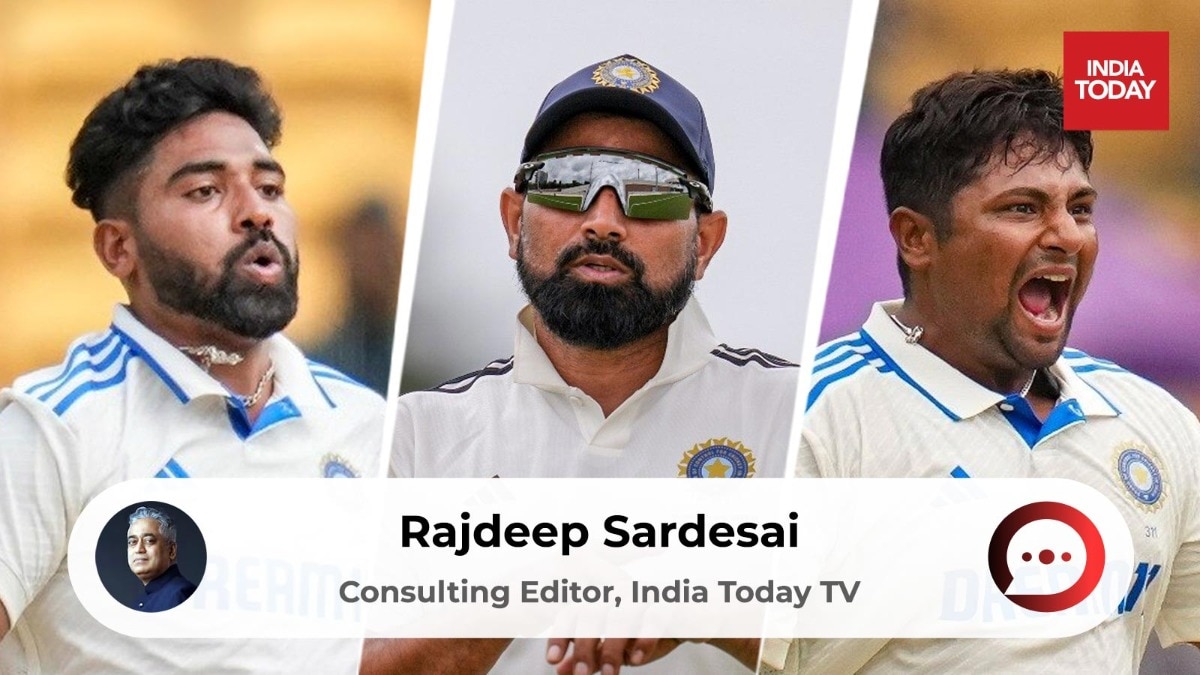
Mahatma Gandhi questioned the communal spirit of the Bombay Pentangular cricket tournament in December 1940. He said, “Can we not have some field of life which cannot be touched by the communal spirit?” Today, debates over player selections show that we must keep religion out of Indian cricket matches.
“Can we not have some field of life which cannot be touched by the communal spirit?”
That was Mahatma Gandhi’s pointed question in December 1940 when he was asked about the proposed Bombay Pentangular cricket tournament. Gandhi was deeply uncomfortable with the idea of organising sporting contests around religious communities. The famous Bombay Quadrangular had begun with teams representing Europeans and Parsis, before Hindus and Muslims were added. In 1937, with the addition of a fifth team called the Rest, it became the Pentangular. Cricket, instead of bringing Indians together, was often played as a contest between religious communities.
Gandhi wanted this communal division to end. In his response, he urged the public of Bombay to erase communal matches from its sporting calendar. The Pentangular was eventually discontinued in 1946.
Nearly 86 years later, Gandhi’s question seems remarkably relevant again. One of the great achievements of Indian cricket has been its ability to move beyond the religious and regional divisions that once defined it. Yet, the exclusion of Mohammed Shami, Sarfaraz Khan and most recently Mohammed Siraj has triggered allegations that Muslim cricketers are being treated differently. Have we begun to take our cricket backwards just when we should be celebrating how far it has come?
Let’s start with the immediate controversy. I have no hesitation in saying that Siraj’s exclusion from India’s playing XI against New Zealand in the first test was a questionable cricketing decision. He has been one of India’s most dependable fast bowlers, particularly in overseas conditions. His record deserves respect and the team management owes cricket fans a convincing explanation for leaving him out.
Shami, too, has been one of India’s finest fast bowlers in recent years, while Sarfaraz has made a compelling case through his prolific domestic performances.
There are perfectly legitimate questions about these selections. But to suggest, as Congress MP Imran Masood has done, that Siraj’s name or religious identity explains his exclusion is an entirely different matter. That is a serious allegation and requires evidence, not innuendo. A questionable selection decision does not automatically become a communal one.
There is, however, an institution that must accept some responsibility for the suspicion surrounding these decisions: the BCCI. The world’s richest cricket board continues to operate with a remarkable lack of transparency. Why was one player preferred over another? What were the considerations of form, fitness, workload and team combination? Why are experienced players with impressive records left out? These are questions that deserve clearer answers.
When the BCCI refuses to explain its decisions, it creates an information vacuum. That vacuum is then easily filled by speculation, conspiracy theories and, increasingly, communal insinuations. Transparency is not a favour the board does to the public. It is an obligation that comes with running a national sporting institution.
But let’s step back and look at the larger history of Indian cricket. Independent India made a conscious break with the communal model of the Quadrangular and Pentangular. The Ranji Trophy became the principal domestic competition, with teams representing states rather than religious communities.
Later, the zonal system of selection, which dominated Indian cricket from the 1950s through the 1970s, was based on regional representation. It had its own limitations and regional biases, but religion was no longer the organising principle.
Today, Indian cricket is far more competitive and merit-driven than it was in the past. The talent pool is wider, scouting is more extensive and players from small towns and modest backgrounds have a genuine opportunity to make it to the national side. The system is far from perfect. Favouritism, regional lobbies and poor selection calls cannot be ruled out. But the broad principle that a cricketer must earn his place through performance is much more firmly established.
Look, too, at the history of Muslim cricketers in India. Iftikhar Ali Khan Pataudi captained India in 1946. His son, Mansur Ali Khan Pataudi, became one of India’s most admired captains. Ghulam Ahmed was another distinguished captain. Then came Mohammad Azharuddin, who led India for several years. These were not symbolic appointments made to demonstrate India’s secular credentials. They were cricketers who earned their place through talent and performance.
In more recent times, players such as Zaheer Khan, Irfan Pathan, Yusuf Pathan, Mohammad Kaif and Munaf Patel have all worn the Indian jersey with distinction. Nobody needed to ask what their religious identities were. They were simply Indian cricketers representing their country. That, surely, is how it should be.
Look at the contemporary generation. A young fast bowler like Auqib Nabi from Jammu and Kashmir and a cricketer like Sanju Samson from Kerala may come from very different social, linguistic and cultural backgrounds. Yet they compete for the same national colours. The beauty of Indian cricket is precisely this ability to bring together talent from across the country, often from places and backgrounds that would otherwise have little in common. There is something profoundly democratic about that.
Of course, I am not suggesting that Indian cricket is a perfect institution, or that discrimination can never exist in sport. Selection decisions must be open to scrutiny. Questions about access, opportunity, regional representation and the functioning of selectors are legitimate. But we must distinguish between questioning a selection decision and alleging communal discrimination without evidence.
The larger danger is that religion has become so deeply fused into our political discourse that we are beginning to view almost every public event through the prism of religious identity. Political leaders invoke faith to mobilise voters, target opponents and manufacture grievances. The danger is that this language will gradually seep into every institution, every sporting contest and every public space.
Cricket must resist that temptation. It remains one of the few institutions capable of bringing millions of Indians together, irrespective of their faith, language or region. It would be a tragedy if the cricket dressing room became another battleground for communal point-scoring. Fans are entitled to ask questions about selection choices; former cricketers are entitled to disagree. But the debate must remain about cricket.
Gandhi once asked whether there could be a field of life untouched by the communal spirit. Indian cricket has, over the decades, come remarkably close to providing that common ground. We should be careful not to surrender it now. We have travelled a long way from the Quadrangular and the Pentangular. Let’s not put religion back into the cricket dressing room.
Rather than connecting cricket selection to religious identity, here’s an inconvenient question I’d want an answer: why does the BJP, India’s dominant ruling party, not have a single Muslim MP? Now that’s a political bouncer that surely cannot be ducked!