
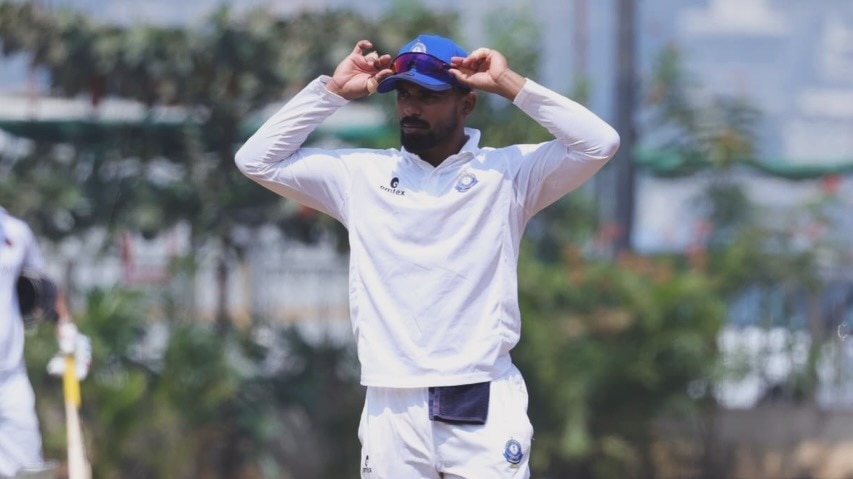
Chinmay Sutar became the second batter to score a quadruple century in the 92-year history of the Ranji Trophy. Playing for Mizoram, Sutar hit 400 not out. "When I reached 100, it was the biggest relief," he said. He got into his groove as many wickets fell around him.
Chinmay Sutar became only the second batter to score a quadruple century in Ranji Trophy's 92-year history. His father once took down while playing a tour game against Australia for Mumbai. Here's Chinmay's story.
Last week, in an otherwise unremarkable Ranji Trophy match, a rare piece of history was made. Chinmay Sutar, playing for Mizoram, slammed what was only the second quadruple century scored in the 92-year history of the competition. The innings places him alongside BB Nimbalkar, who made 443 not out for Maharashtra against Kathiawar in 1948-49.
Sutar's 400* was also only the second time a quadruple century was scored in first-class cricket since Brian Lara's 400* against England in 2004.
Sutar, 29, went through a range of emotions through his innings. It started out with hunger, a zeal to hit his maiden century in red ball cricket and prove people wrong. After surviving the moving ball in the first hour, Suthar got into his groove and patiently raked up the runs when others fell around him. As the pitch eased out, and Suthar realised that there were runs to be made on this wicket, a sense of ease took over him. He added 168 runs with No.6 Jehu Anderson, before facing a bottom order collapse again.
With Mizoram nine down, Sutar found an ally in last man Lalrempuia Chhakchhuak. The batter knew that without scoring 450 runs on this wicket, it would have been difficult for the Mizo side to get the 3 points from the first innings lead.
So the pair got to work.
Sutar and Lalrempuia added 189 runs together for the final wicket in the match - the third highest last wicket partnership in his history of the Ranji Trophy. Lalrempuia took body blows in his 76-ball innings, while Sutar scored bulk of the runs himself.
"When I reached 100, it was the biggest relief because I had got out for 99 in the previous game (first class debut). After that, I just wanted to contribute more and make it a big innings. I never thought about scoring 200, 250 or 300. When I reached 200 and then 250, I was thinking about what the team needed. I scored 200 on the morning of Day 3. We were seven wickets down, and I just wanted to score more runs," Sutar told IndiaToday.in over phone.
"We were around 350/8, and I thought I wanted to help the team get past 450. I kept talking to my partners about building small partnerships of 20 or 25 runs so that we could get past that score," he added.
It was only around the 380-run mark that he finally realised what had been happening. The dressing room was cheering, and the opposition players had been chatting about the possible milestone as well.
Mizoram declared after Sutar reached 400. He walked back into the dressing with a standing ovation from both the dugouts. Mizoram had 581 runs on board, and that's what mattered.
After the end of day's play, his first call went straight to his father - Rajesh Sutar.
RAJESH SUTAR AND THE LEGEND OF SHANE WARNE
Chinmay's father Rajesh was well known in Mumbai cricket in the 1990s for his six hitting exploits. He played 7 Ranji Trophy matches, and 30 List A games representing Mumbai in his career. For someone who never played for the national team, Rajesh's most famous red ball innings came against Australia, when Steve Waugh's side visited India in 1998.
Batting alongside Sachin Tendulkar in a tour game for Mumbai, Rajesh Sutar joined in on an epic slog against none other than Shane Warne. Sutar and Sachin hammered Australia for 97 runs off just 15 overs.
Sutar's 45 off 43 balls was made in one-day style and also included six fours, Sachin on the other end, remained unbeaten at 204.
Naturally, Chinmay grew up in a home that was dedicated to cricket.
But while his father's exploits against Australia became a familiar story in the family, Chinmay's own journey through Mumbai cricket was a much longer exercise in patience.
THE EARLY DAYS OF CHINMAY SUTAR
Born in Mulund, Chinmay spent his early childhood in Chinchani, a coastal town in Maharashtra's Palghar district, where his father grew up. His uncle and grandfather also played cricket, and watching them was what first drew him to the game. There was no pressure to follow in his father's footsteps. He simply loved being around cricket.
The family moved to Thane when Chinmay was around 11 or 12, partly to give him better opportunities to pursue the sport. He began as a leg-spinner idolising none other than Shane Warne, making the probables for Mumbai's Under-14 and Under-16 teams. He gradually shifted his attention towards batting after scoring runs for his school and club.
He eventually captained Mumbai's Under-23 side and led the team in four matches in the CK Naidu Trophy. In 2019, he also represented India Emerging in the ACC Emerging Teams Asia Cup, scoring a century against Hong Kong.
The progress, however, did not translate into a regular place in Mumbai's senior team.
THE WAIT FOR A MUMBAI BREAK
Among all the domestic sides in the country, Mumbai is perhaps the toughest to break into. The team was already packed with established cricketers, and the competition grew even fiercer in 2023, when the BCCI directed centrally contracted players to turn out for domestic matches. For someone still waiting to make his mark at a senior level, opportunities became harder to come by.
Chinmay continued to score runs away from the senior team. But even a prolific run in the Mumbai Premier League did little to change his fortunes.
When Maratha Royals won the Mumbai Premier League in 2025, Chinmay top-scored for the franchise with 271 runs from 7 matches. Earlier this season, when Maratha defended their title, Chinmay was once again among runs - finishing as the fifth-highest scorer in the league.
He continued to score runs, but a place in Mumbai's senior team remained elusive. That probably was the last straw.
"I was among the top run-scorers, but I still wasn't picked in the probables. I think that made me consider switching teams. Then I got the opportunity from Mizoram, and I switched," he said.
Leaving Mumbai was difficult. He had spent his entire cricketing life there, dreaming of playing the Ranji Trophy for the side. But at 29, he desperately wanted his Ranji Trophy debut, prompting him to walk away.
A FLIGHT FROM LONDON TO MIZORAM
When Mizoram called him for trials, Chinmay was in England playing for Brondesbury Cricket Club. He had been travelling to the UK for club cricket since 2023, and in his first full season there, with Folkestone Cricket Club in Kent, he finished as the league's highest run-scorer.
He was unsure whether a trip back to India for a trial would lead anywhere. His father encouraged him to take the chance, reminding him that playing as a guest professional for Mizoram would bring both an opportunity and responsibility.
Chinmay flew from London to India, attended trials that lasted barely two hours and returned to England. Two weeks later, he was told he had been selected.
Chinmay has not forgotten the people who helped shape his career in Mumbai. He speaks with particular warmth about Abhishek Nayar, who mentored Maratha Royals, and Siddesh Lad, Mumbai's current captain.
"I learnt a lot from Abhishek Nayar, who was the mentor of our team," he said.
He also remembers sharing the dressing room with Rohit Sharma during last year's Vijay Hazare Trophy. Rohit's presence, he said, changed the atmosphere in the room. For a young cricketer who had grown up wanting to play for Mumbai, that was one of his favourite moments with the team.
But that is the past. He has now been put on the map, certainly in cricketing circles at least, for his rare feat of 400, which only a few cricketers in the world can boast of.
Asked whether he would return if Mumbai called him back, Chinmay did not offer a definitive answer.
"I don't know. I have no answer to that because I like to stay in the present and not think about what's going to come in the future," he said.
For now, his focus is on Mizoram. The team are in the Plate Group, and he wants to help them win matches and earn promotion to the Elite Division. The 400 has given him a place in the history of the Ranji Trophy, but his immediate ambition, shaped by years of rejections, is more practical: to help the team that finally gave him a shot at red ball cricket.