
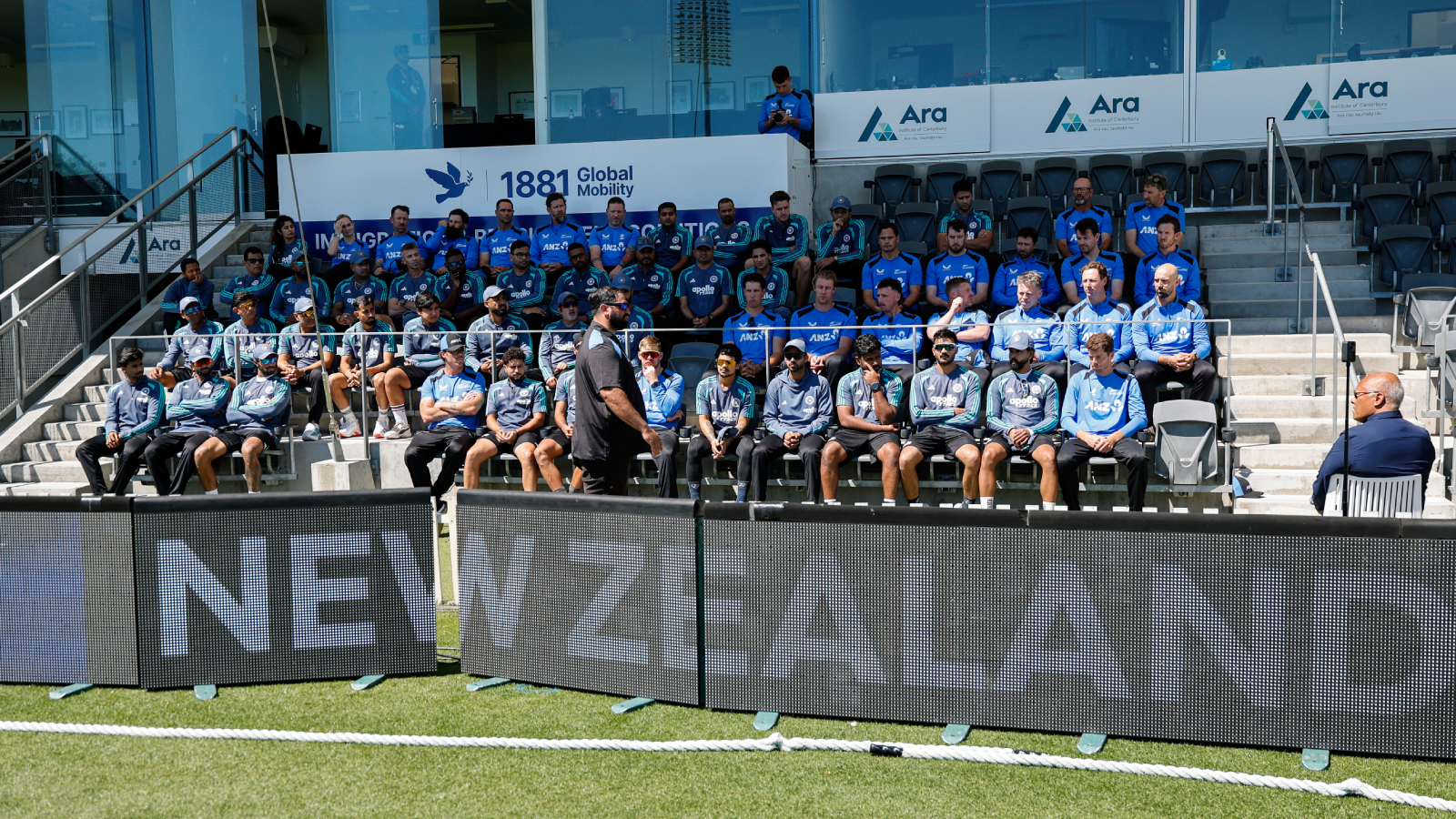
India’s top-order trio of Sanju Samson, Abhishek Sharma, and Ishan Kishan face a tough test in New Zealand. After playing on flat tracks at home, they must now adapt to bouncy, windy conditions. Captain Shreyas Iyer said, "It is not like he can walk in right now, because our openers are scoring consistently."
After batting on flat tracks at home can the top order trio of Sanju-Abhishek-Ishan adapt to conditions in New Zealand?
It didn't take long for the thread to stop at Vaibhav Sooryavanshi in the press conference. The question's gist: "There is a lot of chatter around Vaibhav and his place in the eleven?" The reply from India's captain Shreyas Iyer was firm, rather than dismissive. "It is not like he can walk in right now, because our openers are scoring consistently, and they have won the World Cup."
It's reflection of India's glowing top-order riches that Sooryavanshi is bench-bound, or that Shubman Gill, Yashasvi Jaiswal, and Sai Sudharsan have coiled into a long queue behind him; or that the incredibly consistent KL Rahul is no longer in the selector' scheme. Iyer and the team management wouldn't fix a piece of furniture that is not broken. Sanju Samson, Abhishek Sharma and Ishan Kishan have an imposing body of recent work, a post-modern approach that has won India the World Cup and multiple bilateral series, and hitting range the bowlers dread. Sanju was T20 World Cup's player of the match, Ishan helms the T20I batting rankings; Abhishek is No.2.
But they have only a lone practice session to acquaint themselves with the peculiar conditions of New Zealand. The evenings are windier, the nights are chillier, the sunlight during the day is brighter; the drop-in surfaces, specifically in Hagley Park, are quicker, bouncier and potentially with sideways movement with the new ball; the hosts' bowlers are interrogative than any others India have encountered in recent times. The circadian rhythm is desynchronised. In short, New Zealand and its caprices could show whether the perceivably glittering jewels in India's crown can shine in all conditions.
It's an examination with multiple layers. A test of technique as much as adaptability, a reflection of their courage, common sense, and cricketing wisdom. None of the surfaces would be as demonic as those that await Test batsmen in late November; some grounds are invitingly small and blissfully placid. But batting in New Zealand, irrespective of formats, could be demanding, requiring a heightened level of adapting, especially as India's batsmen have been indulged with ultra flat decks at home against the West Indies.
The troika of Sanju-Abhishek-Ishan is not hubristic enough to underestimate the conditions. The audience wouldn't probably see Sanju leaping to uppercut Jacob Duffy's hard-length ball; or Abhishek giving room and lashing Adam Milne through extra cover, or Ishan swirling Lockie Ferguson over deep fine-leg. They would obviously resort to these shots when the innings progress, but whether they temper their impulses and tweak their muscle memory at the start of the innings, would define their tours and keep the spots intact. Do they have the required gears, or the sufficient technique and flexibility, or the knack to makeover their game in one practice session?
Pakistan were shot out for 91 last year at the Hagley Oval in Christchurch, the sort of score India were plundering in powerplays against the West Indies recently. In 15 T20Is, only twice have teams scored more than 200. The average total is 159, boundaries are longer than most grounds in the country. New Zealand skipper Mitchell Santner warns that "there is always a bit (for the bowlers)." "Bhuvi would love these conditions," he adds. It is a roundabout way of saying that seamers could get some assistance.
All three have obvious flaws when the ball bends and leaps. Sanju's static feet led to a poor string of scores in Ireland and England in June (33 in four innings). His previous outings in New Zealand yielded him only 10 runs in two games. Abhishek is relatively judicious outside the off-stump on bouncy wickets abroad, but he has developed a habit of miscuing his pulls, often because he is hurried into the stroke or due to the extra bounce. The instinct to pull even hard length balls could be self-destructive in New Zealand. As is Ishan's inclination to heave across the line. England's seamers employed the short ball to good effect (dismissing him twice) as well.
True bounce
Hitting the length balls out of the park is not as straightforward as they are in the subcontinent either, owing to the bounce and hint of sideways movement. Since the 2025-26 season, New Zealand's seamers have averaged 23.41 per wicket at home, the second lowest in the world. Their economy rate has been 8.4 while picking a wicket every 17th ball. The last eight games have not produced a 200-plus total. But the positive is that the bounce would be true enough to play through the line, unlike those in Asian Games.
The conditions and ground dimensions could vary too. "You get to Wellington, dimensions again are different -- short square (boundaries), longer straight... Hamilton is quite small, and Eden Park is small as well," Santner gives the local's tip.
In this vein, the series could not have been better timed. If the established trio fails, India have ample time to devise remedial measures for the World Cup defence in Australia and New Zealand the year after. They could probably experiment with a less dare-devilish batsman like Shubman Gill; they could rethink their full-throttle aggression guide. History throws up lessons -- the man of the series in 2020, which India claimed 5-0, was KL Rahul, a batsman cast in a classical mould. The game has quickened up in six years, and his method could well be obsolete now.
But New Zealand offers a more strenuous assessment of top-order batsmen in this format than anywhere else in the world.