
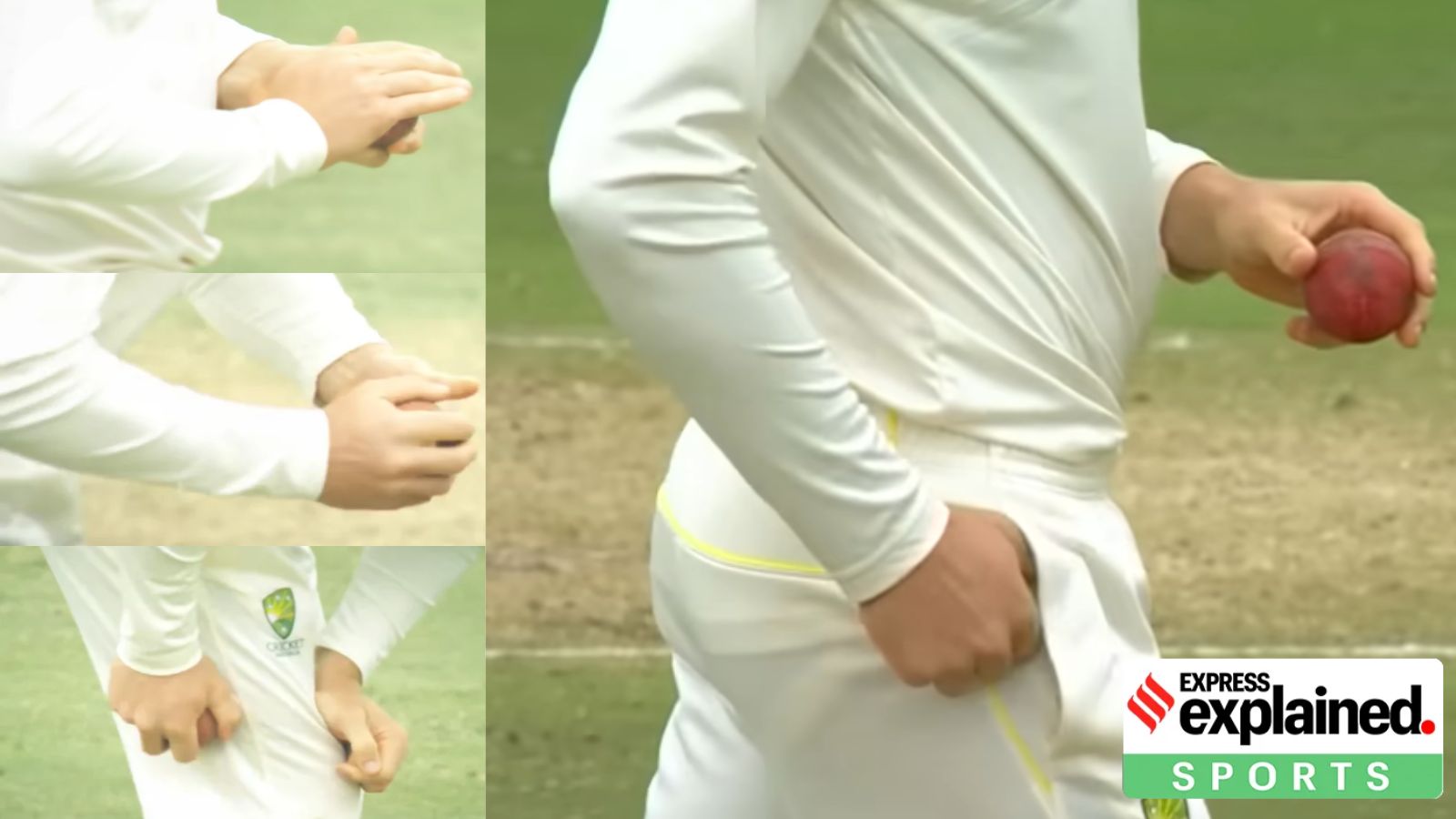
Usman Khawaja’s book has made ball tampering a talking point again. Bowlers have used many items like zippers, blades, and lip balm to make the ball move in the air. The most infamous episode involved sandpaper by the Australians in a 2018 series in South Africa, which still haunts cricket.
Usman Khawaja's book has made ball tampering a talking point again, but this practice is as old as cricket itself. From lip balm to bottle-tops, here's how bowling sides have often pushed the boundaries of legality to compete in what is generally a batter's game.
Bowling is hard work. And bowlers have used a fascinatingly innovative repository of contraband devices to coax all the help they can get out of a cricket ball.
Tampering virtuosos have been known to rely on natural endowments such as fingernails and teeth, as well as instruments such as zippers, metal bottle-tops, blades and bricks, to make the piece of leather misbehave. Lip balm, lozenge, Vaseline, and facewash too, have found its way into many a vanity bag.
One of the most infamous tampering episodes, however, was the use of sandpaper by the Australians in a 2018 series in South Africa. Its ghosts still refuse to be exorcised, especially after Usman Khawaja's assertions about its use in his recently released autobiography, Sabr.
Swing, swerve
First, how does the ball swing? Essentially, the more the disparity between the two sides of a cricket ball, the more devious its movement in the air will be.
With a newer ball, fast bowlers generally tilt the seam towards the direction in which they want the ball to swing -- first slip for outswing, and leg slip for in-swing (assuming the batter is a right-hander). The raised seam disturbs the airflow on the side towards which it is tilted, and thus affects its movement.
This is what is known as conventional swing, when the ball moves towards the dull, or non-shiny, side.
But what after the ball becomes old and the seam goes flat?
Here's where reverse swing comes in. For this to happen, the ball has to be rough on the one side and shiny on the other. Due to friction, air passes over the shiny side quicker than it does on the rough side, creating a drag effect that ensures the ball moves in the direction of the shine.
Reverse swing is an inexact science, and often the bowlers themselves can't predict which way the ball would move. Batsmen expect this late in the stint of a ball -- especially in the subcontinent, where surfaces are drier -- but not so much in the middle phase of an innings.
Shine, scuff
An abrasive outfield and a hard pitch can ensure that one side gets roughed up. But the other side has to be maintained. So, all through the day, the bowlers and the designated ball-tenders work to maintain shine on one side, so that the uneven weight distribution causes disturbances in air flow and produces reverse swing.
There are legally approved ways of producing shine -- by using sweat, rubbing the ball on clothing or removing mud from it with a piece of cloth approved by the umpires. It's painstaking, conditions-dependent, and doesn't guarantee success.
The amount of organic wear and tear is not in the bowlers' hands. So to facilitate this effect, the bowling team sometimes uses artificial substances.
Whereas zippers and metal bottle-tops were employed to expedite the deterioration of the rougher side, sugary saliva, lozenge and lip balm were entrusted to preserve shine on the other side, which is the tougher assignment.
A crime older than W G Grace
Manipulating a cricket ball predates modern cricket. Bowlers in the late 19th century used resin, sawdust, some accounts say tobacco, to get extra grip or movement. The lawmakers codified a set of laws in 1884 to restrict the use of foreign particles on the ball. But it was not until the late 1970s that ball tampering acquired hues of roguish violation. Bowlers bragged, as though they had orchestrated a heist.
Arthur Mailey, an Australian leg-spinner in the 1920s, nonchalantly claimed in his autobiography that he kept powdered resin in his pockets and lifted the seam for his side's seamers. Martin Crowe's troops performed a measure-for-measure tactic in the 1990 tour to Pakistan. They felt Pakistan's seamers were manipulating the ball, and enacted their own version by scratching the old ball with a bottle top.
"With that technique, even guys like Mark Greatbatch and Martin Crowe were swinging the ball miles in the air," Chris Pringle wrote in his autobiography, Save the Last Ball for Me.
"We practised long and hard in the nets and were quite excited about the results we were getting with it," he added. Pringle grabbed seven wickets in the Test at Faisalabad, but Waqar Younis wrecked them with 12 wickets.
In his autobiography Coming Back to Me, former England opener Marcus Trescothick admitted he used mint to shine the ball for his team's pace quartet during the epic 2005 Ashes that England won. It had been common knowledge in county cricket for some time that certain sweets produced saliva which, when applied to the ball for cleaning purposes, enabled it to keep its shine for longer and therefore aid swing. Australia's leggie Stuart MacGill confessed that he used to sew a piece of sandpaper inside his trousers.
Hall of shame
Over the next decade, a host of scandals surfaced. Prominent violators included luminaries like Sachin Tendulkar (for allegedly pulling the ball's seam with his nails), Rahul Dravid (for allegedly rubbing the ball with a cough lozenge), Wasim Akram, Shahid Afridi, Imran Khan and James Anderson.
The lens of suspicion was more stringent, often unfairly, whenever Pakistan's seamers swung the ball on batting-friendly surfaces. The stigma came later, with more stakes, competitiveness and broadcast policing.
Not too long ago, bowlers and ball-tenders got away lightly. Sanctions ranged from a penalty of five runs or a deduction from match fees.
It was a Level Two offence, before it was upgraded to Level Three. Now, infringements incur lengthy bans, running to a four-match suspension, depending on the offence's gravity.
The punishment for Sandpapergate, however, was more severe, with Steve Smith and David Warner serving a one-year ban while Cameron Bancroft was out of the game for nine months. From outlier thuggery, ball-tampering has transformed into a morality-shaking sporting crime.