
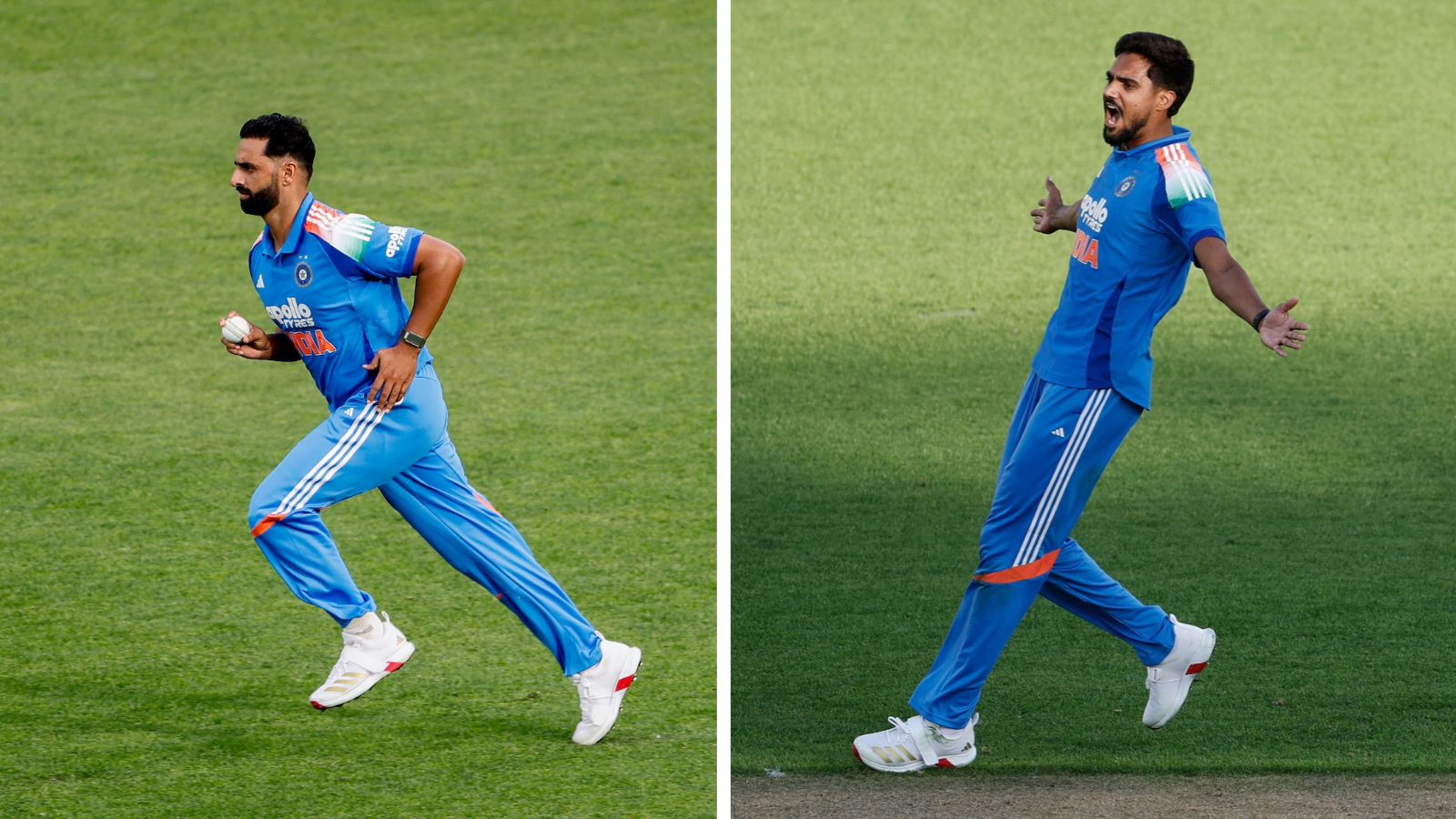
Auqib Nabi and Gurnoor Brar helped India take control of the second ODI against New Zealand in Wellington on Saturday. Nabi bowled fuller with the new ball to get two early wickets. He made the batsmen play and tested them with movement, giving India the upper hand they needed.
One bowled fuller with the new ball, the other kept it short and quick, and India took control of the second ODI.
Auqib Nabi had more than just a point to prove with the ball in Wellington on Saturday. Playing his third ODI, the Jammu and Kashmir pacer was still waiting for his first international wicket. He had conceded 84 runs on debut against the West Indies in Guwahati and gone wicketless in Auckland, where he was the only Indian pacer not to take a wicket despite a helpful surface.
Nabi showed what he could do when he got it right. He bowled fuller, drew the batsmen forward and made better use of the movement on offer at the Hnry Stadium. The result was two wickets inside the first six overs of the rain-curtailed second ODI and the early upper hand India were looking for.
His first wicket came in the second over. Having kept Tim Seifert quiet for the first four balls, Nabi pitched one up on off stump. Seifert was slightly early into his drive and chipped the ball towards mid-on, where Anshul Kamboj dived forward to take the catch and give Nabi his maiden ODI scalp.
He struck again in his third over. Will Young, who had looked tentative in the middle, pushed at a delivery outside off and edged it behind, with KL Rahul diving to his right to take the catch.
The difference between Auckland and Wellington was not just the length Nabi bowled. He made the batsmen play at the ball a bit more and tested them with movement. He got one to nip back sharply at Seifert and another to move away. Against left-hander Henry Nicholls, he brought the ball in before getting another to shape away.
Nabi also made Daryl Mitchell work for his runs. He kept the New Zealand batsman quiet with deliveries on a good length outside off, forcing him to defend or play with soft hands into the off-side. Mitchell eventually looked to break free in the ninth over. He got to the pitch of a delivery and lofted it over mid-on for six. Two balls earlier, he had attempted a big slog but got a thick outside edge that flew over the slips for four.
Gurnoor Brar's success came from a different method. While Nabi relied on a fuller length with the new ball, Brar used pace and bounce to trouble the batsmen.
Mitchell found it difficult to get away. Brar mixed short-of-a-length deliveries with the occasional fuller ball, keeping the batsman on the back foot. He had to defend several deliveries and struggled to find gaps. In the 17th over, one delivery nipped back and struck his boot as he tried to defend. Another climbed sharply and caught the splice of his bat.
Tom Latham was kept quiet too. Brar kept him tied down, making it difficult to find gaps or rotate the strike. The left-hander managed only a few singles, mostly by working the ball towards the leg-side or dropping it into the off-side. In the 20th over, Brar shortened his length again. Latham went for the pull but mistimed his shot towards deep square leg, where Naman Dhir took the catch.
Brar then dismissed Glenn Phillips off the final ball of the over. A short ball at 141 kmph climbed sharply as Phillips tried to pull. He got a top edge, and Kamboj judged the swirling ball well at fine leg to complete the catch. Brar had beaten Phillips with a 140 kmph delivery earlier in the over, while another had nipped back and passed close to the off stump.
After dismissing the spine of the batting order, Brar returned to dismiss Nathan Smith again with a short-of-a-length delivery that took the outside edge, and Rohit Sharma made no mistake at slip. He had taken 10-0-30-4, and New Zealand simply had no answers to what he had to offer.
The two bowlers had given India control in different ways. Nabi made better use of the new ball in Wellington than in Auckland, going fuller and picking up both openers. Brar used pace and bounce to keep the other batsmen in check and picked up two wickets for eight runs in six overs. Their methods were different, but both made it difficult for New Zealand to set a platform in their innings.