
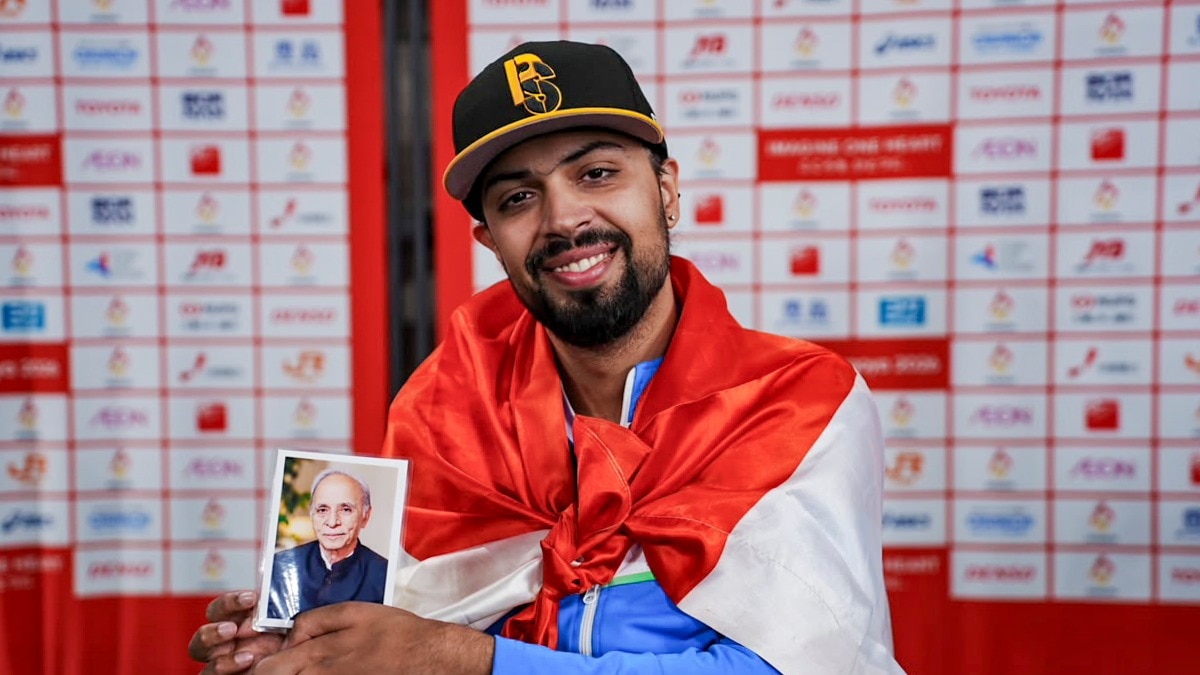
Pranav Soorma won gold in the men’s discus throw at the Asian Para Games on Tuesday. He set a new Asian record with an 11.66-metre throw. Soorma said, "Like Virat Kohli does batting very well. But after a long time, he bowls an over in which he gets out."
Pranav Soorma compared his Asian Para Games gold medal to Virat Kohli occasionally taking a wicket with the ball. The Indian para-athlete set a new Asian record with a throw of 11.66 metres to win gold in the men's discus throw on Tuesday.
India's Pranav Soorma struck gold in the men's discus throw at the Asian Para Games on Tuesday, setting a new Asian record in his first major competition in the event. The 32-year-old had a fitting comparison for the achievement, likening it to India batting star Virat Kohli picking up a wicket with his occasional bowling.
Soorma clinched gold in the F51/52/53 combined event with a throw of 11.66 metres in his fourth attempt. Compatriot Ram Ratan Singh claimed silver with a best effort of 10.35 metres in his second attempt, securing a 1-2 finish for India.
"When we play cricket, a batsman sometimes bowls. Like Virat Kohli does batting very well. But after a long time, he bowls an over in which he gets (a batter) out," Soorma said after winning gold.
The 32-year-old had won gold in the club throw F51 event at the previous Asian Para Games in China. Discus throw, however, is his second event, and he was delighted to make an immediate impact on his debut at a major competition.
"It's a new event for me. I am competing in this event (discus) for the first time in such a big event. I am very happy to do my personal best and break the Asian record," he said.
"My pet event is club throw, this (discus) is my second event. This time I am participating in both the events, discus throw and club throw."
Soorma also explained the technical differences between the club throw and discus throw, particularly the way athletes handle the equipment.
"Club throw and discus throw are technically very different games. We have to apply glue to the club, we stick it with our fingers.
"But in discus, we apply it on the whole hand. So technically, applying glue and sticking it properly and releasing it, that is a very technical aspect," he said.
Soorma said he had spent the past year working hard and putting in extra practice to prepare for discus throw, a relatively new addition to his competitive programme.
Iran's Alireza Hemami, a F53 athlete, won bronze with a 20.20-metre throw on his fourth attempt. Although Hemami recorded a greater distance than the Indian pair, he finished behind them under the Raza Point System, which determines the standings in combined events featuring athletes from different classifications.
The system converts performances into standardised scores after accounting for athletes' impairment classifications. This allows competitors from different classes to be ranked fairly, meaning a shorter throw can earn a higher placing than a longer one.
Soorma and Singh are both F51 athletes. The classification covers competitors with significant limitations in trunk, leg and hand movement, along with varying degrees of restriction in arm movement.
Athletes with similar classifications may compete together when there are not enough participants to hold separate events. The F51-F57 categories cover seated throwing events for athletes with lower-body impairments, limb deficiencies, reduced muscle power, restricted range of movement or leg-length differences.