
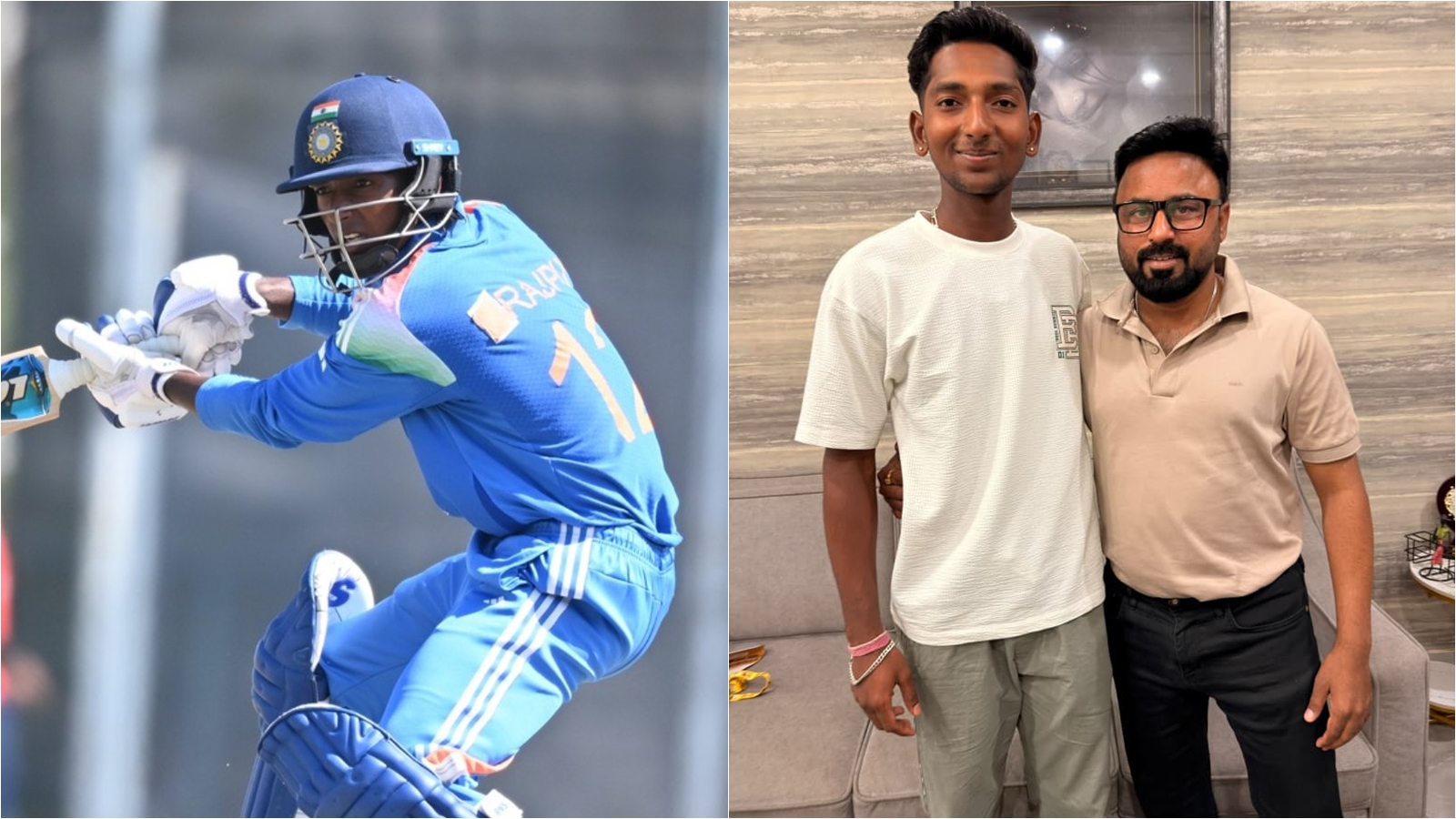
Arjun Rajput scored 107 runs for India against Pakistan in the Under-19 Asia Cup on Sunday. His father, Hoti Ram, once sold chole-kulche from a cart while dreaming of cricket. Now, Arjun plays for the same team as Virender Sehwag’s son, fulfilling a dream his father could never reach.
His father now owns a bakery and has a son in the same India side as Sehwag's boy.
Hoti Ram Rajput is a massive cricket aficionado. That does not make his story special. So is every other Indian.
He used to love watching Virender Sehwag bat. Still not special. Najafgarh's Nawab had more admirers than he ever scored international runs.
What he never did was dream of following Sehwag into the blue.
Even to harbour the thought seemed far-fetched, let alone pursue it. "My financial circumstances were such that I have had to work and earn since a very young age. I am a cricket fan, and loved the Sachin-Sehwag jodi, but dreaming of becoming a cricketer was beyond our reach. My concern was to earn so that I could get food on the plate," he tells The Indian Express from Jalandhar.
He played in the streets when he could, but only after a day of selling chole-kulche from his rehri, a roadside cart. What, then, makes his story special? Decades after he became a fan of Sehwag, a figure who seemed as distant as folklore, his son Arjun Rajput wears the same Indian blue, and plays for the same Indian team, as Sehwag's son Aaryavir.
On Sunday, India lost to Pakistan by three wickets in the Under-19 Asia Cup in Oman. Arjun struck 107 from 85 balls on an Al Amerat surface where none of his teammates could find their feet. It was 51.4% of India's 208.
For his coach Vikram Sidhu, it was not an unprecedented innings. "He has played such one-man-army knocks many a time in his career," he tells The Indian Express.
It began in 2015, when Hoti Ram brought eight-year-old Arjun to Sidhu's previous academy, the Harbhajan Singh Institute of Cricket. Arjun had been inspired by his elder brother Karan, who was by then representing Jalandhar in inter-district age-level tournaments.
"My father's passion for cricket rubbed off on me, so I started playing. Eventually, Arjun also wanted to play after watching me. Things were not great at my home financially, but my father encouraged Arjun to pursue his dream, saying he would manage everything," Karan says.
It was not always manageable.
Sidhu says teaching children the basics means repeating yourself many times. With Arjun, "it was always one and done". "We knew at the onset that he was special. Our hopes were high, and he would never miss a session, until he stopped coming altogether all of a sudden."
"Kumar sir, another coach in the academy, assumed that his father, who had this chole-kulche cart outside the DAV college, might not have been able to gather funds for the academy fees. At that point, I decided that I will not be taking a single penny from Arjun. Not only cricket, but his family also struggled with school fees. My academy had a tie-up with a school called the Ivy World School. Their fees is about Rs 6-7 lakh per annum, but I cut a deal with the principal. I told him that I will give him a player who is bound to represent India, but in return, he would have to waive off Arjun's entire fees."
Hoti Ram no longer operates a cart. It has been replaced by a kulche bakery with many bakers on his payroll. "I have never stopped my kids from playing sports; his elder brother also played cricket, while his elder sister, Kiran, plays tennis. Maine socha main to nahin khel paya, mere bachche khel le (I thought I couldn't, but let my kids play). There have been many difficulties, but now that I see him playing for India, the hard work makes sense."
Karan, now 27, quit cricket four years ago to aid his ailing father in his work. Family responsibilities never stood in his brother's way.
"He was playing for Punjab U-16 at the time. His coaches would tell me that my brother has huge potential. I got convinced when I saw him scoring five consecutive centuries. That was the moment I told myself, 'This boy is built to play for the country.'"
Arjun captained Punjab U-16, Sidhu says, and under him the state won its first-ever U-16 title. There was also a missed trip to Dubai. "Arjun was very excited to go, and we had everything booked for him. But unfortunately, a spelling mistake in the visa made him miss that trip. He was crestfallen, but I told him more opportunities will come his way. A few months later, we went to South Africa. No one could score runs on those wickets, but Arjun won us games single-handedly and ended up getting the Player of the Tournament award."
Hoti Ram did not harbour dreams when he was young. He could not afford to. Now, he does. "My dream will truly be fulfilled when my son plays for the senior Indian team. We want him to bring home the World Cup."