
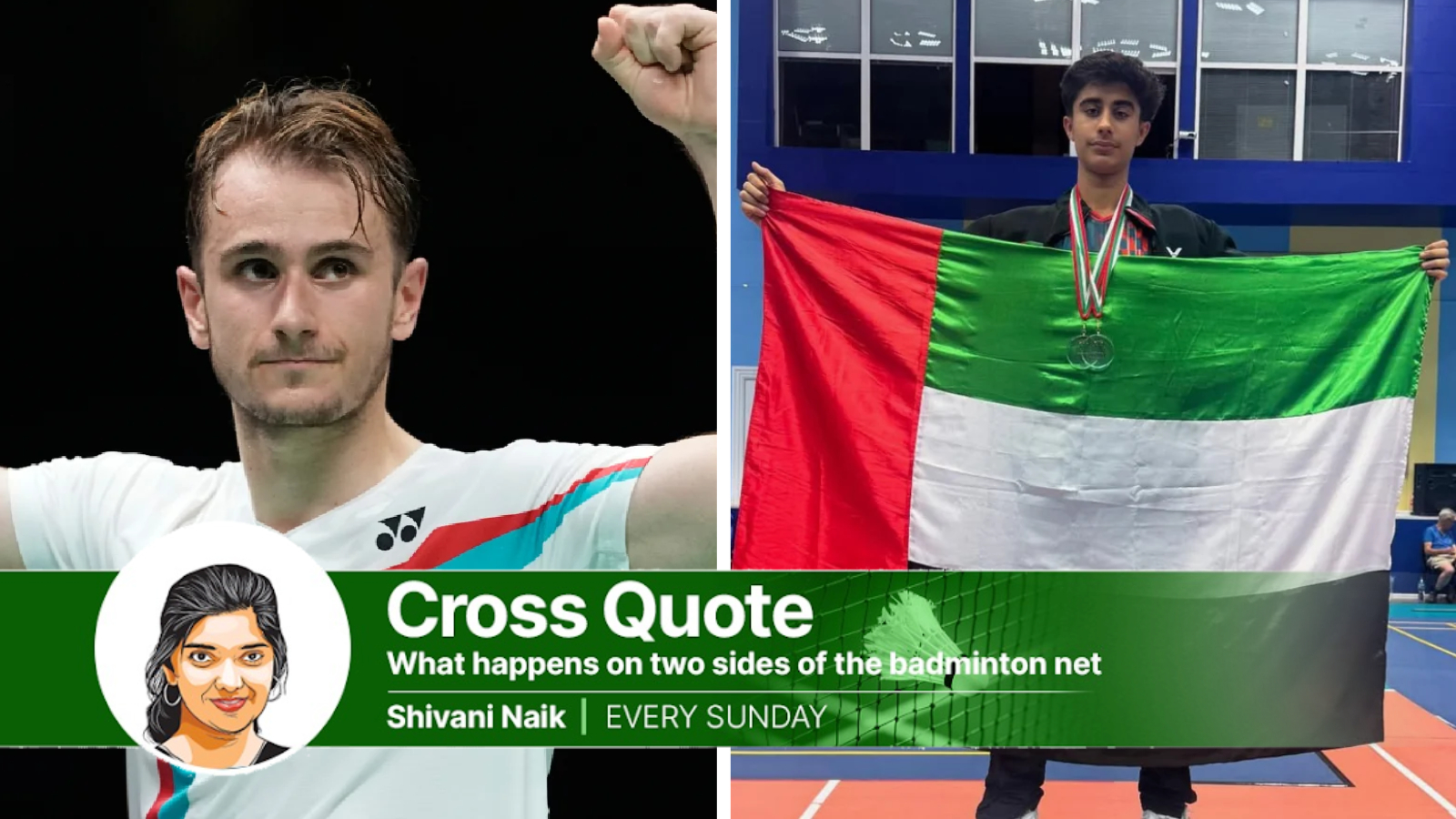
Badminton is moving west as new nations challenge traditional Asian dominance. Riyan Malhan beat Mady Sow, showing how the sport spreads beyond its usual borders. With French players winning world titles and Danish stars moving to the UAE, the game is changing. These shifts show a new global reach today.
There’s more than enough indicators of how the sport dominated by the Far East – is moving West. Not just within Asia. But beyond to the Americas, pollinated by expats from China, Taiwan, Hong Kong, Malaysia, Indonesia, Japan – and India largely. These Westerlies of shuttle also encompass Africa, alongside West Asia. Riyan Malhan, who traces his immediate roots to Delhi – one set of grandparents in Gurgaon – defeated Mady Sow, born in France. Mady’s ethnic origins? Senegalese. Ten longitudes further west to France.
With the Junior Worlds held in Egypt, and the Youth Olympics in Senegal, the eas(ier)-to-pick racquet sport briefly leant west, liked what it saw, before matters resumed in Korea, Japan and Taiwan for the backend of the season’s tournaments.
But it’s the nationalities of winners at Juniors that are tilting the rooster arrow of badminton’s weather vanes – west. 2026 has thrown up many surprises. Starting with the westernmost point of the east (though the globe is round, and directions are mere conventions of sun rising in the east): Turkey.
Turkish Neslihan Arin has been winning the Mediterranean Games gold since 2013 – but the Turkish women’s team won the European Team Championships bronze this year, and went on to debut at the Uber Cup.
The French won two titles at the World Championships – one more than China did. And Mady Sow, the 1.90m giant Malhan beat, took bronze at the Juniors.
Shi Yuqi snuck one in last year, but it’s notable that after years of dominance from the now-retired Viktor Axelsen, the seniors World crown has now been ensconced in France. Still in Europe, some would reckon. The French system will likely churn out very athletic specimens who win on physicality for a few years now.
Just as well then that the pushback to France dominating the European championships comes from the destabilized auld-enemy equivalent: Denmark. Whose three big names have settled, like BWF reported, in UAE. First Axelsen trained there extensively, then Anders Antonsen followed and Mathias Boe has set down roots there too. It could be the friendly tax regimens, or a genuine ambition to grow the sport in the emirates, but Danish Michael Noerbaek leads the UAE program as a High Performance Director, and Malhan’s success in winning a shock final against the Frenchman opens up a new corridor for the sport.
UAE, the melting pot of Asia, has a team full of first-generationers born to Indian expats, having grown up there. The UAE backing saw Malhan notch up training stints at Hyderabad, Bangalore, China and Malaysia, as his father devoted himself to constantly coaching him. But one of the biggest state-of-the-art facilities for badminton has sprung up in Dubai at the Aspire academy, and they are attracting coaching talent from around the world. Badminton with its surge in popularity in India attracts the expatriate community, just like it does in the US and UK.
A bunch of Malhan’s UAE teammates are Indian-origins and his first-ever gold for the UAE has already seen the presiding royalty fete him and extend support. At the Youth Games meanwhile, shuttlers representing various western countries were of Indian descent – Smrithi Adepu & Om Neelam of Australia, Rithik Rasamsetti of US, Shaurya Gullaiya of Canada, Rajvi Parab of UK are all taking up the sport, safe in the knowledge that they could be in competitive reckonings pretty soon.
Further west across the Atlantic, things have gotten serious already. Victor Lai won his second World Championships medal in Delhi after training at what is one of the best assembling of top coaches from China and Indonesia at his Canadian centre. Americans are inching close to medal rounds in women’s and mixed doubles, while France has shown how an incoming Olympics can be the trigger charge to grow the sport and even reach the top, challenging China across events.
These breakthroughs – beyond Carolina Marin – prove that new countries can compete with sustained investment, unlike in tennis, and Europe is stirring awake, seeing the potential beyond capital-intensive tennis. 2026 broke the myth that pure physicality cannot bulldoze past Asian skill when Alex Lanier won at Delhi World’s. It’s not quite a westward storm, but the breeze is sustained.