
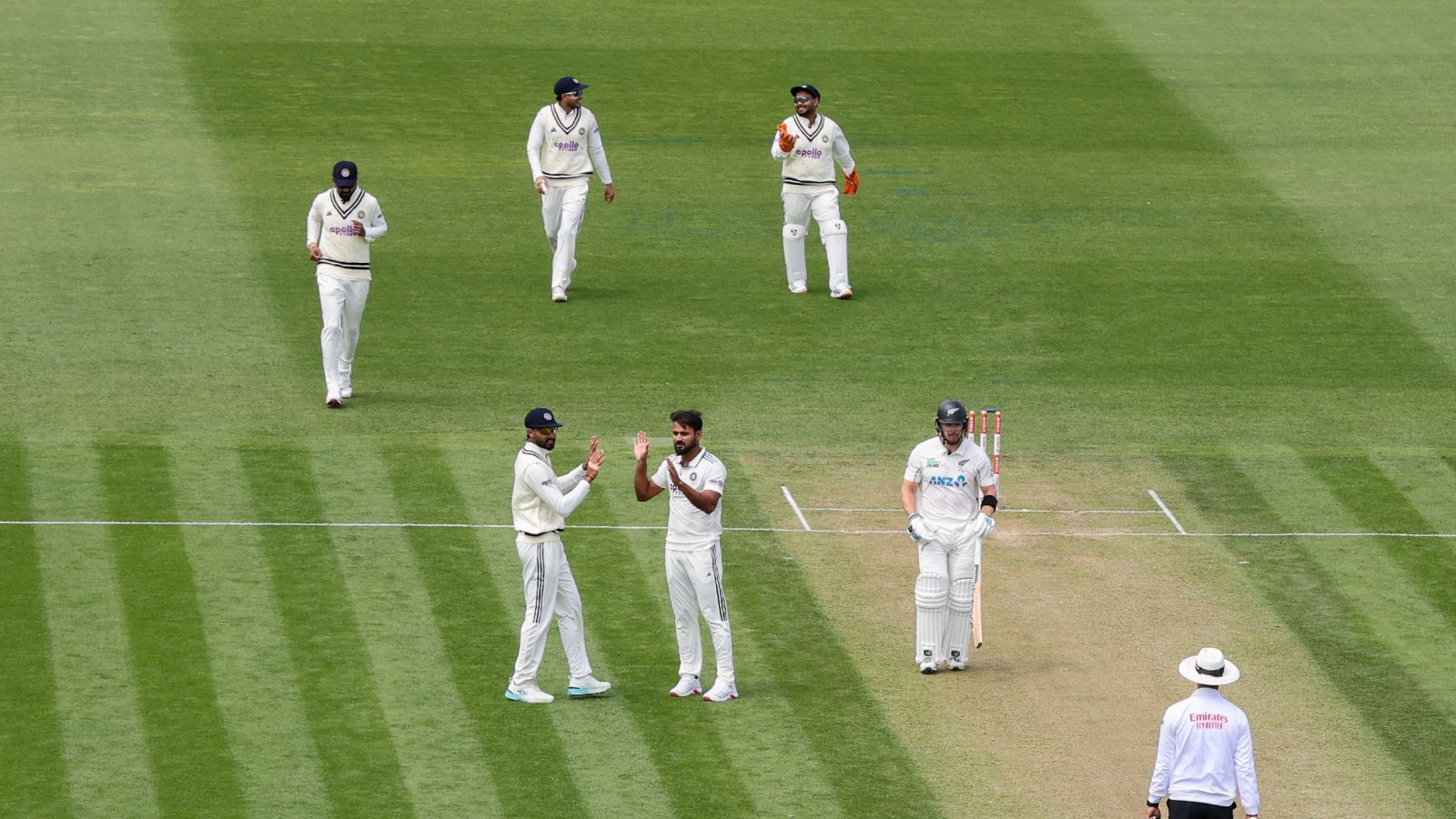
Akash Deep bowled Glenn Phillips for 118, ending a 216-run stand during the match. Returning after seven months due to a stress fracture, he took 3 for 53 from 23 overs. His sharp delivery proved vital as he helped India restrict New Zealand after they were 70 for 5.
Back after seven months out with a stress fracture, he bowled Glenn Phillips for 118 and ended a stand of 216.
Akash Deep roared, punched the air and shouted a big come on, then turned to Kumar Dharmasena to check that his front foot was fine. Thumbs up. Then he pointed a finger at the sky. Three no-balls in the innings had been his.
He had just bowled Glenn Phillips for 118 with the best ball of the game, even better than Jasprit Bumrah's peach to take out Tom Latham. It came off the last ball of the 94th over and removed a well-set centurion, and without it New Zealand might well have gone past 450. It was short of a length on off, angled in, and then it nipped away and took the top of off stump. Phillips had covered the original line. The movement beat him, and he gave the ball a nod.
Phillips had reached his second Test hundred in a stand of 216 with Henry Nicholls, after New Zealand were 70 for 5. Akash finished with 3 for 53 from 23 overs, seven of them maidens.
It was his first Test since The Oval in August 2025, and the back had been the story. Nine months ago, at Kalyani, a stress fracture in the L5 vertebra put him out for seven months, and when it flared again in March he missed the whole of IPL 2026. India gave international debuts to six frontline quicks while he was out. He did his rehabilitation at the BCCI's Centre of Excellence in Bengaluru and came back at the Irani Cup in Srinagar, taking three wickets in each innings. Then came India A in New Zealand: three wickets in the first game, none from 23 overs in the second.
It was not only the back being watched. It was how he would bowl. Anshul Kamboj and Prasidh Krishna weren't effective on the opening day, leaving Bumrah almost on his own.
It was here that Akash Deep stepped up. He had a clear plan, especially once the pitch lost its grassy venom. He changed his angles of release, often running in from wide of the crease and trying to take the ball away from the right-handers. He tried catching Henry Nicholls with a few surprise bouncers, before slanting a few away from back of a length. Then he went fuller, trying to trap him lbw with skidding in-curlers, but Nicholls was compact and could not be breached. To Phillips he began with the wide-of-the-crease routine, the ball coming in with the angle, and a couple here and there would straighten. Then, suddenly, he came much closer to the stumps, and had that ball talking to silence Phillips. Later a brute of a bouncer took out Kyle Jamieson, who has so often resisted with valuable contributions.
At The Oval he had made 66 in a third-wicket stand of 107 with Yashasvi Jaiswal, the man who set India's reply going in Wellington. Four weeks before that, at Edgbaston, he had tapped his chest and pointed at the ground. India had won there for the first time, by 336 runs, and he had taken ten wickets in the match, the best figures by an Indian fast bowler in England. Afterwards he said that the performance was for his elder sister, who was being treated for cancer. Later she said she was in the third stage, with six more months of treatment to go.
Nothing Phillips could do about that one! 😮💨
Akash Deep produces an absolute beauty to knock over Glenn Phillips for 118.
Watch the HERO VIDA India Tour of New Zealand, 1st Test Day 2, LIVE NOW on Sony Sports Network TV channels & Sony LIV.
#SonySportsNetwork #SonyLIV #NZvIND https://t.co/12l1EVcxFu
-- Sony Sports Network (@SonySportsNetwk) November 19, 2026
His father, Ramji Singh, taught physical education at a government school in Sasaram. He was paralysed after he retired and spent five years in bed. He died in February 2015, when Akash was 18. His elder brother went too. "In my native place, there is a dearth of medical facilities," he had told this newspaper. "I lost both of them due to medical negligence."
On the eve of his Test debut at Ranchi in February 2024, he rang his mother, Laduma Devi, who was overseeing the building of the family house in their village in Rohtas, and told her she had to come. The village had pooled money for a generator so that they could watch him bowl without a power cut.
He had left home years before that. As a teenager he told the family he was going to look for work and ended up in Durgapur, in West Bengal, where he lived with a cousin and became a tennis-ball star. After the deaths he went to his elder sister in Delhi, and then to Kolkata at a friend's invitation, to play club cricket. In Kolkata he shared a room of about 150 square feet with eight others and got by on lemon tea. His father had told him that cricket would take him nowhere.
Now, in Wellington, he was the bowler India turned to alongside Bumrah, when the other new-ball bowlers had found nothing.