
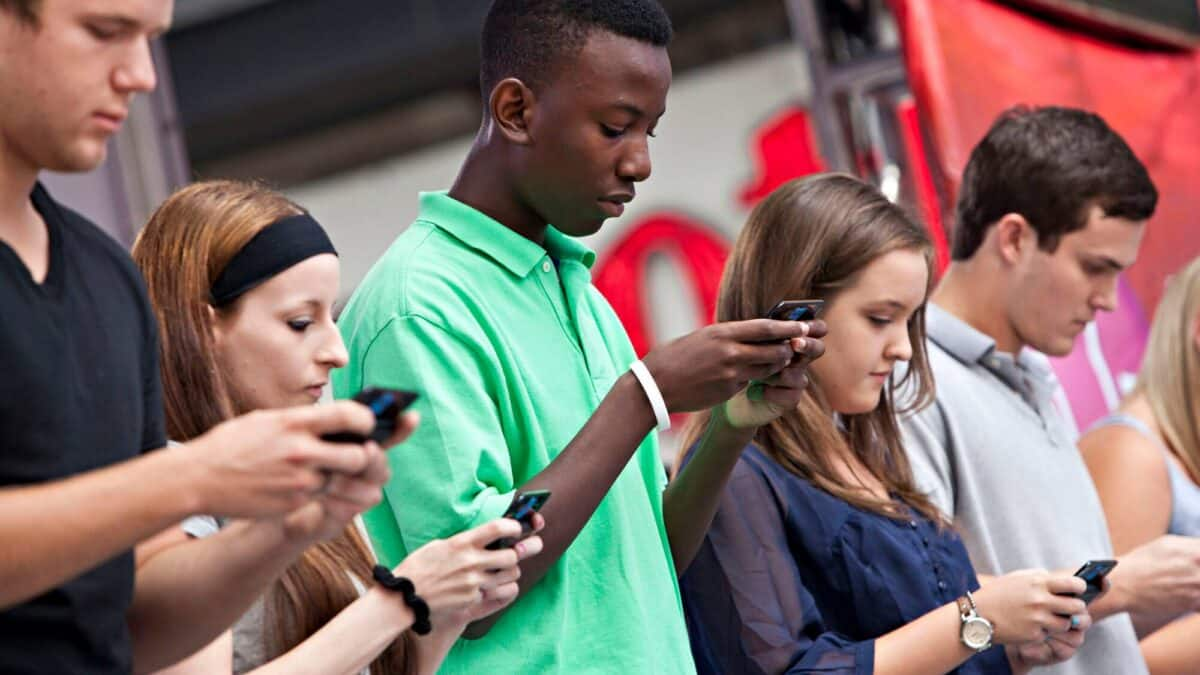
A study published in March 2026 shows that daily spoken words fell sharply over the past decade. Researchers analysed recordings from 2,197 people and found a 28 per cent drop in speech. As texting and social media use grew, many people got used to typing instead of talking to each other.
A study finds that daily spoken words have fallen sharply over the past decade. The bigger question is what we lose when conversation becomes optional
For more than 2,00,000 years, the human voice was not merely a tool of communication. It was the primary medium through which knowledge, status, emotion, and coordination moved between minds.
Spoken language evolved under conditions of limited memory, high error costs, and the need for immediate presence. It shaped the architecture of our social brains. That monopoly is ending, not with a dramatic collapse, but with a measurable, quiet contraction that most people have not yet registered as historic.
The measurable decline of everyday speech
The evidence is already in. A study published in March 2026 in Perspectives on Psychological Science, a peer-reviewed academic journal, reports a striking decline in everyday speech. Psychologists Valeria Pfeifer and Matthias Mehl analysed recordings from 22 studies involving 2,197 individuals aged 10 to 94, collected between 2005 and 2019.
Their analysis estimated that daily spoken-word counts declined by approximately 338 words for each successive year in the study period. Across those fourteen years, the estimated cumulative decline reached roughly 28 per cent. That is the equivalent of losing about 1,20,000 spoken words per person per year, the length of a short novel, vanishing annually from daily life.
The study participants came from the United States, Europe, Australia, and Mexico, and the recordings captured people going about their ordinary lives. The decline was steeper among those younger than 25.
The timeframe coincides with the mainstreaming of texting, email, and social media. Some of the "lost" conversations may simply have moved into typed channels. The researchers are careful not to claim that digital communication caused the decline. Yet the parallel is difficult to ignore, and it leaves the central question open: whether those typed exchanges deliver the same emotional and relational returns that live speech once provided.
This is not the first great demotion of speech. Oral cultures once held nearly all cultural memory in living voices. The invention of writing externalised that memory, and began the long process of making speech optional for certain high-value functions.
Print accelerated the shift. Digital text completed a further stage by making language searchable, editable, asynchronous, and nearly costless to store and transmit. What the recent study may reveal is the behavioural consequence of that continuing transformation. When a lower-friction alternative exists, people often use it. Speech has not been abolished. It has been reclassified from default infrastructure to specialised preference.
When conversation becomes optional
The cultural shock will be uneven and, for many, disorienting. Older cohorts still experience pure conversation as the unmarked form of human connection, the place where tone, timing, laughter, and presence do work, that text approximates imperfectly. Younger cohorts already treat sustained live speech as slightly effortful or even performative, something reserved for intimacy, performance, or high-stakes repair.
Public space is growing quieter. The low-stakes verbal exchanges that once filled the interstitial moments of daily life, hallway coordination, shop-counter small talk, and casual catch-ups, are thinning.
In twenty-five years, the gap will feel wider. By 2050, everyday talking in highly digital populations may occupy a narrower band of social life: emotional attunement, rapid collaborative problem-solving, status display, and pure presence. Most coordination, information transfer, and low-stakes maintenance will live in durable, inspectable, asynchronous forms. Voice will survive the way handwriting survived the keyboard: still practised, still valued in specific contexts, no longer the primary production method.
Technology will not merely accompany this shift; it will deepen it. Real-time transcription, predictive systems that anticipate intent, shared semantic spaces, and eventual lightweight neural interfaces will further reduce the necessity of vocalising.
Speaking out loud will increasingly feel like an optional output layer rather than the required input. The residual advantages of speech, its speed of repair, its capacity to convey relational care at low cost, and its theatrical power, will keep it alive. They will not necessarily restore its former monopoly.
The hidden cost of communication efficiency
The deeper revelation is not that humanity is becoming silent. It is that a channel we treated as almost biological necessity is revealing itself as historically contingent technology. Speech was shaped by a world of limited external storage and high coordination costs among small groups. We no longer live entirely in that world.
The measured decline in spoken volume suggests that much of what we once needed the voice for can be done more efficiently another way. Whether the social and emotional returns of the substitute fully match the original remains an open empirical question.
Loneliness, relational depth, and the cumulative capital built by countless small verbal exchanges may carry costs we have not yet fully priced. But the behavioural vote is already being cast. People are speaking less. The trend is generational. Twenty-five years is enough time for today's measurable contraction to become tomorrow's new normal.
We will still be talking in 2050. We will simply no longer treat talking as the inevitable centre of human connection. That quiet demotion, from necessity to preference, is the real cultural shock.
(Sreejith Sreedharan is a technology analyst and author of Future of Work - AI Augmented Autonomous Decentralised. He works on organizational AI readiness and created the AI Instinct Index®, a psychometric diagnostic designed to assess behavioural readiness for AI adoption and adaptive capacity in constraint-heavy environments. Views expressed in the above piece are personal and solely those of the author. They do not necessarily reflect Firstpost's views.)