
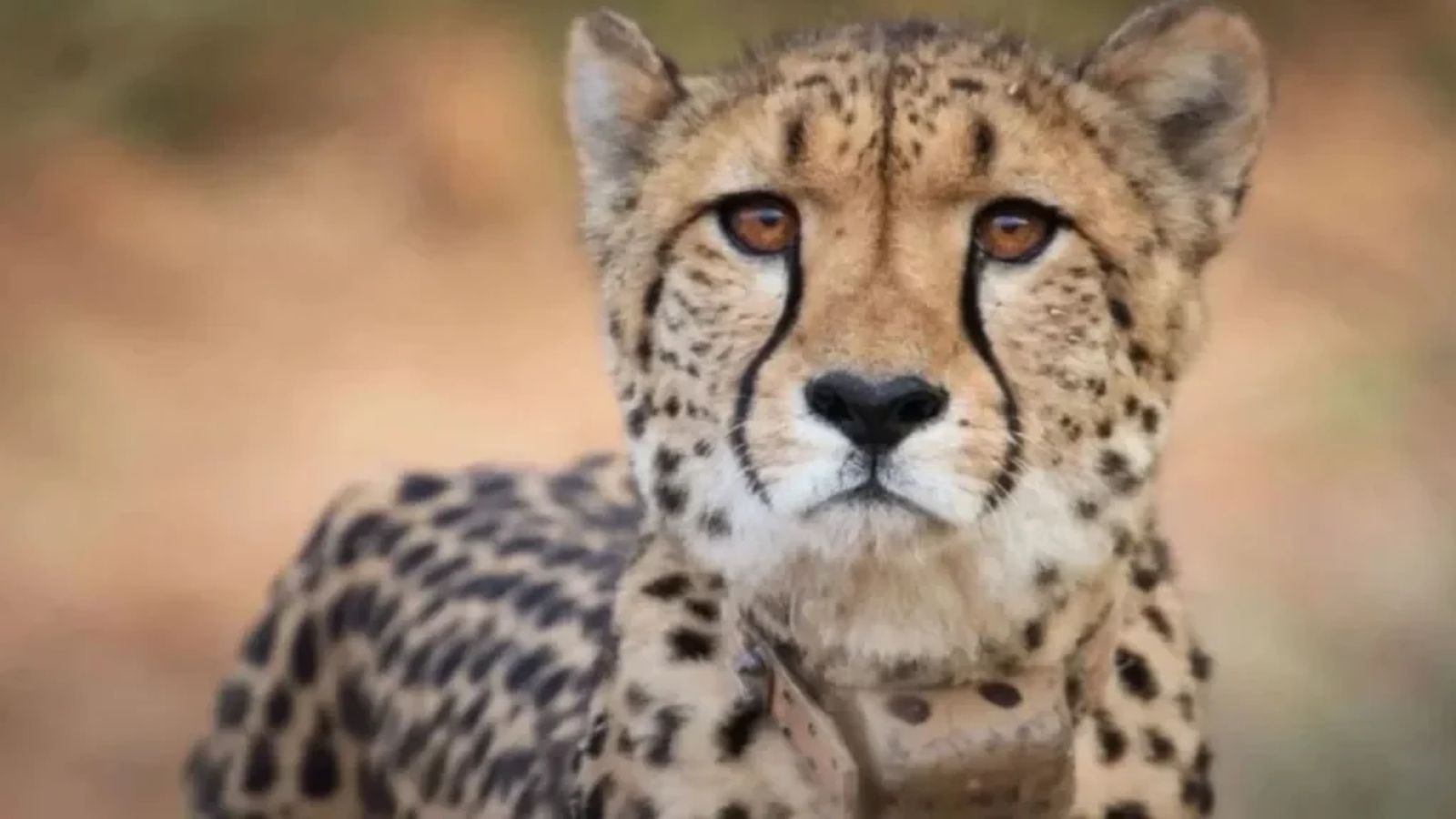
Six forest officials got suspended after a 19-month-old cheetah died on October 27. Kuno director Uttam Kumar Sharma said satellite collars do not provide live tracking. "Let us get rid of the misconception that a satellite-collared animal is available for continuous live tracking, like a live television broadcast," he wrote.
Six forest officials suspended after 19-month-old KNG22 was found with five firearm pellets in his body; director details the technological and terrain-related challenges of monitoring the animals
Satellite collars fitted on cheetahs are not a live telecast and cannot provide continuous live tracking, Kuno National Park Director Uttam Kumar Sharma said - remarks that come as officials face the heat over lapses in monitoring following the death of a 19-month-old cheetah.
The explanation comes as the state government has suspended six forest department officials in connection with the death of KNG22, a male cheetah who was found seriously injured in the Sheopur territorial forest division on October 25 and died during treatment at the veterinary facility of Nanaji Deshmukh Veterinary Science University in Jabalpur on October 27.
The cheetah, an offspring of Nirva - a six-year-old female South African cheetah that is part of India's Project Cheetah at Kuno - was found with multiple foreign bodies lodged in his body. Five firearm pellets were recovered during emergency surgery.
In his note recently written, Kuno director Uttam Kumar Sharma sought to explain the limitations of satellite-based wildlife monitoring, saying that a satellite location only provides the geographical position of an animal at a particular point in time. By the time the information reaches the monitoring team and personnel reach the reported location, the animal may have moved several kilometres away.
"Therefore, let us get rid of the misconception that a satellite-collared animal is available for continuous live tracking, like a live television broadcast," Sharma wrote.
At Kuno, monitoring teams track around 15 cheetahs through a combination of satellite collars and radio receivers. Satellite collars provide location information over large and often inaccessible areas, while VHF equipment is used by field teams to locate animals more precisely on the ground.
The collars are generally programmed to transmit location information at six-hour intervals. Sharma said this frequency was chosen to maintain a balance between obtaining location information and ensuring the battery lasts sufficiently long.
However, the transmission schedule also means that a missed location can significantly increase the time between two successful fixes. If one scheduled transmission is missed, the gap can increase to 12 hours. If the next transmission is also missed, the interval can extend to 18 hours, and so on.
Sharma said satellite collars were expensive, generally costing around Rs 4-5 lakh each, and the frequency of transmission had to be determined by balancing monitoring requirements, battery life and the expected duration of collar use.
A temporary loss of satellite signal, he said, was not an unusual occurrence and could happen for several reasons. Dense forest canopy can interfere with the collar's ability to obtain an accurate GPS location, while rocky terrain, caves and deep valleys may obstruct satellite visibility.
Temporary signal interference or poor satellite geometry can also affect location acquisition or transmission. An animal resting under dense vegetation, near water or in an area with poor satellite reception may not transmit its location at the scheduled time.
A missing location, therefore, does not necessarily indicate that a collar has malfunctioned or that something has happened to the animal. Sometimes, the collar simply cannot obtain or transmit a location at the scheduled time, and monitoring teams have to wait for the next successful transmission.
Why tracking cheetahs across Kuno's terrain is difficult
Sharma said the limitations of satellite tracking were particularly significant at Kuno because of the extensive movement of cheetahs across the landscape.
Cheetahs are highly mobile animals and move an average of 6-8 kilometres a day. On many occasions, they cover 12-15 kilometres or even more, with their movements often concentrated during the early morning and late evening hours.
This means that by the time a monitoring team reaches the last reported satellite location, the animal may have moved several kilometres away and could have gone outside the team's VHF radio range.
"If the scheduled satellite transmission is also missed, the only option is to wait for the next successful location fix," Sharma wrote.
Once a new location is received, the team moves towards that point and attempts to bring the animal back within VHF radio range.
Following a cheetah on foot is extremely difficult, while vehicles cannot move through forests in straight lines, as animals do. The actual distance covered by a monitoring vehicle can be several times the straight-line distance between two locations.
Moving on foot through dense forests in poor light also carries its own risks.
"Consequently, keeping an animal within visual or radio-tracking range throughout the day is an extremely demanding task. It requires continuous coordination, patience, technical understanding and tremendous physical effort from the monitoring teams," Sharma wrote.
He said these challenges were part of the daily monitoring experience at Kuno and were not occasional or exceptional situations.
KNG22 was found injured in compartment No. 748 of the Sheopur Territorial Forest Division, near the Morena district border, on October 25. He was rescued and brought to Kuno for an initial medical examination before being shifted to Jabalpur for advanced treatment.
An X-ray revealed multiple foreign bodies at different locations in his body. A subsequent CT scan showed damage to his internal organs, musculoskeletal system and nervous system. Five firearm pellets were recovered during emergency surgery, but the cheetah could not be saved.
The state government has constituted a Special Task Force comprising forest and police officers to investigate the incident. Six forest department officials have been suspended in connection with the case.