
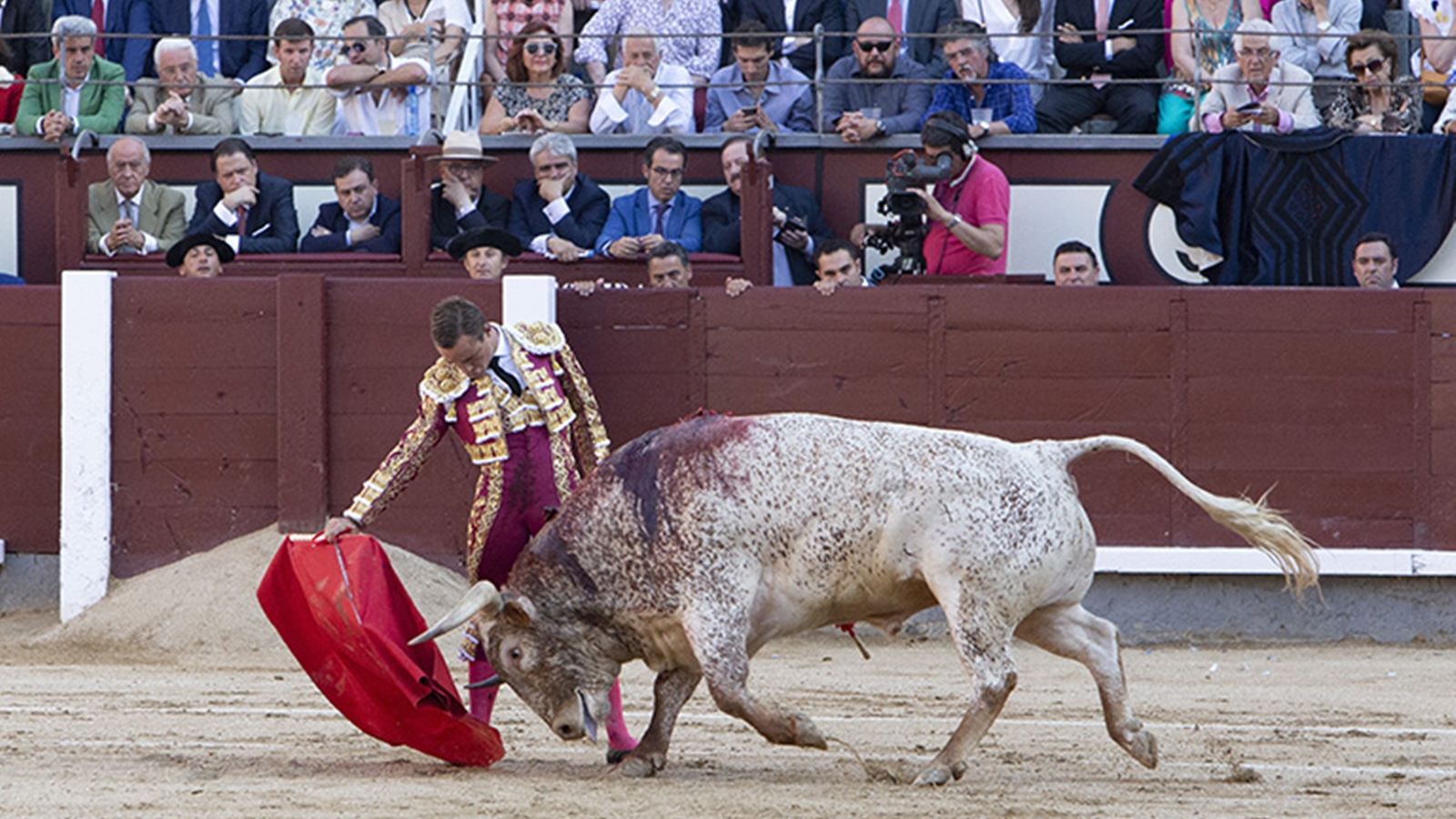
Bulls do not charge at red capes because of the colour. Scientists said that bulls are actually colour blind and cannot see red. Instead, the animals react to the movement of the cape. Experiments in 2007 showed that bulls chased moving objects regardless of their colour, proving the myth wrong.
Picture a classic bullfight: a matador poised with a vivid red cape, the muleta, taunting the massive beast across from him. The crowd holds its breath. The bull snorts, lowers its head, and charges furiously. To many spectators, it seems obvious: the bull sees red, becomes enraged, and reacts.
But, scientifically, that narrative doesn't hold up.
Despite what tradition and pop culture might suggest, bulls do not "hate" the colour red. In fact, they can't even see red in the way humans do. The idea that red provokes aggression in bulls is a long-standing myth -- one scientists, zoologists, and researchers across fields have repeatedly debunked. What actually causes a bull to charge has less to do with colour and far more to do with movement, fear, and instinct.
The science of bull vision
This misunderstanding stems from how bulls, and cattle in general, see the world. Unlike humans, who have trichromatic vision (three types of colour receptors in our eyes), bulls have dichromatic vision. This means they have only two types of cone cells in their eyes, so they can see certain wavelengths of light but not others.
Specifically, bulls cannot distinguish red from green. What appears as red to a human will likely look like a dull yellow or grey to a bull. This form of colour blindness isn't unique to bulls; many mammals, including dogs, experience similar vision limitations. The bottom line: red isn't special to bulls, because they simply don't perceive it as red.
So why do bulls charge at the red cape in bullfighting arenas?
The answer is motion. What draws a bull's attention and triggers its instinct to charge isn't the cape's colour, but its dramatic, unpredictable movement. Multiple experiments have confirmed this, most notably by the team behind the television show MythBusters in 2007. In one episode, bulls were exposed to stationary capes of different colours -- red, white, and blue -- and showed no preference for any particular hue. However, when those same capes were waved or jerked around, the bull responded immediately.
Even more tellingly, the bull ignored a person dressed entirely in red who stood still, while it pursued people in other colours who moved around. The conclusion was clear: bulls charge because of the motion, not the colour.
This aligns with what we know about bull behaviour in the wild. Bulls are territorial animals and rely heavily on movement to detect threats or intruders. When something moves rapidly or unpredictably in their field of vision, they interpret it as a challenge, or at the very least, a cause for concern. Their response is an act of defence or assertion, not rage induced by colour.
The role of red in bullfighting
If bulls don't respond to red specifically, why is the bullfighter's cape always red?
There are two main reasons, and both are rooted in human concerns, not bovine psychology.
First, there's a practical consideration: during a bullfight, the animal is often injured by picadors and eventually by the matador himself. The red colour of the cape conveniently hides the blood that stains it, maintaining the visual spectacle for the audience without making it overtly grotesque.
Second, the colour red carries cultural and symbolic weight. Red is bold, theatrical, and emotionally charged. It's associated with danger, passion, violence, and drama. In a tradition as ritualistic and performative as bullfighting, the visual impact of a flowing red cape has become an icon, regardless of what the bull actually sees.
In short, red is used for the audience, not for the bull.
A misunderstood creature
Bulls, despite their fearsome appearance, are not naturally aggressive animals. Like most creatures, they become defensive when they feel threatened, stressed, or cornered. The bullfight arena is a high-stress environment: filled with noise, bright lights, human provocation, and, above all, confusion. Add in physical pain from spears and prods, and the bull's charge becomes an act of fear and desperation, not irrational rage at a specific colour.
Understanding this nuance helps dispel the notion that bulls are naturally "angry" or irrationally violent toward the colour red. They're not reacting to the cape's colour, but to everything else happening around them, especially the way it moves.
So where did the myth originate? Most likely, it grew out of a misinterpretation of the bullfighting ritual itself. Because the muleta is red and the bull charges at it, the connection seems obvious at first. However, tradition and spectacle often leave scientific reality behind.
Centuries of storytelling and artistic portrayals have solidified the idea of red as a "trigger" for bulls, and it persists even today in cartoons, advertisements, and even language (consider the phrase "like a red rag to a bull"). But as with many myths, when we take the time to examine the facts, the truth is far more interesting and compassionate.
Explore more captivating stories about pets and animals here, and make us your daily stop for the latest from the animal kingdom.