
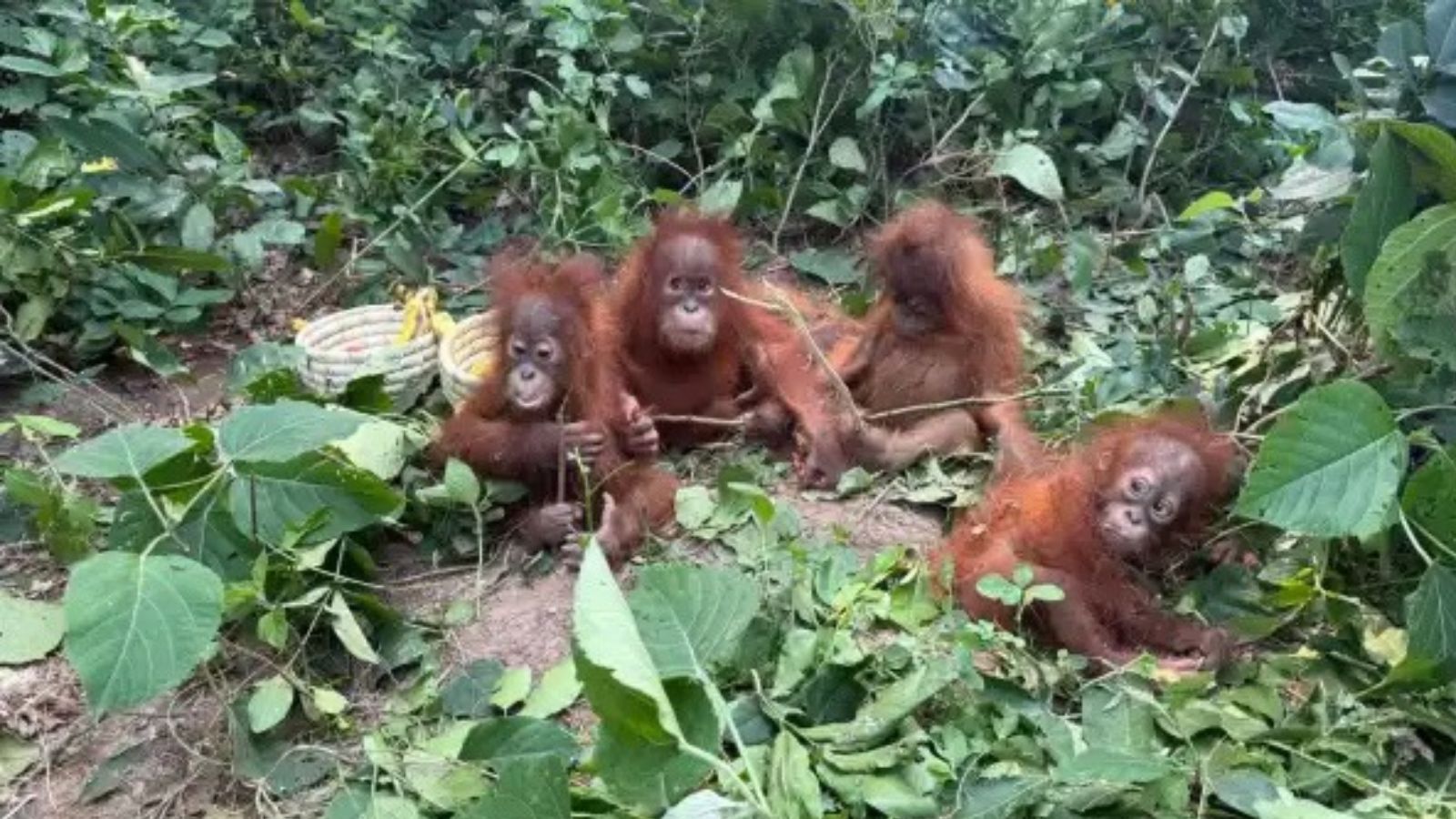
A seven-member Indonesian delegation wants to visit Nandankanan Zoological Park to assess five orangutans rescued on September 8. Indian authorities agreed to the proposal in principle. Ristianto Pribadi said, "The proposed visit will enable the delegation to assess the condition of the animals first-hand, review their care arrangements."
A seven-member delegation from Indonesia wants to visit Nandankanan Zoological Park to assess the health of 5 orangutans rescued from Bichitrapur forest last month.
The Indonesian government has proposed a visit by a seven-member delegation of officials and experts to Nandankanan Zoological Park in Odisha to assess the health and welfare of the five infant orangutans rescued on September 8 from Bichitrapur forest in Balasore, The Indian Express has learnt. Indian authorities have agreed to the proposal in principle, it has been gathered.
The visit has been proposed even as the Odisha forest department is yet to determine the exact origins of the orangutans. Indonesian officials said the visit will support verification of their species and origin, among other things.
The animals were sent to the Nandankanan Zoological Park for care and rehabilitation and are stable.
People aware of the matter in India confirmed the outreach by the Indonesian CITES management authorities.
Vets and specialists in delegation
"Indonesia's CITES Management Authority has formally communicated a proposal for a technical delegation to visit Odisha through diplomatic and technical channels. The Indian side has conveyed its agreement in principle, and both sides are coordinating the timing and practical arrangements," said Ristianto Pribadi, Director of Public Relations and International Cooperation Bureau, Ministry of Forestry of the Republic of Indonesia, in response to queries from The Indian Express.
CITES, or the Convention on International Trade in Endangered Species of Wild Fauna and Flora, is the global treaty that regulates cross-border trade of wild animals and plants. Orangutan trade is strictly restricted under CITES and is allowed only for research purposes. Each country has a designated CITES management authority that implements the treaty and issues CITES trade permits.
Pribadi added that the proposed visit will enable the delegation to assess the condition of the animals first-hand, review their care arrangements, and crucially, support verification of their species and origin.
Indonesia authorities have proposed a delegation comprising a representative of its CITES Management Authority, veterinarians, and specialists in orangutan biology, identification, health, welfare, and conservation, Pribadi said.
Origin of rescued primates not ascertained
Soon after the primates were rescued, Indonesia's Ministry of Forestry had written to its Indian counterpart expressing willingness to cooperate in repatriation or return of the animals, which they said were suspected to be of Sumatran origin.
The three orangutan species -- Borean, Sumatran and Tapanuli -- are all listed as critically endangered in the International Union for Conservation of Nature's Red List, which grades the conservation status of animals.
Prem Kumar Jha, Odisha's Principal Chief Conservator of Forests (Wildlife) and Chief Wildlife Warden, told The Indian Express that the rescued orangutans are in good, stable condition after initial days of distress.
A technical committee comprising a veterinary doctor from Mysore Zoo and experts from the Wildlife Institute of India and National Zoological Park, Delhi, and Centre for Wildlife Health, Bhubaneswar, is being consulted on their welfare.
Meanwhile, Odisha's special task force is continuing its investigation into the alleged trafficking of these orangutans. Odisha authorities said that it is also important to complete the process of determining the origin of the rescued primates. DNA samples of the five primates will be sent to the Zoological Survey of India for ascertaining the exact species.
Sanath Kumar N, Director, Nandankanan Zoological Park, said that when the animals were brought to the zoo, they were anaemic and had to be de-wormed. They have been housed in the zoological park section where animals are hand-reared and are under continuous watch.
There are three males and two females. The oldest are a male and a female, both about 1.5 years old, while the others are younger, he added.