
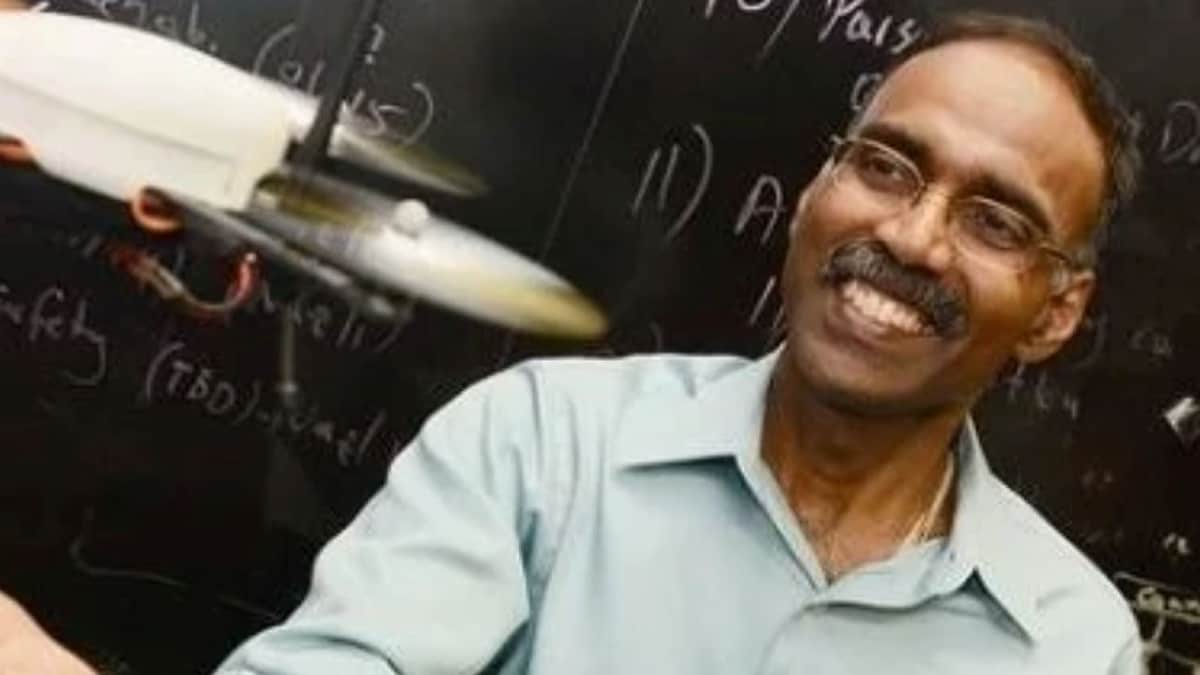
Aerospace scientist Maruthi R Akella got a minor planet named after him for his work on the IM-1 lunar lander mission. He developed computer programmes that helped guide the spacecraft to the Moon. The IISc will honour him at a ceremony on December 19 at the JN Tata Auditorium.
Aerospace scientist Maruthi R Akella developed critical guidance programs for a historic lunar lander mission, earning him the naming honor of a minor planet and a distinguished alumni recognition at IISc. Discover what specific navigation challenges his algorithms overcame during the descent.
An Indian scientist, Maruthi R Akella, has been honoured for his contribution to a mission that took a spacecraft to the Moon. He has developed computer programmes that helped guide Intuitive Machines' IM-1 lunar lander during its journey to the Moon.
Now, a minor planet numbered 5376 has been named 'Maruthiakella' in recognition of his contributions. All the awardees will be honoured at a ceremony on December 19 at the JN Tata Auditorium on the IISc campus.
Who is Maruthi R Akella?
Maruthi R Akella is an aerospace scientist and professor at The University of Texas at Austin in the United States. He holds the Cockrell Family Chair in Engineering at the university. He completed his Master's degree in Engineering from Indian Institute of Science's (IISc) Department of Aerospace Engineering in 1994.
Akella has written more than 260 research papers that have been published in science journals and presented at research conferences. His work focuses on helping spacecraft find their way, stay on the right path and move safely during space missions. He has also worked on systems that allow robots to use cameras to understand their surroundings and move on their own.
Akella developed computer programmes that provided onboard guidance for Intuitive Machines' IM-1 lunar lander mission. These programmes helped the spacecraft with navigation and control during its journey and landing on the Moon. The IM-1 mission made history by achieving the first US Moon landing in more than 50 years.
Apart from his work at the university, Akella is the founding director of the Center for Autonomous Air Mobility at the University of Texas at Austin. He is also the Editor-in-Chief of The Journal of the Astronautical Sciences, a research publication related to space science. He is currently a VAIBHAV Fellow hosted by IISc.
Some of his major awards include the AIAA Mechanics and Control of Flight Award, the Dirk Brouwer Award given by the American Astronautical Society, the IEEE Control Systems Society Award for Technical Excellence in Aerospace Control and the IEEE Judith A. Resnik Space Award.
He has also received fellowships from three major international organisations: the American Institute of Aeronautics and Astronautics, the Institute of Electrical and Electronics Engineers and the American Astronautical Society.