
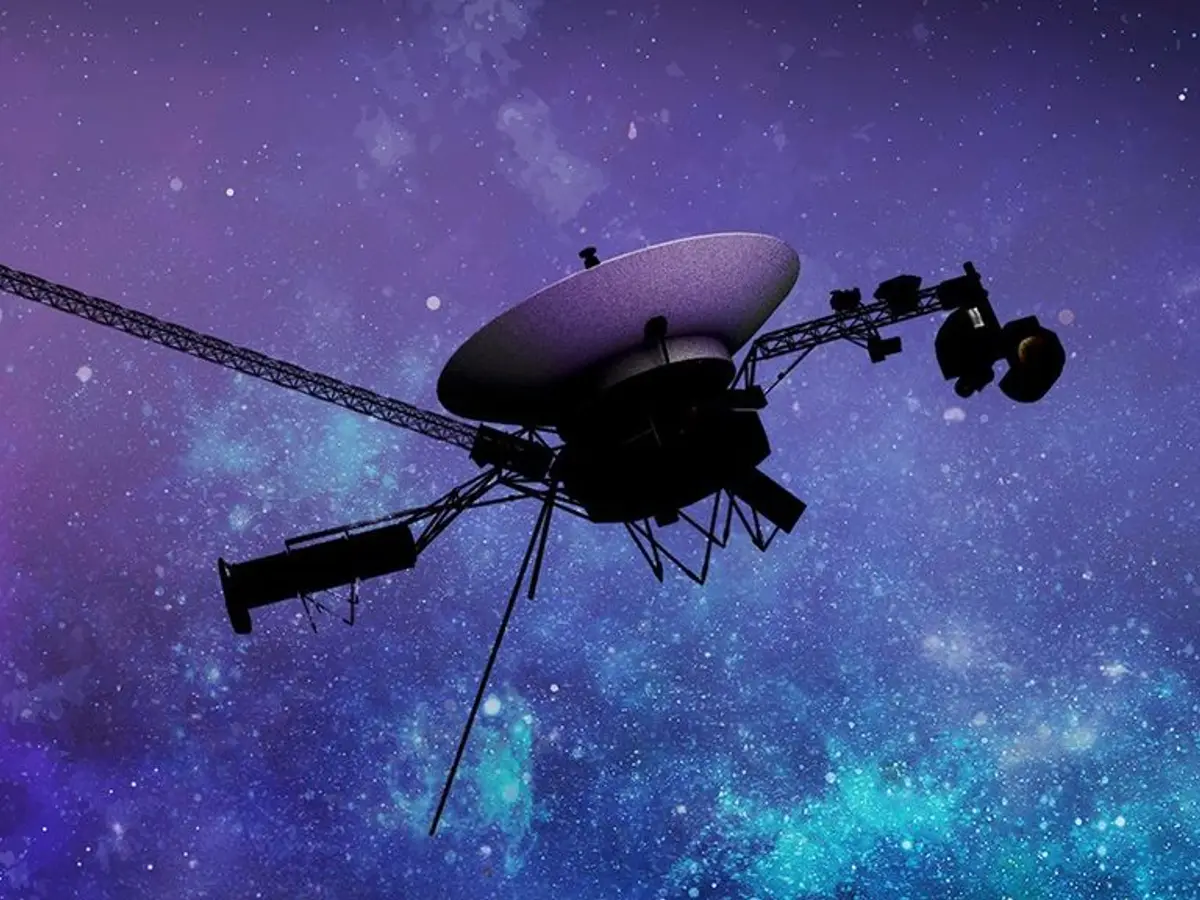
On 18 November 2026, Voyager 1 will reach a distance of one light-day from Earth. This machine will have travelled for 49 years, 2 months and 11 days to reach this point. Scientists use light to measure space because nothing moves faster than light, which travels at 3 lakh kilometres.
On Wednesday, 18 November 2026, at 5:16:07 a.m. US Eastern time, which is 3:46:07 p.m. in India, a machine built by human hands will cross a line nothing human-made has ever crossed. Voyager 1 will be exactly one light-day from Earth. In plain words, a torch beam switched on here would need a full 24 hours to touch it. That works out to roughly 2,590 crore kilometres, and the spacecraft will have taken 49 years, 2 months and 11 days to cover a gap that light clears in a single day.
To feel the size of that number, it helps to understand why astronomers measure space in light at all. Nothing in the universe outruns light, which races along at about 3 lakh kilometres every second. Radio waves, microwaves, infrared, X-rays and gamma rays all move at the very same pace, because they are all forms of the same electromagnetic energy. So scientists simply ask how long light needs to cover a gap. One light-day is the stretch light covers in 24 hours. One light-year is what it covers in a full year, about 9.46 lakh crore kilometres.
Think of it like describing a journey by travel time rather than by odometer reading. The Moon sits roughly 3,84,400 km away. Astronauts on NASA's Artemis II mission needed around three days to get there; light needs 1.3 seconds. Sunlight has to travel nearly 15 crore kilometres, so it reaches us 8 minutes and 20 seconds after leaving the Sun. The warmth on your face this morning is, quite literally, eight-minute-old news. Mars and Earth keep shifting positions as they circle the Sun, so a light signal between them takes anywhere from 3 to 22 minutes. Every command sent to a spacecraft near Mars, and every reply, obeys that same waiting time.
Go further out and the numbers swell. Neptune, the farthest planet, averages about 450 crore kilometres from Earth, a distance light crosses in 4 hours and 10 minutes. Voyager 2, racing at nearly 56,327 km per hour, needed about 12 years to get there. Beyond our solar system, the nearest star with planets, Proxima Centauri, lies 4.24 light-years, or 40.15 lakh crore kilometres, away. The Andromeda galaxy, one of our closest large neighbours, is 25 lakh light-years off; its glow left home before our ancestors learnt to make fire.
Where does all this sit? Picture India as the universe, Bengaluru as the Milky Way galaxy, Jayanagar as our solar system, and a single house in Jayanagar as Earth. The house belongs to the locality, the locality to the city, the city to the country. Earth is a planet, the Sun is a star, the Milky Way is our galaxy, and a galaxy holds millions or billions of stars inside a universe holding billions of galaxies. Voyager 1 has merely stepped out of the house and walked to the end of the lane.
Both Voyagers left Earth in 1977. NASA sent Voyager 2 on a longer road so it could visit Uranus and Neptune, which is why it will reach its own one-light-day mark only in November 2035, about nine years later. Voyager 1, speeding at nearly 61,000 km per hour, took the more direct route. Fast as that sounds, against light it is a snail on a highway. Light is roughly 18,000 times faster than Voyager 1.
Trending Stories
Where is the snail headed? It is heading towards a faint star called Gliese 445 (also catalogued as AC +79 3888) in the constellation of Ursa Minor, the Little Bear that many of us know as the Little Dipper. Its light takes more than 17 years to reach us. Voyager 1 will need about 40,000 years just to reach its nearest point to that star, and even then it will not arrive. It will slip past at a gap of 1.7 light-years, a distance light itself would need one year and about eight months to cross.
And that is the humbling heart of this story. Half a century of patient engineers, some long retired, some no longer alive, kept a 1970s machine alive and listening. For a country like ours, now nursing its own ambitions beyond Earth's orbit, the lesson is plain: great distances are conquered not by speed alone but by stubborn, generational persistence. On 18 November, when a signal from Voyager 1 finally takes a full day to come home, it will carry with it the quiet pride of everyone who refused to stop listening.