
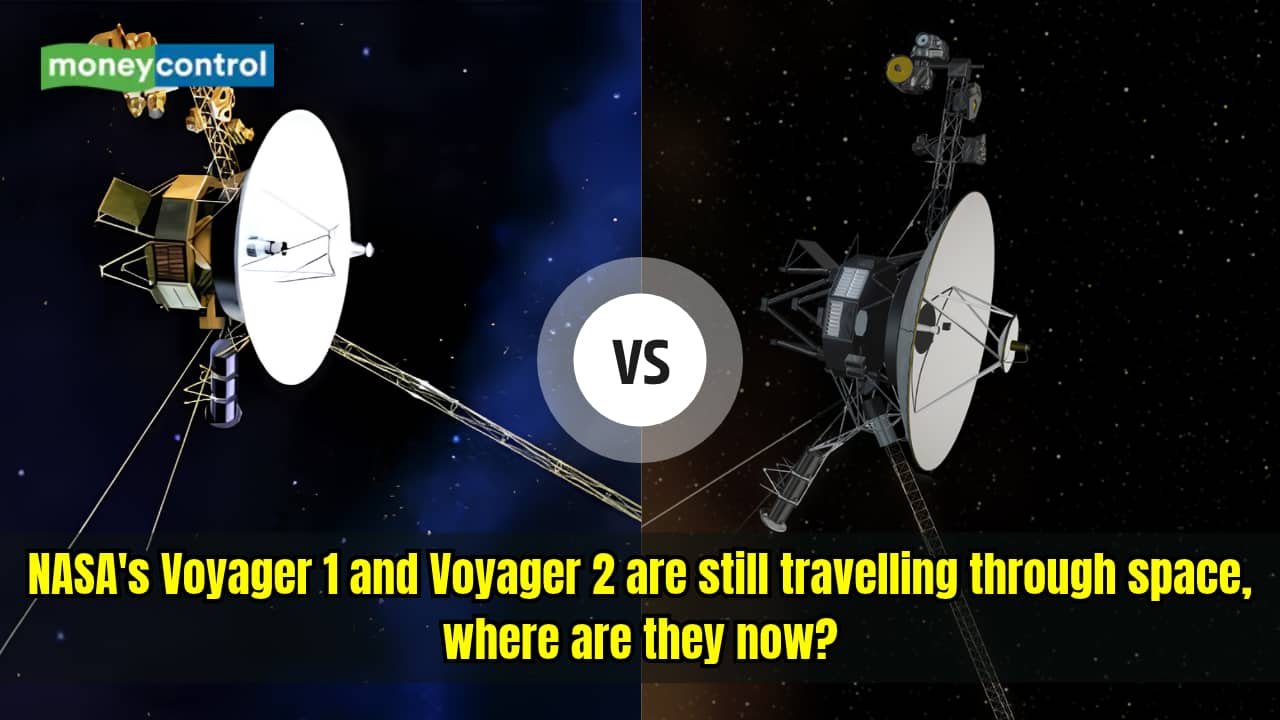
NASA’s Voyager 1 and Voyager 2 are still travelling through interstellar space nearly 49 years after leaving Earth. Voyager 1 reached a distance of one light-day on November 18, 2026. Both spacecraft use active instruments to measure magnetic fields and plasma waves as they head in different directions through space.
Nearly 49 years after leaving Earth, NASA's Voyager 1 and Voyager 2 are still travelling through interstellar space. Originally launched to explore the outer planets, the twin spacecraft have travelled billions of kilometres beyond their original destinations. However, they are now following different paths through space. While Voyager 1 reached the historic one-light-day distance from Earth in November 2026, Voyager 2 is expected to achieve the same milestone in 2035. So, where are NASA's two distant explorers today? NASA Voyager 1 launch: When did it leave Earth? NASA launched Voyager 1 on September 5, 1977, from Cape Canaveral, Florida, aboard a Titan-Centaur rocket.
Its primary mission was to study Jupiter and Saturn, including their moons, magnetic fields and atmospheric conditions. Voyager 1 flew past Jupiter in March 1979 and Saturn in November 1980. It subsequently continued towards the outer reaches of the Solar System. NASA Voyager 2 launch: When did it begin its journey? Voyager 2 actually launched before its twin, on August 20, 1977, from Cape Canaveral. Unlike Voyager 1, it followed a trajectory that allowed it to visit all four giant planets: Jupiter, Saturn, Uranus and Neptune. It became the first spacecraft to closely explore Uranus and Neptune, during flybys in 1986 and 1989.
Voyager 2 entered interstellar space on November 5, 2018. Voyager 1 Vs Voyager 2: How far apart are the two spacecraft? Voyager 1 is currently the farthest human-made object from Earth. On November 18, 2026, it reached approximately 25.9 billion kilometres (16.1 billion miles) from our planet, equivalent to one light-day. Voyager 2 is around 3.2 billion kilometres closer to Earth. Both spacecraft are travelling in different directions, with Voyager 1 heading north and Voyager 2 south of the planetary orbital plane. Voyager 1 Vs Voyager 2: What are both spacecraft still detecting in interstellar space?
Despite their age, both spacecraft continue collecting scientific measurements. Voyager 1 has two active science instruments, while Voyager 2 has three. They measure magnetic fields and plasma waves, helping scientists understand the environment beyond the Sun's protective bubble. Voyager 2 also continues measuring cosmic rays. What is the future of Voyager 1 and Voyager 2? Both spacecraft rely on plutonium-powered generators that gradually lose electrical output. NASA is switching off instruments and non-essential systems to conserve power. Recent engineering upgrades in 2026 have helped extend their operations.
Their journeys may eventually end when their power supplies become insufficient for communication. However, both will continue travelling through interstellar space long after they stop transmitting data.