
The UAE unveiled a space probe that will travel to six asteroids and land on a seventh. The mission starts from Japan in March 2028. It will cover five billion kilometres over eight years to reach asteroid 269 Justitia. This ambitious project aims to study the early Solar System's history.
The United Arab Emirates has unveiled a homegrown space probe designed to travel across the main asteroid belt, fly past six asteroids and attempt a landing on a seventh, in an ambitious interplanetary mission that could offer new insights into the early Solar System.
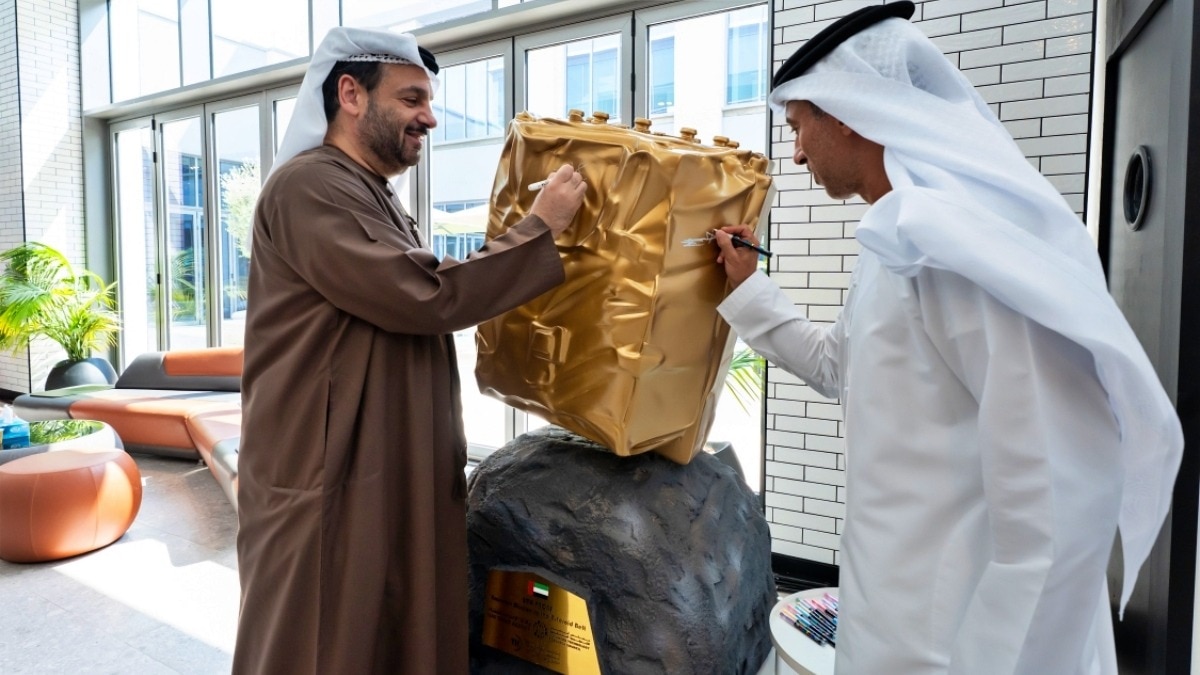
The Technology Innovation Institute (TII) revealed the probe developed for the Emirates Mission to the Asteroid Belt (EMA).
The UAE-built payload will travel to Colorado, the United States, for final integration with the MBR Explorer spacecraft ahead of its planned launch from Japan in March 2028.
The mission will cover approximately five billion kilometres over eight years, using gravity-assist manoeuvres at Venus, Earth and Mars to reach its destination, asteroid 269 Justitia.
If successful, the probe's landing would make Justitia only the seventh asteroid in history to be reached on the surface by a spacecraft.
A MISSION TO AN UNUSUAL ASTEROID
Justitia has attracted scientific interest because it is among the reddest objects observed in the main asteroid belt between Mars and Jupiter.
Its spectrum resembles objects found in the Kuiper Belt, a distant region beyond Neptune containing icy bodies left over from the Solar System's formation.
Scientists believe Justitia may have originated in the Kuiper Belt before migrating inward during the early history of the Solar System. Its surface could contain complex organic materials formed through the irradiation of ancient ice.
Studying the asteroid could help researchers understand how water, volatile compounds and organic materials were distributed during planetary formation.
The probe will separate from the MBR Explorer spacecraft during a low-altitude pass in early 2036, descend towards Justitia and make contact with its surface.
While the spacecraft will study the asteroid from orbit, the probe is designed to capture close-range images and excavate surface material to investigate its composition and physical characteristics.
AN AUTONOMOUS SPACECRAFT BUILT IN THE UAE
Developed and tested in Abu Dhabi by TII's Propulsion and Space Research Center, the probe is the mission's only deployable payload.
The project involves collaboration with the UAE Space Agency, HEX20, Khalifa University and UAE University's National Space Science and Technology Center.
The compact probe will operate autonomously in deep space, making decisions without receiving commands from Earth or the mothership after deployment. Its onboard software will determine when to take photographs, how many images to capture and which images to retain.
Two cameras, one wide-field and another narrow-field, will provide contextual and high-resolution observations. The probe will also image objects during its cruise, transmitting data at approximately six-month intervals.
TII Chief Executive Officer Najwa Aaraj said the project demonstrated the UAE's ability to translate advanced research into mission-ready space technology.
The EMA is the UAE's second interplanetary mission and its first in which the spacecraft element has been designed, engineered, assembled and tested within the country, reflecting its push to build independent space capabilities.