
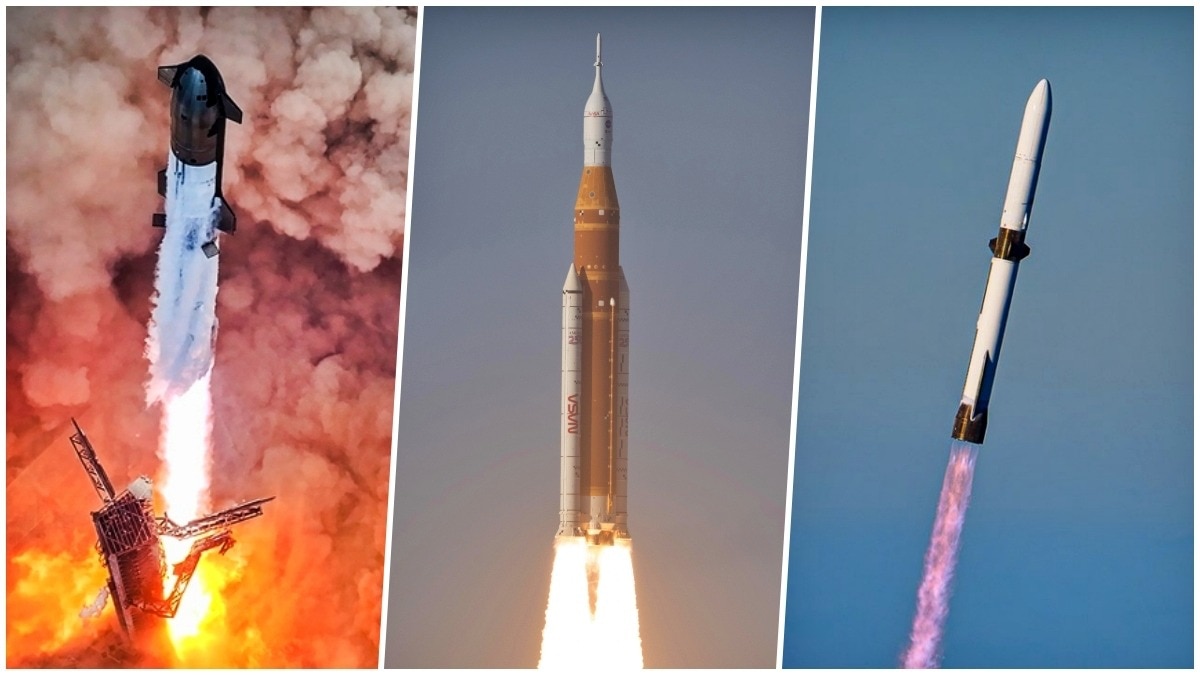
Nasa will fly four astronauts on a 14-day Earth-orbit mission involving three spacecraft and two dockings. Scheduled for 2027, the mission tests systems before a 2028 lunar landing. "Every piece of this mission in Earth orbit is designed to reduce risk before we put astronauts back on the Moon," said Jeremy Parsons.
Nasa will fly four astronauts on a 14-day Earth-orbit mission involving three spacecraft and two dockings. The tests are intended to reduce risks before a planned lunar South Pole landing in 2028.
Nasa is preparing for one of the most complex missions in its history as it gets ready to return astronauts to the Moon.
Scheduled for 2027, Artemis III will send four astronauts into low Earth orbit to test the spacecraft, docking systems and technologies needed for future lunar landings.
Unlike previous Artemis missions, which relied on Nasa's Space Launch System (SLS) rocket and Orion spacecraft, Artemis III will involve three spacecraft launched on three different rockets and two critical docking demonstrations.
The 14-day mission aims to reduce risks before astronauts attempt to land near the Moon's South Pole in 2028.
The crew will comprise Nasa astronauts Randy Bresnik, Frank Rubio and Andre Douglas, along with European Space Agency astronaut Luca Parmitano.
"Every piece of this mission in Earth orbit is designed to reduce risk before we put astronauts back on the Moon," said Jeremy Parsons, Nasa's Artemis programme manager.
FIRST DOCKING: ORION MEETS BLUE ORIGIN'S BLUE MOON
The mission will begin with Blue Origin launching a test version of its Blue Moon Mark 2 lunar lander into low Earth orbit, approximately 273 miles above Earth.
Days later, Nasa's SLS rocket will launch Orion and its four-member crew from Kennedy Space Center in Florida. After checking the spacecraft's systems and manoeuvring into the appropriate orbit, Orion will rendezvous and dock with the waiting Blue Moon test vehicle.
The astronauts will spend approximately two days evaluating the lander's cabin environment, controls, atmosphere, pressure and life-support systems. The test article incorporates technologies planned for future lunar missions, allowing engineers to assess how its systems perform together in space.
This will give Nasa valuable experience integrating a crewed Orion spacecraft with a commercial lunar lander.
SECOND DOCKING: TESTING SPACEX'S STARSHIP
After completing the Blue Moon demonstration, Orion will undock and prepare for a second rendezvous, this time with a test version of SpaceX's Starship Version 3.
SpaceX will launch the Starship test article from Florida into a lower Earth orbit. Orion will then dock with it in a demonstration expected to last up to two hours.
Unlike the Blue Moon exercise, astronauts will not enter Starship. Instead, engineers will evaluate spacecraft control, communications, software integration and the dynamics of docking and undocking.
Testing both systems during one mission will help Nasa understand how Orion can operate with two different commercial lunar lander designs.
MORE THAN DOCKING: PREPARING FOR THE MOON
The mission will continue with additional tests involving spacesuits, docking sensors, thermal and acoustic measurements, human factors and scientific experiments.
The crew will also investigate how astronauts could conduct health assessments without direct communication with mission control, an important capability for future deep-space missions.
Other activities will include a cellular biology experiment, Earth and solar observations, and tests related to returning lunar samples to Earth.
After completing its objectives, Orion will return to Earth for splashdown in the Pacific Ocean, where Nasa and US Navy personnel will recover the crew.
Ultimately, Artemis III is designed to establish proven procedures for future lunar exploration. By testing spacecraft, docking systems and crew operations in Earth orbit, Nasa hopes to make the next human landing on the Moon safer and more reliable.