
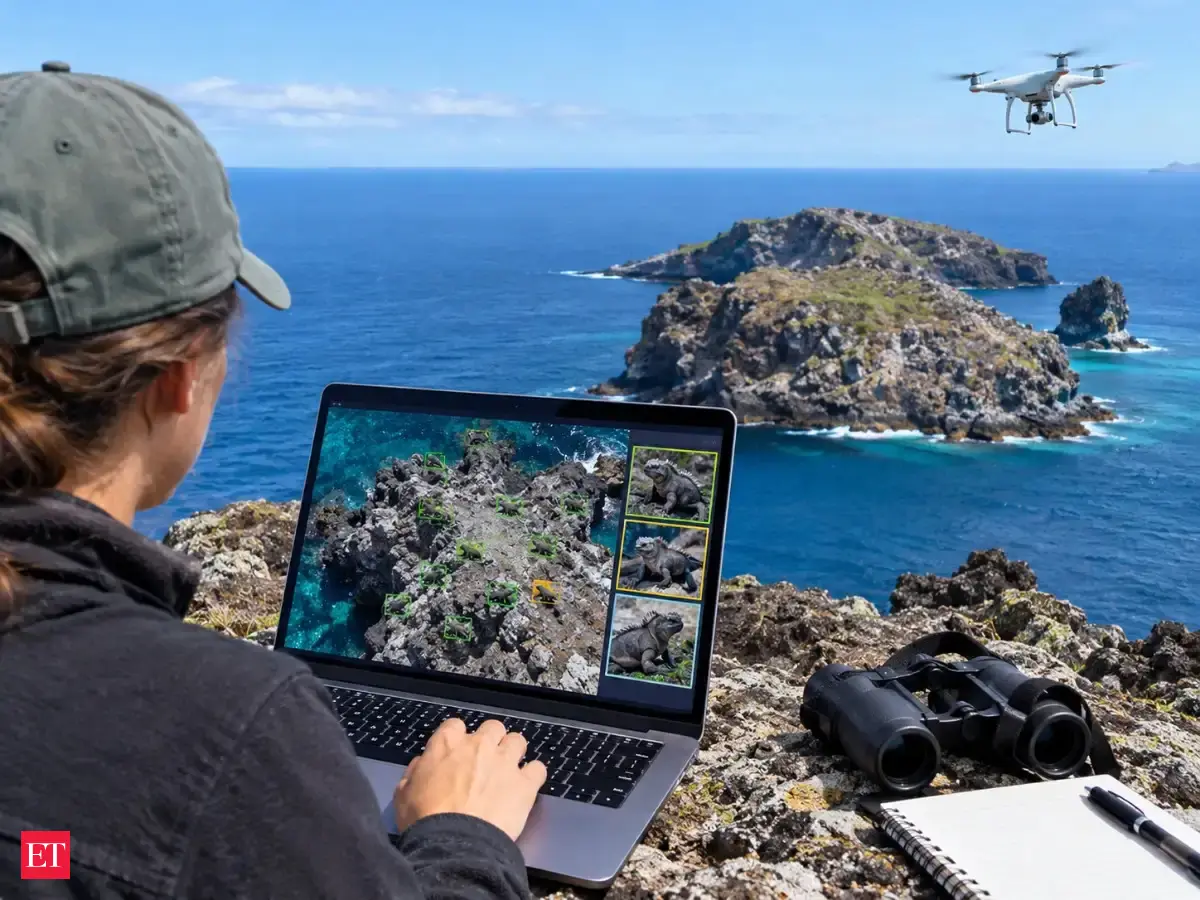
By September 2023, 13,988 volunteers searched drone photos to count endangered Galápagos marine iguanas. Participants used a citizen-science platform to identify reptiles hidden on rocky islands. While many volunteers undercounted the animals, the project showed 92% accuracy. This approach helps conservationists monitor wildlife across remote areas using thousands of aerial images.
Participants used a citizen-science platform to identify and count the reptiles in aerial photographs. Research indicated that most volunteers undercounted the animals, posing challenges for conservation efforts. The study highlighted the potential of crowd participation in wildlife monitoring despite certain limitations. Future developments may involve machine learning to enhance image analysis and accuracy.
The Galápagos marine iguana spends much of its life in places that are difficult for people to reach. Against dark volcanic rocks, the reptiles can be surprisingly hard to spot, even from above. That has made counting them across the islands a demanding task for conservationists. A new approach, however, has turned thousands of ordinary internet users into wildlife surveyors, asking them to inspect drone photographs and mark the iguanas they can find.
According to a study published in Scientific Reports, by September 2023, 13,988 volunteers had contributed 1,375,201 classifications across 57,838 aerial images to help identify and count endangered Galápagos marine iguanas. Using a statistical clustering method to combine their observations, researchers achieved 91 to 92% agreement with expert counts in the project's two later phases. The findings highlight how citizen science can help conservationists monitor wildlife across remote, rocky habitats, although the tendency to undercount animals remains a challenge.
Turning drone images into a conservation survey
It all began with a concrete problem. A drone can rapidly scan a vast space and take photos in great detail. However, someone will still have to look at each image. It takes a lot of time for a species that is capable of blending into its environment to manually count the number of animals in thousands of photographs. Hence, the researchers uploaded the pictures to the citizen-science platform Zooniverse, which anyone could access. They had to answer two questions: whether there was an iguana in the picture and how many animals, if any, they saw.
The images were collected during surveys carried out between 2020 and 2022. These surveys took place on several islands of the Galápagos archipelago during the mating period of marine iguanas, when the animals congregated in breeding territories. Some images featured obvious groups of animals, while others showed small, cryptic animals against a background of rocky terrain. Participation was substantial, with more than 10,000 registered users and about 3,500 unregistered users taking part in the study's three analysed phases.
Why counting an iguana is harder than it sounds
It was not always easy to detect the presence of reptiles from the aerial photograph taken. Blurry images, poor focus, and harsh lighting might make the animals hard to distinguish from the dark volcanic background. This was especially difficult in some northern islands since the iguanas are much smaller there. Researchers compared volunteer identifications against the "gold standard" data of numbers counted by experts in 4,345 images. The volunteers' success rate ranged from 68 to 94 per cent, depending on the project phase.
Simply considering the majority answer was not the most effective strategy. In fact, what the scientists discovered was that an image would be classified as having an iguana in it if at least five participants independently marked it, out of 20 or 30 responses per image that were gathered. The scientists also observed a certain bias in favour of missing the animals rather than imagining them. This suggests volunteers were more likely to undercount than overcount the animals, especially when image quality was poor.
Thousands of volunteers contributed to counting endangered marine iguanas through drone images from the Galápagos Islands. Image Credits: Wikimedia Commons.
A 92 per cent result, but not the final answer
For counting the iguanas themselves, the researchers explored various techniques for merging marks created by the volunteers. The best outcomes came from using a clustering algorithm known as HDBSCAN, which used participant marking locations to estimate where the animals were located. When data from the inferior pilot stage were excluded, counts of volunteers were suggested to be accurate in one phase and another phase in comparison with experts' counts.
This does not mean, however, that volunteers can just substitute for field biologists. As noted above, the study found a persistent tendency to undercount, so a correction factor would be needed before citizen-science counts could estimate population size. The image quality was another limitation. There is one more issue: analysis of images by crowdsourcing remains rather labour-intensive. The researchers refer to machine learning tools as the next step in development, with volunteer annotations possibly providing training for the system.
The experiment shows how conservation work can extend beyond laboratories and field stations. Drones can capture the images, computers can distribute them worldwide, and thousands of people can analyse them. For the elusive marine iguana, a second pair of eyes can be anywhere in the world.