
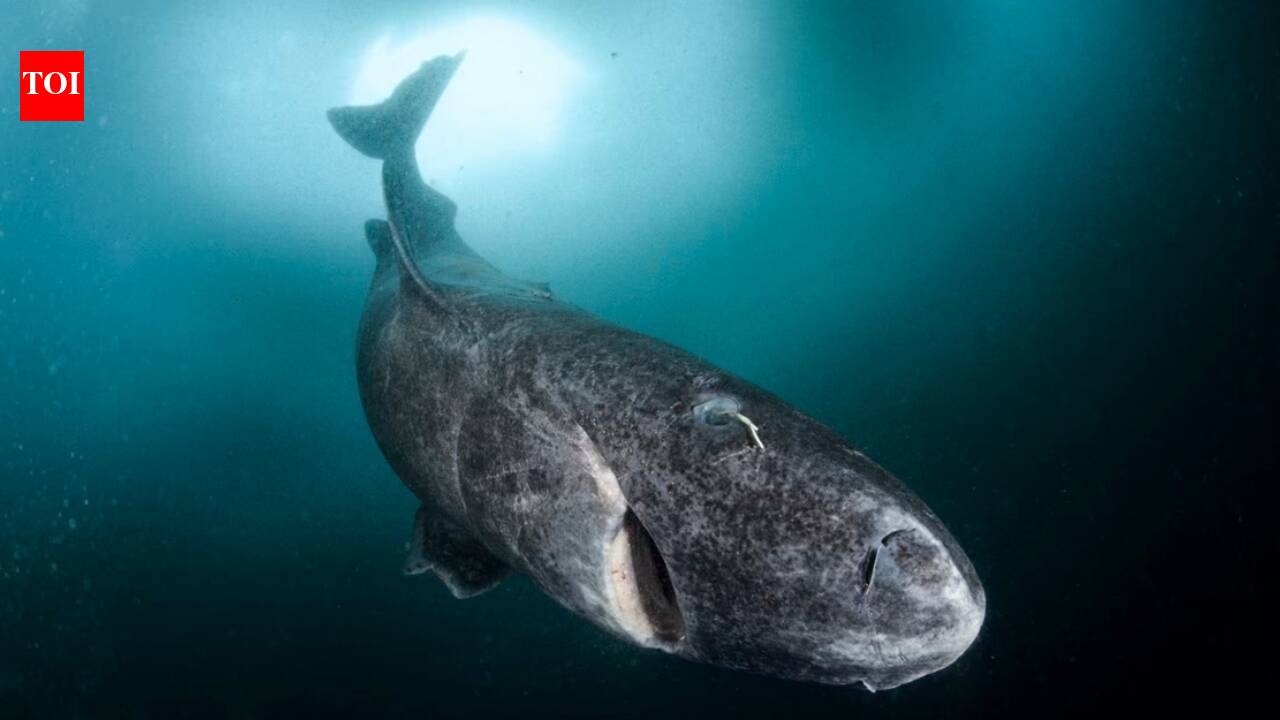
A Greenland shark born around 1626 might still be swimming in the Arctic Ocean today. Scientists found these creatures can live 400 years, making them the longest-living vertebrates. In 2016, a team led by Julius Nielsen used radiocarbon dating on shark eyes to show they truly live for many centuries.
Picture this: back in 1626, Shakespeare had been dead for ten years; the Mughal Empire was on the rise; and amidst all these important global events, a Greenland shark might have been born around then, that could still be alive, silently gliding through the Arctic right now.
It feels impossible to wrap your mind around. Picture a creature swimming beneath packed Arctic ice when Shakespeare was just starting to be studied, when the Mughal Empire stretched across India, before trains, planes, or even telegrams were a thing. Sure, the idea sounds like fantasy, but the Greenland shark, Somniosus microcephalus, actually comes terrifyingly close. Scientists now estimate these sharks can routinely live 400 years, and maybe even longer, making them the longest-living vertebrate animals known to science. That means there are sharks in the Arctic right this moment who might remember, in their own shark way, the world as it was before electricity or engines, or even the earliest newspapers.Per BBC Wildlife, these giants lurk deep in the icy North Atlantic and Arctic waters: out of sight and out of reach. They can get over five meters long, sometimes closer to seven meters even, and weigh hundreds of kilograms, though you rarely see them.
Despite their size, they move so slowly and live so deep, it's like they're ghosts below the ice.
How scientists discovered the Greenland shark's extraordinary lifespan
For years, biologists guessed Greenland sharks must be exceptionally old, as something about their sluggish growth and cold environments just made sense. But figuring out how old an animal can get when it might outlive kingdoms, empires, and most countries' entire histories? That was an enormous puzzle. Then, in 2016, a team led by Julius Nielsen in Denmark pulled off something nobody saw coming. By radiocarbon dating proteins deep in the sharks' eyes, which get locked in before birth and never really change, they managed to estimate ages for 28 female sharks. Their results spun the scientific world's head around: the largest shark they sampled, more than 5 meters long, looked to be about 392 years old, give or take 120 years. And yes, that's not a typo!
It made the Greenland shark the oldest known vertebrate on the planet, absolutely altering our understanding of what a lifespan could mean in the animal kingdom. But it's not just about bragging rights. The discovery opened up huge questions: How does a creature even survive that long? What does it mean for our understanding of aging, genetics, and the deep ocean?
Why do Greenland sharks last so long?
Well, there's no single answer, but their slow pace is a huge part of the story. This species exists in some of the coldest, harshest waters on Earth. The temperature is near freezing year-round, and everything in their world moves slowly, including their metabolism. These sharks might grow less than a centimeter a year, swimming at a top speed that's barely over a slow human walk. They can go down over 2,000 meters, which is so deep you'd be crushed by the pressure, but also surface if they need to.
Even their reproductive cycles crawl along. Most female Greenland sharks don't become sexually mature for about 150 years. It's at once haunting and beautiful: a life that's slow, nearly timeless, and precarious. Because if an adult is killed, replacing it could take centuries. It brings home a kind of conservation crisis that's easy to overlook.
What new research in 2026 reveals about the Greenland shark
Now, fast forward to 2026, and researchers keep unlocking new aspects of their biology. This year, a new paper in Nature Communications turned assumptions about the sharks' eyesight upside down. Because these giants often have monstrous copepods latching onto their eyeballs, scientists used to think their vision was practically gone. Turns out, they have special genes and eye cells letting them see in pitch darkness, and there's none of the expected retinal degeneration, even in some of the oldest specimens. Whatever lets their vision last centuries, researchers aren't sure yet, but it's striking.
And there's more. In 2024, an international team finally mapped the shark's whole genome. They found evidence of robust DNA repair mechanisms, which is a possible secret to their epic longevity. These hints might shed light on how living things, from sharks to humans, resist aging, or at least slow it down. There's no immediate path to translating that into human medicine (so don't go hunting for shark DNA anti-aging pills just yet), but it gives biology new targets to examine.
Why protecting a centuries-old shark matters
Now, it's easy to treat a slow-moving, ancient shark as more legend than fact, but the need to protect these creatures is real. For starters, Greenland sharks often wind up as accidental bycatch in commercial fisheries. Historically, people hunted them for their massive livers, rich in oil, which made them targets even in an environment so remote. Because their lives unfold on a scale of centuries, the loss of even a single adult reverberates across generations.
The latest Canadian government reports in 2025 lay out the uncertainty: there's so much we still don't know, from their population numbers to the intricacies of their life cycles. But if we want a world where living fossils like the Greenland shark still haunt the deep, conservation can't wait.