
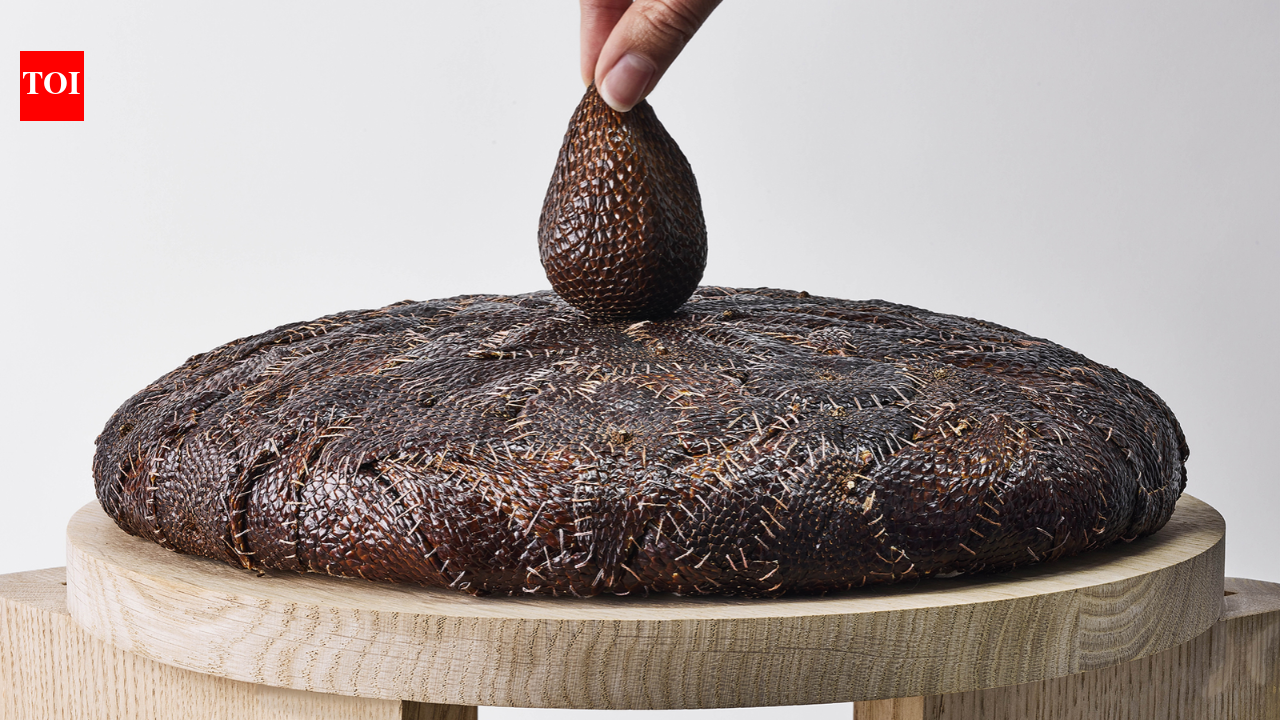
Nefeli Vitoraki, a designer based in the United Kingdom, turned discarded salak and lychee skins into a biodegradable leather alternative. Her material, PEEL, produces carbon emissions up to 95% lower than traditional leather. She said the skins felt "too considered to throw away," leading her to create this sustainable textile.
Biodegradable leather alternative PEEL turns discarded tropical salak and lychee skins into a durable textile, with estimated carbon dioxide emissions up to 95% lower than leather and synthetic substitutes. Created by Nefeli Vitoraki of Imperial College London in the United Kingdom, the finished material is fully compostable at the end of its life. PEEL won the iF Design Student Award 2026 and has been selected for three further showcases and programmes this year. So far, the textile has featured in two products, a white oak stool with a salak peel seat, and a bag made from salak and lychee peels.
Why growing up around salak and lychee in Indonesia inspired a leather alternative from fruit skins
According to the James Dyson Award, Nefeli Vitoraki grew up in Indonesia surrounded by salak and lychee, fruits whose skins are discarded in enormous quantities every day. What struck her, she wrote in her entry, was not only the waste but the skins themselves, whose texture, colour variation and structural complexity felt "too considered to throw away". She set out to discover whether these overlooked skins could become a material in their own right, honest about what they were rather than imitating something else.
She also pointed to the problems with existing options. Conventional leather relies on toxic tanning chemicals and carries a substantial carbon footprint, while synthetic vegan substitutes are largely petroleum-based and not biodegradable.
How discarded skins become a textile through low-heat drying, natural treatments and stitching
The skins are collected after the fruits have been eaten. Because both fruits have a short shelf life, the peels are abundant and easy to source in large quantities. Each peel goes through a controlled low-heat drying process that preserves its natural structure and flexibility, then is treated with a combination of naturally derived materials that build durability and water resistance.
The treated peels are stitched by a sewing machine onto backing made from cotton muslin or linen. No adhesives, synthetic polymers or toxic chemical treatments are used at any stage.
Over fifty tests and six fruit varieties took PEEL from brittle salak peels to a workable textile
Development began with salak alone, with no certainty the process would work. Early experiments focused on drying, and slow, controlled drying proved to preserve the natural pliability the material depends on. A long series of trials followed, varying combinations of naturally derived materials until the recipe delivered consistent flexibility and durability.
The prototype had to be hand-stitched throughout because early peels were too brittle for a sewing machine. Refining the recipe solved that problem, and the second prototype extended the system to lychee and four other tropical fruit peels. Home testing across abrasion, water, heat, humidity and bend fatigue gave consistently high results for all six materials, and every peel showed high resistance to heat and humidity. Samples have remained stable for over a year.
What sets PEEL apart from other plant-based leathers, and the plan to make it in Indonesia
Most plant-based leather alternatives are blended and homogenised during processing, which requires synthetic binding agents or polymer coatings to hold them together. The result is a uniform surface that erases the character of the source material. PEEL instead processes and applies each skin individually, keeping its natural texture, colour variation and irregularity.
Unlike alternatives that need dedicated cultivation, it draws entirely on existing food-system waste, so no additional land, water or resources are required. Skins are sourced where they are discarded and processed within the communities where the fruit is grown, creating a closed regional loop from waste to finished material.
Where PEEL has been shown in 2026, from the Materials Research Exchange to the Royal College of Art
Vitoraki's entry sets out the next steps. She plans sourcing partnerships with Indonesian fruit processing factories where skins are currently thrown away, creating a zero-cost raw material supply, with production run as a small local workshop in fruit-growing communities. She is also working with Imperial College London to move testing into rigorous laboratory conditions, measuring tensile strength, abrasion resistance and long-term durability, to bring PEEL to commercial release.
PEEL was selected as an exhibitor at the Materials Research Exchange 2026, listed with Innovate UK, and at Following Fallowing at the Royal College of Art 2026. It is also part of the Green Grads 2026 cohort, as both a selected member and an exhibitor.