
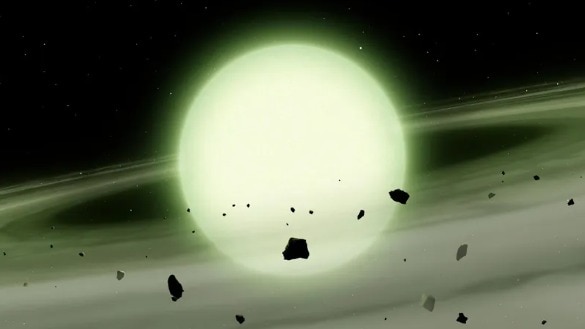
Astronomers identified a white dwarf named WD J1330+6435 that glows with a yellowish-green hue. Located 280 light-years away, the star got its unique colour after absorbing rocky planetary debris. "Take away some of the colour going into the mix, and the output will change," said co-author Boris Gansicke about this.
Astronomers have identified a white dwarf that appears green because of something it borrowed. Here's how a dead star turned into a zombie and glows green in the black vacuum of space.
Just in time for Halloween, astronomers have identified a star with an unusual yellowish-green glow, challenging what scientists know about the colours of stars.
Named WD J1330+6435, the object is a white dwarf located about 280 light-years from Earth in the constellation Draco.
It's the first documented example of a star that appears greenish to the human eye, according to findings published in RAS Techniques and Instruments.
Unlike most stars, whose colours are largely determined by their temperatures, this stellar remnant owes its unusual appearance to the elements in its atmosphere.
HOW DID A DEAD STAR TURN GREEN?
White dwarfs are the dense remains of stars that have exhausted their nuclear fuel and shed their outer layers. They can continue glowing for billions of years after their active lives end.
WD J1330+6435 appears to have absorbed rocky debris left behind by planets that once orbited it. This material enriched its outer layers with calcium, lithium and sodium.
"We first became interested in this white dwarf because bits of planetary material have fallen onto its surface," astrophysicist Mark Hollands of the University of Warwick, the study's lead author, told Reuters.
The key to its unusual colour is sodium. In ordinary stars, sodium absorbs a narrow band of orange light. But the extreme density of a white dwarf changes how sodium atoms interact with surrounding helium atoms, causing them to absorb a broader range of yellow, orange and red light.
With more of these colours filtered out, the balance of light escaping from the star changes, giving it a subtle yellowish-green hue known as chartreuse. It is not a vivid, pure green; its unusual appearance results from how its atmosphere alters the light reaching our eyes.
Researchers analysed its light spectrum and used models to calculate how its colour would appear to human vision, rather than photographing a green star directly.
Study co-author Boris Gansicke compared the process to a painter mixing colours. "Take away some of the colour going into the mix, and the output will change," he said.
SCIENCE FICTION TURNS REALITY
The team examined 151 nearby white dwarfs and found that their colours vary with the chemical makeup of their atmospheres. Carbon-rich white dwarfs can appear pink or purple, while others may look cyan, pale blue or yellow.
Researchers also identified WD J1011+2845, a white dwarf whose carbon-rich atmosphere gives it an unusual salmon-pink appearance. Unlike the greenish star, its colour comes from carbon rising from its interior rather than planetary debris falling onto it.
The findings show how studying white dwarfs can reveal the chemistry of stellar remnants and offer clues about planetary systems that once surrounded them.
As co-author Simon Hollands told Reuters, "It does show that the universe is sometimes just as weird as anything science fiction can conjure up."