
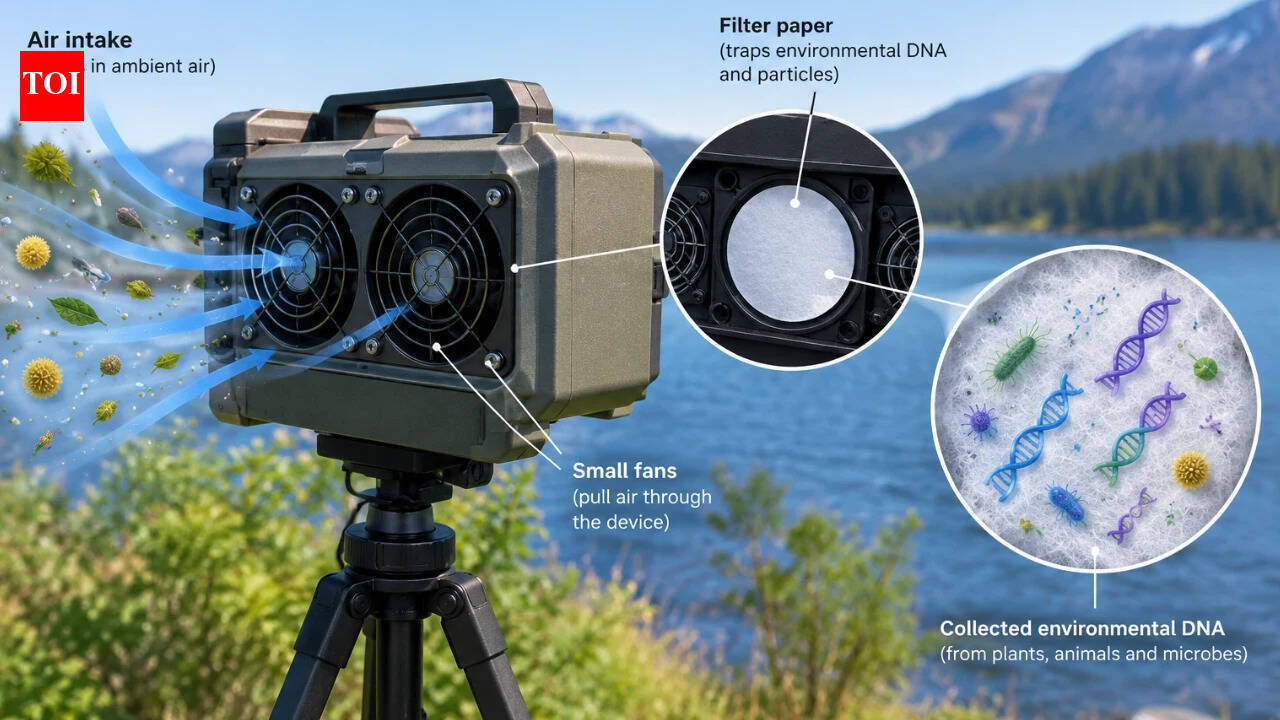
Bailey Quinn Frank, a 15-year-old student from Fort Lauderdale, Florida, won the $25,000 Thermo Fisher Scientific ASCEND Award on October 27. She built a low-cost air sampler using a small fan and filter paper. Her project showed how affordable tools could help rural communities monitor bacteria and potential health threats.
Bailey Quinn Frank, a 15-year-old student from Fort Lauderdale, Florida, has won the top prize at the 2026 Thermo Fisher Scientific Junior Innovators Challenge for developing an inexpensive device that collects airborne bacteria and environmental DNA. She received the $25,000 Thermo Fisher Scientific ASCEND Award for building a sampler using a small fan and filter paper. Her project explores whether affordable air-sampling systems could eventually help rural communities monitor bacteria and potential health threats, particularly in areas where disease surveillance is difficult. The winners were announced on October 27, 2026, at a ceremony in Washington, D.C. Bailey's award reflected her sampler project and her performance in the competition's team challenges, according to Society for Science.
How Bailey Quinn Frank built a low-cost environmental DNA sampler to study airborne bacteria
Bailey's project, titled "Designing an eDNA Sampler To Provide Health Surveillance Through the Detection and Identification of Bacterial Pathogens in Rural Communities," began after she learned about environmental DNA, or eDNA. The term refers to genetic material collected from the environment rather than directly from an organism.
Scientists can analyse these traces to determine which organisms may be present in a particular place. Bailey wanted to investigate whether a sampler made from inexpensive materials could collect airborne DNA and help identify bacteria in communities with limited access to health surveillance. She attached filter paper to small fans so that air would pass through the paper and leave environmental material behind. She collected two indoor air samples and one outdoor sample. She used material collected on the filters to grow bacteria in petri dishes. After a week, she counted the bacterial colonies and attempted to identify them. She also sent selected samples for 16S rRNA sequencing, a method used to identify bacteria. The official Society for Science finalist profile reports that the indoor samples contained more bacterial genera overall and more human-associated bacteria. The outdoor sample included bacteria associated with soil, water, air and plants.
The project is part of a wider area of research into collecting environmental DNA from air. In a 2022 study published in Current Biology, a Danish team used three types of sampling devices at Copenhagen Zoo, including a commercial water-based vacuum and two blower fans fitted with filters. The fan design was described as similar to computer cooling fans. The researchers detected 49 vertebrate species. A separate team working at Hamerton Zoo Park in the United Kingdom used vacuum pumps with filters and detected 25 vertebrate species. Both studies showed that airborne eDNA can be used to identify animals present in an environment. Bailey's project examines a different application: studying bacteria that could be relevant to public health. Her results are an initial investigation, not evidence that the device can identify disease outbreaks or diagnose infections. Although the project title refers to bacterial pathogens, the results described in her finalist profile report bacterial genera and broad associations with different environments, rather than confirming specific disease-causing bacteria. Bailey hopes simple, inexpensive systems like hers could eventually help rural communities monitor bacteria.
Bailey Quinn Frank wins $25,000 ASCEND Award at the 2026 Junior Innovators Challenge
Society for Science and Thermo Fisher Scientific announced Bailey as the winner of the $25,000 Thermo Fisher Scientific ASCEND Award, the competition's top prize. The Society's announcement linked her win to her sampler project and her performance during the finals-week team challenges. The Thermo Fisher Scientific Junior Innovators Challenge is a national STEM competition for middle school students run by Society for Science. The organisation says the program reaches about 60,000 students annually through its Affiliated Fair Network. This year, 30 finalists were selected from nearly 2,000 applicants representing 47 states and five territories. The Society said the finalists collectively received more than $100,000 in awards. Each finalist's school also received a $1,000 grant to support STEM programming.
Students were judged on their research projects and their participation in team challenges testing critical thinking, communication, creativity and collaboration. They used micro processors to design sustainable cities, investigated an outbreak involving multiple illnesses to prioritize patients for care, explored how artificial intelligence could help identify turtle species, and designed protective enclosures for diamondback terrapin eggs. Maya Ajmera, president and chief executive officer of Society for Science, said Bailey's research was an example of how an early interest in science could develop into a lifelong passion. Karen Nelson, chief scientific officer at Thermo Fisher Scientific, said the winners had demonstrated "scientific rigor, personal passion and the character skills to succeed" at a young age.
Other top winners at the 2026 Thermo Fisher Scientific Junior Innovators Challenge
Several other students received major awards for projects addressing wildfire prevention, dementia research and sustainable agriculture. Henry Grover, 14, from Riverside, California, won the $10,000 Broadcom Coding with Commitment Award. Inspired by the 2025 Palisades fire, he and his twin brother Jack investigated whether a water-absorbing hydrogel could help prevent fires from reigniting. They identified sodium polyacrylate as the most promising material and designed a sprayer to apply it to areas at risk of rekindling. Jack Grover received the $10,000 DoW STEM Talent Award for the same project. Myreen Ahsan, 14, from Friendswood, Texas, won the $10,000 Citadel | Citadel Securities Innovation Award. After her grandfather was diagnosed with dementia, she used machine learning to identify molecules that could target tau, a protein that becomes abnormally folded in people with frontotemporal dementia. Of the four molecules she tested, CNS-11 emerged as the most promising candidate for further research.
Wileidy Enid Feliciano-Rivera, 13, from Peñuelas, Puerto Rico, received the $10,000 Lemelson Foundation Award for Invention. She developed a biodegradable mulch using plantain peels collected from her school cafeteria. In tests, the material controlled weeds as effectively as conventional plastic mulch while helping keep the soil cool and moist. The competition also recognized students in its four STEM categories. Seiji Iigaya won the Science Award, Bowen Wang the Technology Award, Andrew Sun-Zhuang the Engineering Award and Isabel Rossi the Mathematics Award. The second-place winners were Lilly Swigert, Rye Lynn Rost, Nathan Gael Montelongo and Ishaan Dokania, respectively. First-place winners received $3,500 educational stipends, while second-place winners received $2,500. The Team Award went to Myreen Ahsan, Ankith Burki, Linden Hunter-Pinsky, Shrikari Punjala and Isabel Rossi. Each received a $200 science-supply gift card. Locklyn Raye Ward received the Thermo Fisher Scientific Leadership Award after being elected by fellow finalists to speak on behalf of the group at the awards ceremony.