
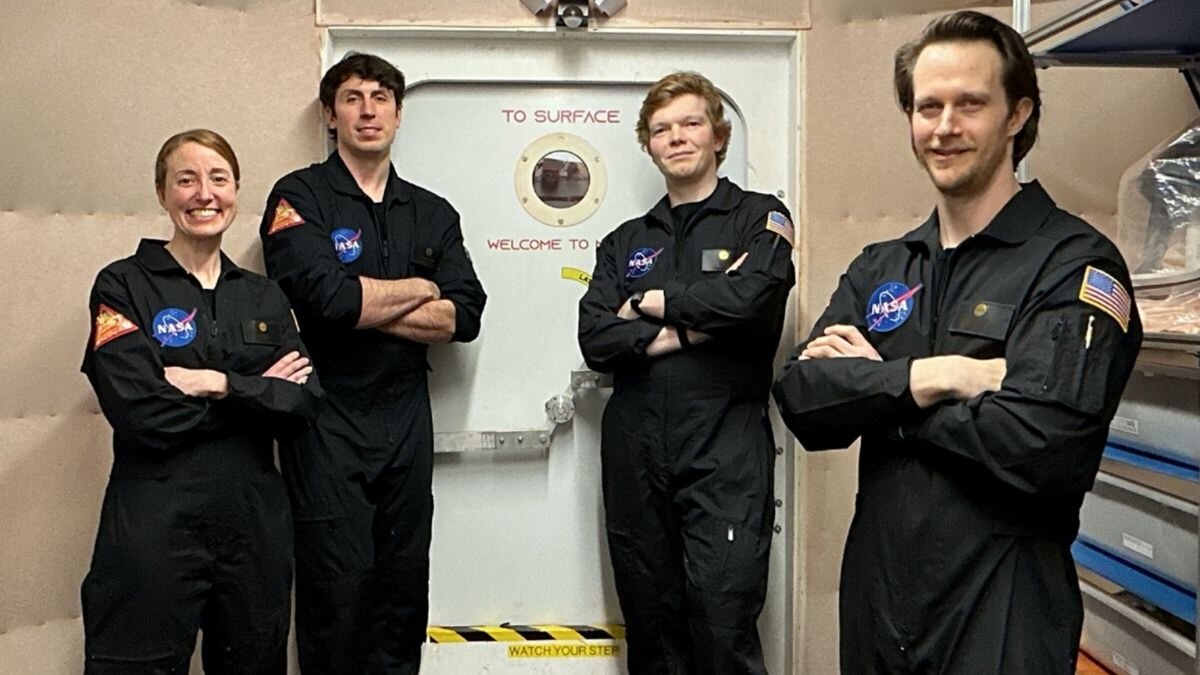
Four volunteers finished 365 days inside a simulated Mars habitat at Nasa’s Johnson Space Center. The crew entered on October 19, 2025, to study how humans survive isolation and resource limits. Grace Douglas said, “We are extremely proud of the crew for their commitment and achievements over the last year.”
Four volunteers have spent the past year living in isolation inside a simulated Mars habitat, growing crops, rationing resources and conducting spacewalk-like activities as Nasa studies what it would take for humans to survive on the Red Planet.
The crew members of Nasa’s Crew Health and Performance Exploration Analog (CHAPEA) Mission 2 have completed 365 days inside a 1,700-square-foot, 3D-printed habitat at the agency’s Johnson Space Center in Houston, Texas.
Their 378-day mission is designed to recreate the challenges of living and working on Mars without leaving Earth.
The crew comprises Ross Elder, mission commander; Ellen Ellis, medical officer; Matthew Montgomery, science officer; and James Spicer, flight engineer. They entered the habitat on October 19, 2025, and are scheduled to emerge on October 31, marking the end of their simulated Martian expedition.
LIFE ON MARS, WITHOUT LEAVING EARTH
During the mission, the crew has followed routines designed to replicate the demands of a future human expedition to Mars. These include growing food, managing limited supplies, carrying out scientific activities and conducting simulated extravehicular activities on a Martian surface.
Communication with the outside world has also been deliberately restricted. The crew has stayed in touch with family members through email, with Mars-like communication delays simulating the time it takes for signals to travel between Earth and Mars.
The experiment aims to understand how isolation, resource constraints and delayed communication affect the physical health, psychological well-being and performance of astronauts during long-duration missions.
“We are extremely proud of the crew for their commitment and achievements over the last year on such a fast-paced, highly demanding mission,” said Grace Douglas, CHAPEA principal investigator.
WHAT NASA HOPES TO LEARN
Nasa scientists will analyse health and performance data collected throughout the mission to determine how astronauts can remain healthy, productive and capable of making decisions independently during extended journeys far from Earth.
The findings could help the agency design food and exercise systems, plan medical and psychological support, and develop decision-making tools for situations in which astronauts cannot immediately consult mission control.
Communication delays between Earth and Mars can reach 45 minutes each way.
Michael Stenger, chief scientist for Nasa’s Human Research Program, said the experiment would help researchers understand the requirements of year-long missions, including medical and psychological care under delayed communications.
After leaving the habitat, the crew will reconnect with their families before undergoing two weeks of post-mission medical evaluations and scientific debriefings.
The findings could inform Nasa’s preparations for future crewed Mars expeditions, as well as sustained human operations on the Moon.
While the experiment cannot reproduce every danger of the Martian environment, it offers researchers a controlled setting to study the human challenges of exploring worlds beyond Earth.