
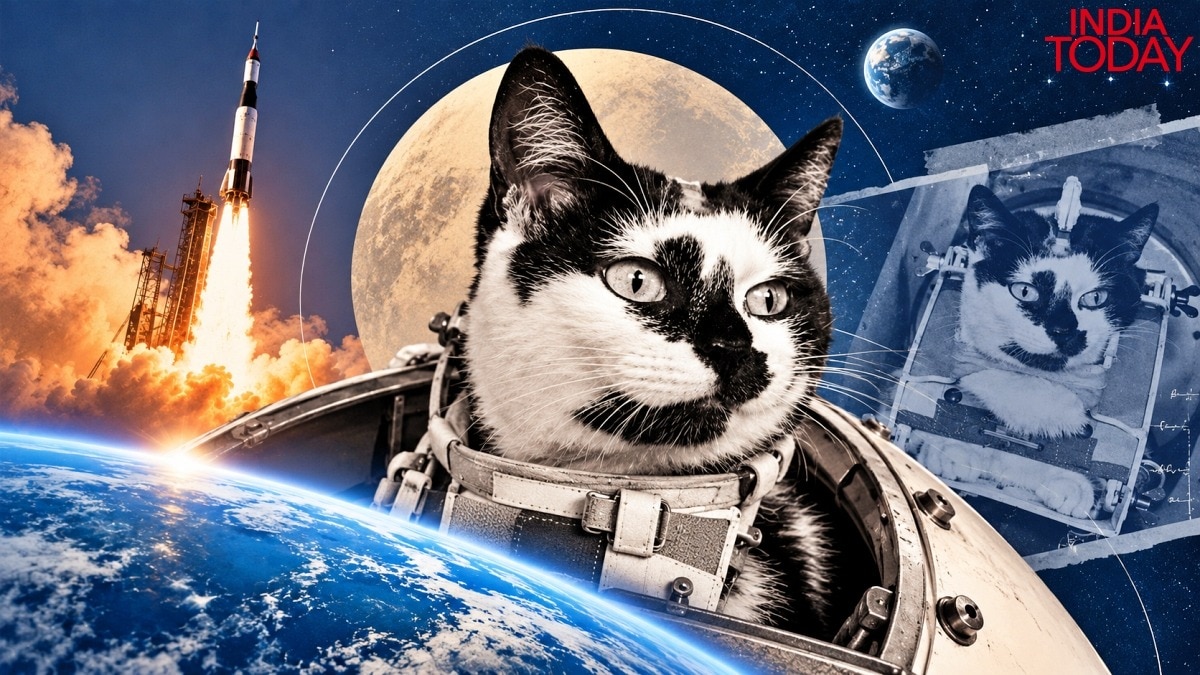
Felicette became the only cat to travel into space and return alive. On October 18, 1963, she launched from the Sahara Desert and reached 157 kilometres. She got back safely, but researchers euthanised her two months later to study her brain. This tragic end marked France's early space research experiment.
Felicette became the only cat to travel into space and return alive. Her later euthanasia marked a tragic end to France's landmark experiment.
On a chilly October morning in 1963, a small black-and-white cat made history by travelling farther from Earth than most humans had ever dreamed of going.
She returned alive, having crossed the boundary of space and experienced a few extraordinary minutes of weightlessness.
But the stray cat, who would later become known as Felicette, could never have imagined that her journey would end in a tragedy back on Earth.
Felicette became the first and, to date, the only cat to travel to space and return alive. Her flight was part of France's early efforts to understand how living organisms respond to spaceflight, at a time when scientists were racing to establish whether humans could safely venture beyond Earth.
FROM THE STREETS OF PARIS TO SPACE
Felicette was reportedly among a group of stray cats collected in Paris for France's space research programme. Scientists selected and trained the animals for the mission, preparing them for the stresses of launch and the unfamiliar conditions of space.
On October 18, 1963, Felicette was launched aboard a Veronique AGI sounding rocket from a site in the Sahara Desert, then part of French Algeria. The rocket carried her to an altitude of around 157 kilometres, taking her beyond the internationally recognised boundary of space.
For approximately five minutes, Felicette experienced weightlessness. Electrodes implanted in her skull transmitted information about her brain activity, allowing researchers to study the neurological effects of the flight.
Her capsule was recovered safely around 13 minutes after launch. Unlike several animals sent on earlier space missions, Felicette survived the journey and returned to Earth.
A SCIENTIFIC MISSION, A TRAGIC ENDING
The mission was conducted during an era when space agencies used animals to investigate the biological risks of spaceflight.
Before humans could undertake longer journeys, scientists needed to understand how launch forces, weightlessness and other conditions affected living bodies.
But Felicette's survival did not mean her story had a happy ending.
Around two months after the flight, she was euthanised so researchers could examine her brain and investigate the effects of the mission. The procedure was intended to provide scientific data, but the experiment did not yield the useful insights researchers had hoped for.
Another cat was launched on October 24, 1963, but that mission ended in failure, and the animal died.
For decades, Felicette received little public recognition compared with other animals that helped pave the way for human spaceflight.
Her legacy has since been revived, including through a bronze statue unveiled at the International Space University in Strasbourg, France, in 2019.
Felicette's journey remains a remarkable and unsettling chapter in the history of space exploration: a stray cat carried into the unknown in humanity's pursuit of knowledge, who survived the journey only to meet a tragic fate back on Earth.