
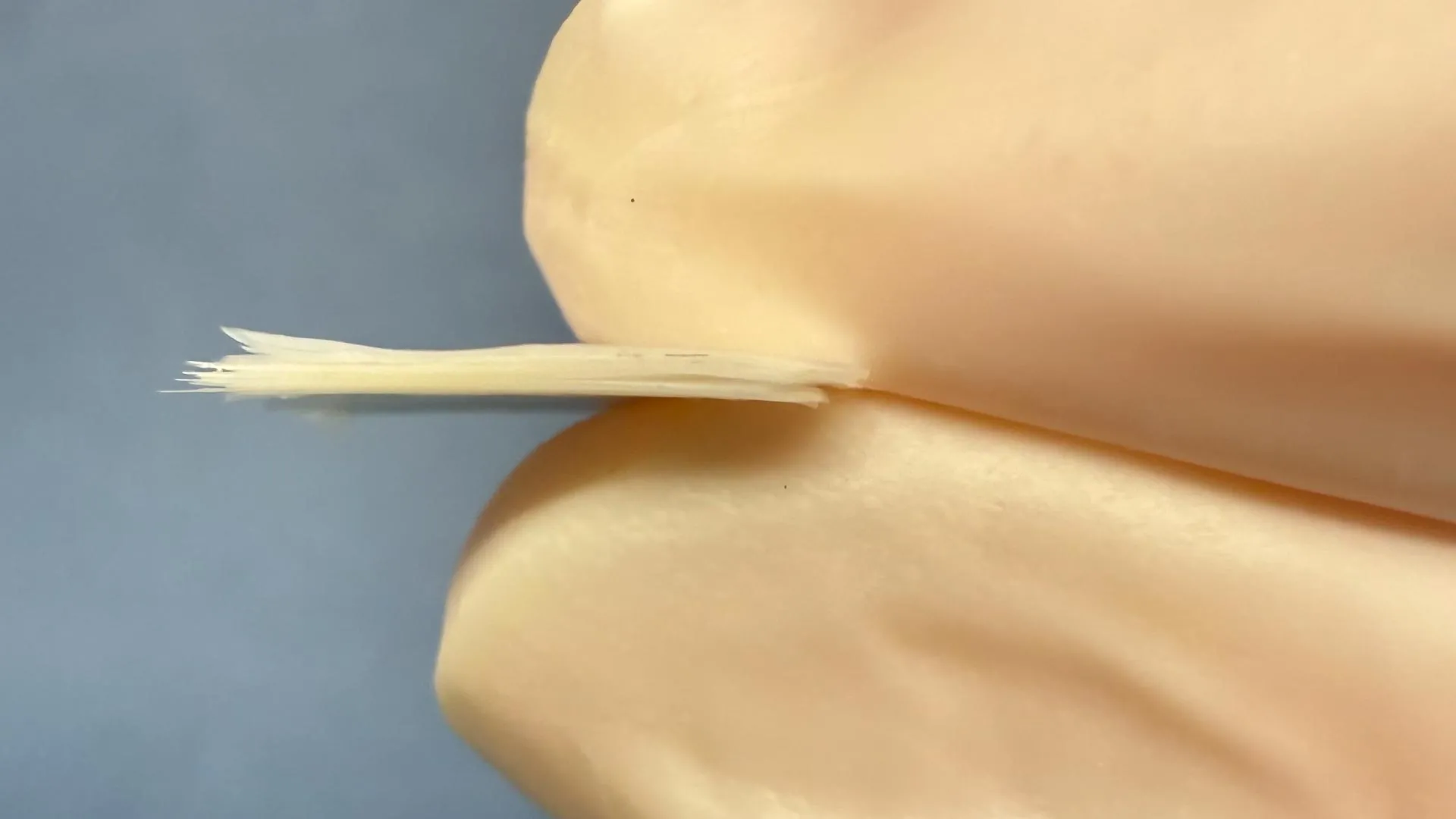
Researchers at the University of Pennsylvania found that Mylar, used in emergency blankets, could help build Moon bases. The team created hybrid layered insulating film stacks that stay effective under pressure. Igor Bargatin said, "These stacks of Mylar can bend, withstand substantial compression and maintain their insulating performance," helping future missions.
Materials used in lunar construction must also survive transportation, installation, accidental impacts, and years of handling. Many of the best insulators are surprisingly delicate, making them poorly suited to the demanding conditions of a working Moon base.
Researchers at the University of Pennsylvania may have found an answer in an unexpectedly familiar material: Mylar. This lightweight plastic is used in everyday products such as food wrap and, when coated with aluminum, the reflective emergency blankets that help marathon runners retain body heat. By arranging hundreds of extremely thin Mylar sheets into carefully designed stacks, the team has created insulation that remains effective even after being bent or subjected to intense pressure.
The research, published in ACS Applied Materials & Interfaces, introduces a material known as hybrid layered insulating film stacks (HyLIFS). Its main advantage is the ability to combine two qualities that are difficult to achieve together: excellent thermal insulation and resistance to physical damage.
"These stacks of Mylar can bend, withstand substantial compression and maintain their insulating performance," says senior author Igor Bargatin, Associate Professor in Mechanical Engineering and Applied Mechanics (MEAM), "potentially allowing them to be packed, transported and survive rough treatment over many years of use."
If engineers can eventually manufacture the material on a large scale, it could be used to protect lunar habitats, spacesuits, and other equipment designed to function for extended periods in the vacuum of space.
"The combination of thermal and mechanical robustness is critical for long-term use on the Moon," notes first author Danielle R. Levin, a recent Penn doctoral graduate in chemistry, who also received a master's in MEAM. "This material could open a pathway to inexpensive, durable and reusable lunar insulation."
Why Moon Bases Need Tougher Insulation
Designing insulation for the Moon involves a difficult balancing act. A material must slow the movement of heat through a vacuum while also remaining strong enough to withstand the stresses of everyday use.
Some existing materials are outstanding at preventing heat transfer but offer little protection against physical damage. Aerogels, for instance, consist mostly of empty space, which makes them extremely lightweight and effective at retaining heat. They have been used in applications ranging from industrial pipelines to NASA's Mars rovers. However, their delicate internal structure can make them vulnerable to impacts and compression.
Another widely used space technology, multilayer insulation, relies on reflective sheets separated by insulating spacers. It works particularly well at reducing heat transfer through radiation, but it is not intended to support substantial weight. Even routine contact can cause tearing or other damage.
Strengthening insulation often creates another problem: the changes that make it more durable can also allow more heat to pass through. For future lunar infrastructure, engineers need a material that can resist damage without sacrificing thermal performance.
"For lunar infrastructure, we would ideally like both," says Bargatin. "The ideal material is both resistant to damage and to the loss of heat."
How Ordinary Mylar Became Powerful Space Insulation
The Penn researchers focused on Mylar, a well-known plastic formally called biaxially oriented polyethylene terephthalate, or BoPET. Already used extensively in aerospace technology, the polymer is also found in the lightweight emergency blankets distributed after marathons. Adding a metallic coating such as aluminum allows Mylar to reflect infrared radiation, helping prevent heat from escaping.
Rather than relying on a single sheet, the researchers investigated what would happen if many thin layers were stacked together. They experimented with different film thicknesses and applied extremely thin coatings of aluminum oxide, also called alumina, to some samples to make the sheets stiffer.
Assembling the experimental stacks was surprisingly difficult. Each delicate film had to be positioned individually, requiring painstaking manual work.
"At the moment, the process is very time-consuming," says Levin. "We use two pairs of tweezers and small weights to handle and stack the delicate films. Even breathing near the stack can send the layers flying."
Despite the simplicity of the basic idea, testing revealed an impressive combination of properties. In a vacuum, the best stacks achieved thermal conductivity comparable to other advanced vacuum insulation materials while retaining their flexibility.
The researchers also tested the material under compression similar to what insulation could experience inside a lunar habitat, where the interior air pressure would push against walls exposed to the vacuum outside.
Crushing Pressure Reveals Unexpected Durability
One of the most striking findings came when the team subjected the material to repeated compression. Even the researchers were surprised by how well the thin plastic layers held up.
The samples were compressed to approximately 20 megapascals, a pressure comparable to concentrating 200 pounds of force onto an area the size of a fingertip. Instead of testing the material only once, the researchers repeated the process 10 times.
"We were concerned about the material failing under such high compressive stress," recalls Levin. "But the stacks didn't survive just one high stress cycle -- they survived 10 in a row."
This resistance to damage could be especially valuable for lunar exploration. Every piece of equipment needed on the Moon must first endure the challenges of being packed, launched, transported, and installed. Insulation that can bend, withstand pressure, and potentially be reused would offer significant practical advantages.
Durability would remain important after construction is complete. Astronauts living and working inside a lunar habitat could accidentally strike or compress insulation during maintenance or ordinary activities.
"You could use these stacks to insulate a lunar habitation, but astronauts will inevitably have little accidents where they bump into them," notes Bargatin. "When we're talking about long-term habitation on the moon, it's really important to have tough materials that can last long enough."
Tiny Particles Reveal a Hidden Secret of Heat Transfer
Beyond demonstrating the material's durability, the experiments uncovered an important clue about how heat travels through layers of Mylar.
The discovery involved microscopic particles already present in commercially manufactured plastic films. Extremely thin sheets naturally tend to stick to one another and to nearby surfaces, which complicates manufacturing and handling. To prevent this, producers add tiny "antiblocking" particles that extend slightly above the plastic surface and keep neighboring sheets from clinging together.
Although manufacturers have long understood why these particles are useful, their influence on heat transfer in stacked Mylar films had received relatively little attention.
Traditional multilayer space insulation is primarily designed to control heat transferred by radiation. As a result, researchers have had less reason to investigate how small points of physical contact between films might affect heat conduction.
The Penn team examined this possibility by constructing mathematical models of heat transfer between individual layers and comparing the predictions with laboratory measurements.
The findings indicate that, in a vacuum, much of the heat moving from one Mylar sheet to the next passes through the tiny contact points created by the antiblocking particles.
That result could have important implications for future insulation design. Instead of accepting the particles as an incidental feature of commercial plastic, engineers might deliberately control their size, abundance, and placement to reduce unwanted heat transfer.
Why Thinner Plastic Does Not Always Insulate Better
The role of these microscopic particles also helped explain another unexpected result.
At first, the researchers assumed that thinner Mylar sheets would produce better insulation. Using thinner films would allow more layers to occupy the same amount of space, increasing the number of boundaries that heat must cross.
However, the experiments did not fully support that expectation. When coated with alumina, the thinnest films the team successfully characterized provided thermal performance similar to films of medium thickness.
The researchers suspect that the antiblocking particles help explain why. In thinner sheets, the particles can produce more contact between adjacent layers, creating additional routes for heat to move through the material. Those extra contact points can offset the expected advantages of adding more layers.
The finding suggests that making films thinner is not automatically the best approach. Engineers must also consider how the sheets bend and deform under pressure, along with the number and arrangement of microscopic contact points.
"As you compress the layers, the contact landscape changes," says Levin. "It's not just a matter of minimizing the film thickness or the number of particles; we must also account for how the contacts change and the films deform as pressure increases."
Ultimately, the ability of these stacks to limit heat transfer depends on several interacting factors, including the thickness and stiffness of the plastic and the distribution of particles within it.
From Tiny Laboratory Samples to Future Moon Bases
Although the early results are encouraging, the new insulation is still far from being ready for lunar construction.
The experimental HyLIFS samples currently measure only about one square centimeter, and producing them requires hours of careful cutting and manual stacking. That painstaking process would be impractical for manufacturing the large sheets needed to insulate an entire habitat.
To make the material useful on a larger scale, the researchers will need a more efficient production method. One possibility involves continuously applying coatings to large rolls of Mylar, using manufacturing techniques that could eventually produce sheets measured in meters rather than centimeters.
Such an approach might also allow engineers to adjust the thickness of the plastic, the protective coatings, and the distribution of antiblocking particles before assembling the material into larger stacks.
Important questions remain. The researchers still need to determine whether large versions of the material will retain the same insulating properties and mechanical strength seen in the laboratory. Further testing must also establish how well the stacks tolerate repeated bending, accidental impacts, scratches, and other wear associated with real-world use.
If those challenges can be overcome, the technology could provide lightweight, flexible, durable insulation for lunar habitats, rovers, electronic equipment, and other systems operating in space.
For Levin, the results also offer a broader lesson about materials engineering. Even familiar products can reveal unexpected capabilities when researchers examine how their structures behave under different conditions.
"The simplest configuration ended up being the best one," she says.
The research was carried out at the University of Pennsylvania School of Engineering and Applied Science (Penn Engineering). Additional co-authors include Matthew F. Campbell, Gulzhan Aldan, and Orevaoghene H. Omodior.
Funding was provided by the National Science Foundation Division of Chemical, Bioengineering, Environmental and Transport Systems (grant number 1845933) and Penn Engineering.