
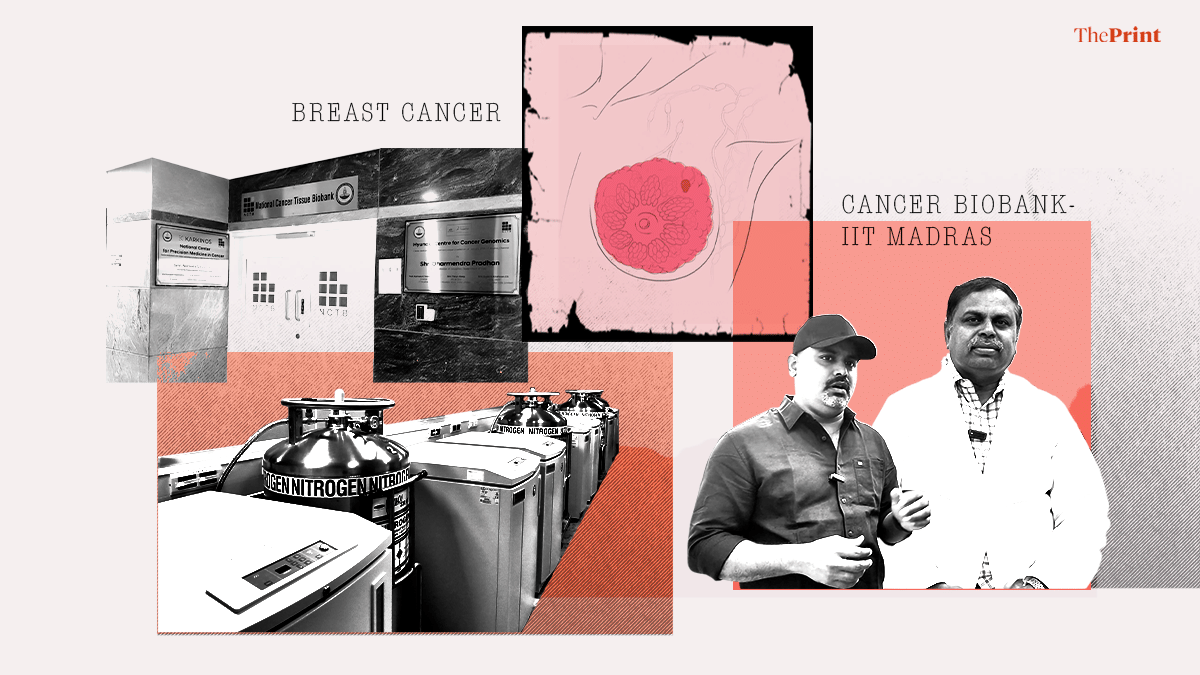
Researchers at IIT Madras are developing an mRNA-based breast cancer vaccine using samples from the National Cancer Tissue Biobank, established in 2015. Professor Mahalingam said, "We have identified tumour antigens that have never been reported in other population datasets." The team now plans to test the vaccine in mice.
This is the National Cancer Tissue Biobank (NCTB), established at IIT Madras in 2015. Biobanks are organised repositories that collect and preserve biological samples, such as tumour tissue, blood and DNA, along with patients' medical records, so researchers can use them for future studies.
A decade later, researchers are using the samples collected at NCTB to develop an experimental messenger RNA (mRNA)-based vaccine for breast cancer. An mRNA vaccine gives cells instructions to make a specific protein that trains the immune system to recognise and fight a target. Unlike traditional vaccines, it does not contain a live or weakened virus.
"We have identified tumour antigens that have never been reported in other population datasets," Professor Mahalingam told ThePrint. "We have also identified tumour antigens that have already been reported."
Mahalingam explained that tumour antigens are proteins, or parts of proteins, that the immune system can recognise. Some arise when mutations change the proteins produced by cancer cells. "Mutations can alter the proteins produced by cancer cells, creating what we call new antigens," he said.
Mahalingam's team is developing an mRNA vaccine construct using selected antigens identified through their research on Indian tumour samples.
The technology to develop mRNA vaccines is already established, having been used in Covid-19 vaccines. Such vaccines carry genetic instructions that prompt cells to produce a selected protein or protein fragment. For a cancer vaccine, the aim is to train the immune system to recognise chosen tumour antigens and mount a response against cancer cells carrying them.
The unique aspect of the IIT Madras project is its focus on antigens identified in Indian patients. Whether these targets can produce a useful immune response against breast cancer, however, remains to be established.
"We cannot reveal the sequence because we are right now developing the mRNA vaccine for that," Professor Mahalingam said, adding that the team had applied for a patent.
The researchers are completing the vaccine construct and preparing to test it in a mouse model of breast cancer. Human trials would be considered if further research supports taking the candidate forward.
The work is part of a broader effort to understand the genetic landscape of cancer in Indian patients. India recorded around 1.56 million new cancer cases and about 9 lakh cancer deaths in 2024, according to the International Agency for Research on Cancer's latest GLOBOCAN estimates. Breast cancer was the most commonly diagnosed cancer, with about 2.37 lakh cases, up from 1.92 lakh cases and 98,337 deaths in 2022.
The problem with studying cancer without Indian samples
The idea for the biobank began in 2013, when Professor Mahalingam needed primary cancer tissue samples to validate findings from his laboratory experiments. He struggled to find a repository from which researchers could obtain tissue for such work.
"In this country, we have so many cancer patients and so many cancer researchers," he said. "But there is no publicly available biorepository that can help the researcher to provide the cancer tissue."
He approached the Department of Science and Technology, which funded the initiative. The biobank began in 2015 with two hospitals and has since expanded its network to more than 12 hospitals. Mahalingam said that samples have been collected from across the country, with around 50-60 percent coming from outside Tamil Nadu.
The repository holds samples from patients with different cancers, including breast, gastrointestinal and liver cancers, as well as leukaemia. For some patients, particularly children with leukaemia, samples are collected at different stages of treatment, allowing researchers to track changes in the disease over time.
Professor Mahalingam said the need for such a resource becomes clear when researchers compare patients who appear to have similar cancers but respond differently to treatment.
He described 10 breast cancer patients of similar ages and with the same tumour type who received the same chemotherapy. Some responded to the treatment, while others did not.
"This means there is a difference in the genetic or genomic variations," he said.
Researchers need to investigate whether such differences are associated with how a tumour develops or responds to treatment, and whether they point to potential therapeutic targets. Findings from Western populations may not capture every genetic variation present in Indian patients.
Cancer drugs and treatments are often developed and evaluated using evidence from patient populations in which people of European ancestry have historically been overrepresented in genomic research. This can leave genetic variations found in Indian patients under-represented in the evidence used to understand how tumours develop and respond to treatment.
"We have to understand what is the genomic landscape of our own population," Professor Mahalingam said.
He cited BRCA1 and BRCA2, two genes linked to an inherited risk of breast and ovarian cancers. Changes, or mutations, in these genes can increase a person's risk of developing these cancers.
The team analysed around 1,000 breast cancer samples and found mutations in these genes in roughly 4 percent of patients, which is less than figures reported globally.
The researchers have also found differences in other genes, including RECQL1, which is involved in repairing damaged DNA. Mahalingam said a particular genetic variation in this gene was found in about 3.6 to 3.9 percent of a specific Indian population, compared with less than 1 percent in some other datasets. Researchers are still investigating what this difference means for patients.
By studying these genetic differences, researchers hope to understand why some patients respond differently to the same cancer treatment.
From preserving tumour tissue to decoding its genetic makeup
Collecting cancer tissue is only the first step. Researchers must preserve the samples, extract genetic material, sequence it and analyse the resulting data to identify changes that may help explain how a tumour develops or responds to treatment.
At NCTB, tumour tissue is stored in liquid nitrogen tanks at around minus 196 degrees Celsius to preserve it for future research. The facility's seven such tanks each have a capacity of around 13,000 vials. Researchers also use freezers maintained at minus 80 degrees Celsius to store blood components, including plasma and peripheral blood mononuclear cells (PBMCs), as well as DNA and RNA extracted from tumour tissue.
Dr John Peter, a senior scientist at the NCTB, explained that tissue processing and the extraction of genetic material take place inside the biobank's laboratory. This helps minimise contamination before the extracted material is taken to a sequencing laboratory for analysis.
The next step is to examine the genetic material. Whole-genome sequencing reads genetic information across the genome, while whole-exome sequencing focuses on the portions of DNA that contain instructions for making proteins. RNA sequencing helps researchers study which genes are active in a sample.
A single sequencing run can generate between 1.5 and 3 terabytes of data, Dr Peter said. "This information must be stored and processed using high-capacity computer systems before we can identify genetic variations and compare them across patients."
Comparing a tumour sample with unaffected tissue or blood from the same patient can help researchers distinguish mutations acquired by cancer cells from genetic variations a person was born with. Blood samples can also help researchers study inherited variations that may be associated with cancer risk.
For some cancers, researchers analyse samples collected at different stages of treatment. In leukaemia, for instance, comparing samples over time can help them track changes in the cancer's genetic profile and investigate why a treatment works for some patients but not others.
Such studies could eventually help researchers identify genetic changes associated with how patients respond to particular cancer drugs. Professor Mahalingam said that if repeated studies show that patients with a particular genetic variation are less likely to respond to a drug, researchers could investigate whether that variation could help identify those who may not benefit from the treatment.
However, the association would need further validation before it could be used to predict an individual patient's response.
The physical samples stored at the biobank also feed into a wider effort to build a digital resource of cancer genetics. The Bharat Cancer Genome Atlas (BCGA), developed with healthcare company Karkinos Healthcare and launched in 2024, brings together genomic information from different cancers.
Professor Mahalingam said the atlas contains close to 2,000 genomic profiles across breast cancer, leukaemia, pancreatic cancer and colon cancer. The team has sequenced more than 3,000 samples, he said, with additional data yet to be added.
Not all the information is publicly accessible. Researchers can access mutation-profile information, while access to raw genomic data and personal information is restricted. Those seeking physical tissue samples must also obtain the required ethical approvals, Mahalingam said.
The cost of building evidence
The biobank and genome atlas depend on infrastructure that is expensive to establish and maintain.
The National Cancer Tissue Biobank at IIT Madras was established with Rs 27.81 crore in funding from the Department of Science and Technology, and an additional Rs 3.9 crore from IIT Madras, taking the total establishment funding to Rs 31.71 crore. Designed to store up to 25,000 cancer tissue samples, the facility requires specialised infrastructure and equipment for sample storage and analysis.
The logistics are challenging. Some tissue samples are stored in liquid nitrogen at around minus 80 degrees Celsius, while others are preserved in formalin, a preserving liquid, and embedded in paraffin, a solid wax. The latter can be cut into thin sections and examined under a microscope.
Sequencing adds another layer of cost. The resulting data require dedicated storage and computing systems, as well as researchers who can analyse the information.
Professor Mahalingam estimated that whole-genome sequencing costs close to Rs 1 lakh per sample.
The team is also developing patient-derived tumour organoids, three-dimensional models grown from a patient's cancer tissue. He said the team had established models for liver cancer and was working on breast and pancreatic cancer models.
These organoids, he explained, could allow testing of how tissue derived from a patient's tumour responds to different drugs in the laboratory. "You can test everything in vitro on the same patient tissue," Mahalingam said. "Then you can go ahead with treatment. This is called personalised medicine."
This remains a research goal for now. The team, he said, is analysing additional samples and plans to expand the genomic database as more data become available.
Around 60 people per lakh population in India are affected by cancer, as the country's cancer burden continues to grow. As per the Indian Council of Medical Research (ICMR), the estimated number of incidences of cancer cases was over 14 lakhs in 2023 in India.
"The scale of the problem is definitely huge," he said.
He added that more institutions across India need to establish biobanks and sequencing facilities so researchers can build a broader picture of cancers across the country's different populations.
A repository drawing heavily from one region cannot, on its own, establish how common a genetic variation is across India. Currently, India has less than 10 cancer-specific biobanks. The shortage comes as India's cancer burden continues to rise. According to the Global Burden of Disease study, the country's age-standardised cancer incidence increased from 84.8 cases per 100,000 people in 1990 to 107.2 per 100,000 in 2023, marking a 26.4 per cent increase.
Mahalingam said collaboration between hospitals, research institutions and engineering institutes is important to this work. "There has to be more public investment."
He recalled that colleagues had cautioned him when he first proposed setting up the biobank, warning that the project would be difficult to establish and maintain. "But somebody has to do it..." he said. "Why not me?"
This reporter visited IIT Madras on an invitation from the institution.