
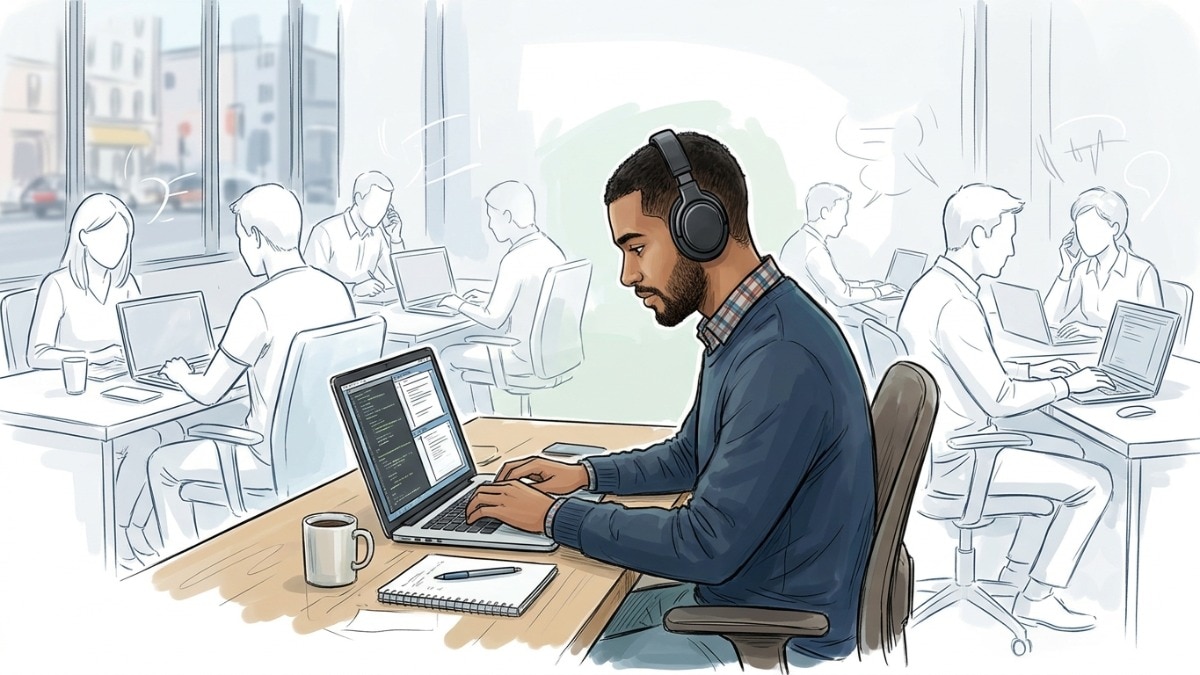
A 2019 study showed that 32% of workers in open-plan offices used headphones to block out noise. Many employees now use earphones as a polite way to say, “Please don't disturb me.” These devices help people focus on tasks while creating personal space amidst the chatter of a busy office.
Earphones. My teammates, my boss, and even my super boss have one question for me: Why do I have them on all the time?
Honestly, I don't have a straightforward answer. For me, music makes it easier to concentrate while writing, editing and working through my daily tasks. A familiar playlist in the background helps me settle into a rhythm, block out the office chatter, and get things done. And sometimes, let's be honest, those earphones also serve another purpose: they are my polite, unspoken way of saying, “Please don't disturb me. I'm working right now.”
And I know I'm not alone. Walk around an office today, and you'll find people tapping away at their keyboards with earphones tucked into their ears, switching between spreadsheets, emails, and stories, all with a personal soundtrack playing in the background.
For some, it's a productivity tool. For others, it's a mood-lifter or simply a way to carve out a little personal space in a busy workplace. It makes you wonder: Have earphones quietly become the new do-not-disturb sign at work?
WHEN OFFICE CHATTER BECOMES BACKGROUND NOISE
Open-plan offices may encourage collaboration, but they also come with their fair share of distractions. There are conversations happening across desks, phones ringing, colleagues discussing lunch plans and the occasional meeting that everyone within a five-metre radius can hear.
A 2019 study published in the International Journal of Environmental Research and Public Health examined responses from 1,078 workers in shared and open-plan offices. It found that irrelevant speech noise, including conversations, telephone calls, and laughter, was associated with greater annoyance and lower perceived work performance.
Interestingly, headphones were among the ways employees tried to manage the noise. The study found that 32% of workers in open-plan offices used headphones with music or noise-cancelling features to cope with it, compared with 22% in shared offices.
So, the next time someone puts on their earphones before opening a laptop, they might not necessarily be avoiding their colleagues. They could simply be trying to create a quieter environment in which to work.
A PLAYLIST FOR PRODUCTIVITY, PLEASE
The connection between music and work is not just anecdotal. Researchers have also explored why employees choose to listen to music during the working day.
In a 2011 study published in Musicae Scientiae, researcher Anneli B. Haake surveyed 295 office employees in the UK about their music-listening habits. The findings suggested that employees listened to music for roughly a third of their working week.
Their reasons went beyond entertainment. Music helped with concentration, inspiration, stress relief, and the management of personal space. Some employees also used it to distance themselves from their office surroundings.
That last point sounds particularly familiar. In a busy workplace, putting on earphones can offer a sense of control over one's immediate environment, even when finding a quiet corner or an empty meeting room isn't an option.
BUT DOES MUSIC ACTUALLY HELP US WORK BETTER?
Before we declare earphones the ultimate productivity hack, there is a small catch: music does not work equally well for everyone or every task.
A study published in the Journal of Applied Psychology in 2025, titled Too Much of a Good Thing? A Multilevel Examination of Listening to Music at Work, examined the relationship between music listening, attention, and task performance across three studies.
The researchers found some evidence of an inverted U-shaped relationship between time spent listening to music and performance. In simple terms, music may help up to a point, but listening for longer does not automatically mean getting more work done.
The research also examined how individual beliefs about willpower influenced attention. Its findings suggest that the relationship between music and performance is more complicated than simply putting on a playlist and expecting productivity to rise.
This makes sense in everyday office life, too. Instrumental music might help someone settle into writing, while a song with catchy lyrics could become an unwanted distraction when they are trying to draft a complicated report. The ideal soundtrack, it seems, depends on the person, the task and the moment.
A LITTLE MUSIC, A LITTLE WORKPLACE ETIQUETTE
Of course, earphones can send mixed signals. One colleague might be listening to music to concentrate, another might be trying to drown out the office noise, and someone else might simply be enjoying a favourite album while finishing routine tasks.
The challenge is making sure that the pursuit of personal space does not come at the cost of communication. Teams can help by agreeing on when uninterrupted work is needed and when colleagues should remain available for conversations, meetings and urgent requests.
Perhaps managers, too, could recognise that not every pair of earphones signals disengagement. Sometimes, it is simply an employee finding a way to focus in a busy environment.
As for me, I might not have a scientific explanation ready every time someone asks why my earphones are on. But between the music, the concentration, and the occasional silent request for uninterrupted work, I think I have my answer.
The modern office do-not-disturb sign doesn't always hang on a door. Sometimes, it comes with ear cushions and a favourite playlist.