
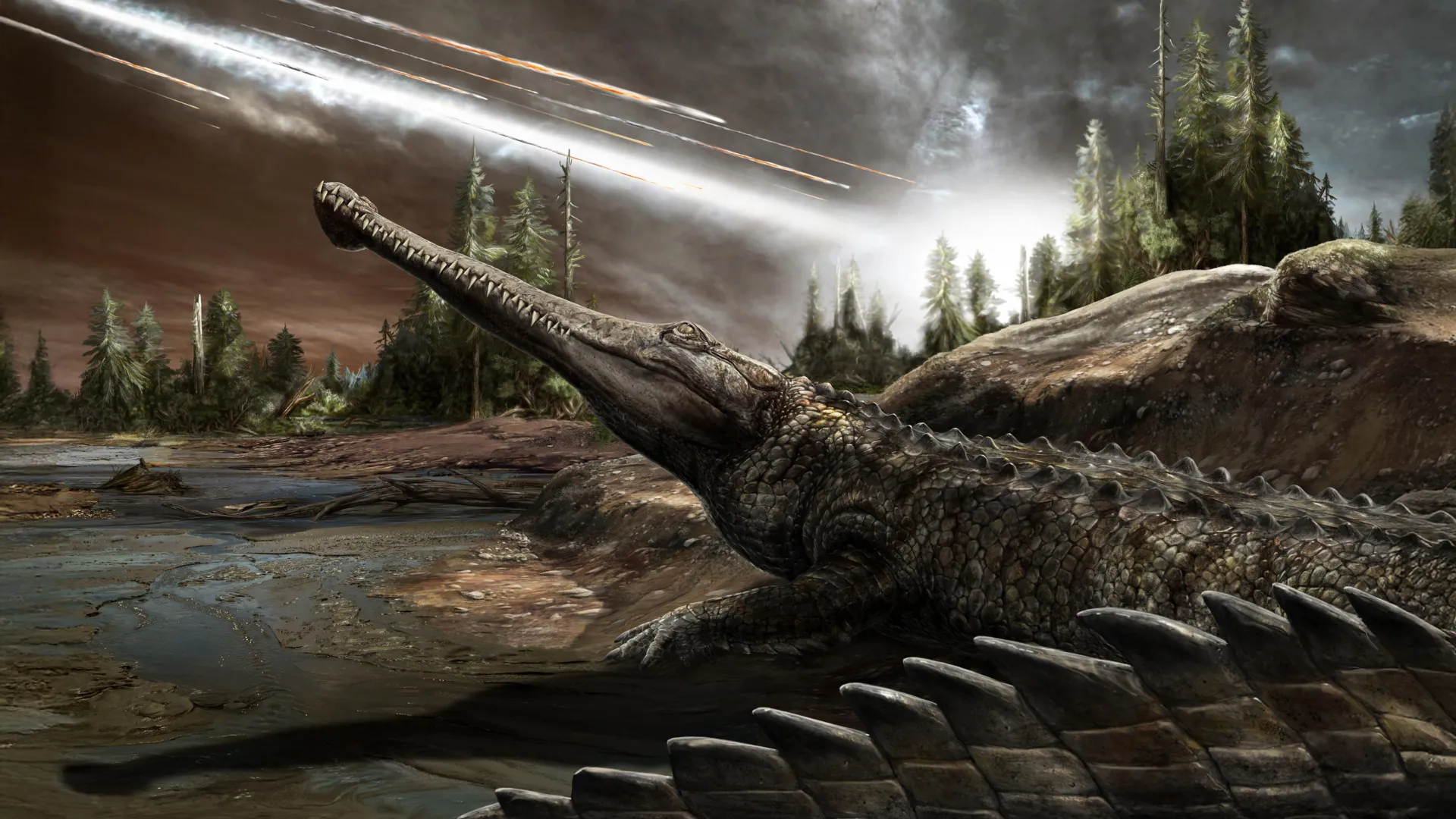
Scientists at UCL found that crocodiles survived the asteroid impact 66 million years ago by staying in warm tropical regions. Lead author Dr. Alfio Alessandro Chiarenza said, "The asteroid did not make the whole planet equally hostile to every group." These warm areas helped them recover while many dinosaurs died.
Scientists led by UCL (University College London) found that crocodiles and their ancient relatives spent much of their 250 million years of evolutionary history following warm climates rather than adapting to dramatically different temperatures. When Earth grew hotter, they expanded into new regions, sometimes reaching as far as Antarctica. As temperatures fell, they moved back toward the tropics.
Published in Science Advances, the study analyzed more than 7,000 fossils and records from over 400 living and extinct species. Researchers combined this evidence with computer models that reconstructed Earth's climate and geography across 245 million years.
The results suggest that tropical and subtropical regions remained suitable for crocodile relatives after the asteroid struck, even as the environments available to many dinosaurs deteriorated. Only the most extreme climate simulations eliminated these potential refuges.
Why Crocodiles Survived the Dinosaur Extinction
The researchers examined how conditions on Earth may have changed following the asteroid impact 66 million years ago. Their simulations indicated that areas near the equator could have remained warm enough to support crocodile relatives, providing places where surviving populations could persist and eventually recover.
Previous modeling by members of the same research team found that suitable habitats for non-avian dinosaurs (i.e., the ones that went extinct) contracted much more severely after the impact.
Lead author Dr. Alfio Alessandro Chiarenza, based at UCL Earth Sciences, said: "The asteroid did not make the whole planet equally hostile to every group.
"Crocodiles' long-standing preference for warm environments may have placed survivors exactly where suitable climates held up best, like around the equator. These refuges could have sheltered populations that later recovered and radiated out."
The discovery offers a possible explanation for how a group of animals that appeared around the same time as dinosaurs managed to endure two of Earth's five major mass extinctions.
Ancient Crocodiles Were Far More Diverse
Modern crocodiles and their close relatives share many recognizable features, but their evolutionary history reveals a much wider variety of body shapes, sizes, and lifestyles.
The broader crocodile lineage, known as pseudosuchians, once included heavily armored plant eaters, predators that hunted entirely on land, and enormous animals weighing more than a metric ton.
Among the most remarkable was Sarcosuchus, a giant predator nicknamed the "super croc" that could reach 12 meters in length. Another prehistoric relative, Postosuchus, was a land dwelling hunter capable of moving on either two legs or all four.
Dr. Chiarenza said: "Crocodiles are often called living fossils, but their ancestors and relatives changed enormously throughout their history, ranging from giants the size of a bus that could have devoured a T. rex, to small, cute animals with the face of a pug.
"Our study shows that, despite all this diversity, what stayed surprisingly consistent was their relationship with climate."
Fossils Reveal 245 Million Years of Climate History
To investigate that relationship, the scientists reconstructed the temperature and rainfall preferences of 400 crocodile species and their ancient relatives. They used fossil evidence, evolutionary family trees, and detailed maps of where living crocodile species are found today.
The team then compared these preferences with reconstructions of ancient geography and climate to identify where suitable habitats existed at different points in Earth's history.
A clear pattern emerged. Crocodile relatives generally followed warmer conditions as the planet's climate changed, expanding their ranges during hot periods and retreating when temperatures cooled.
About 50 million years ago, during the particularly warm early Eocene, global temperatures were approximately 10°C higher than today, and the polar regions had no permanent ice. Crocodile relatives lived at high latitudes across North America, Europe, and even Antarctica.
Over the following millions of years, global cooling gradually reduced the areas where they could thrive. Their geographic range contracted toward warmer tropical regions.
Two Surprising Exceptions
Although this preference for warm environments remained remarkably consistent, the researchers identified two important exceptions.
During the Cretaceous Thermal Maximum, approximately 94 million years ago, global temperatures climbed as much as 14°C above modern levels. One branch of the crocodile family tree evolved the ability to tolerate hotter conditions than the broader lineage could withstand at other times.
A separate adaptation occurred around 34 million years ago in Australia. As a prolonged cooling period reduced rainfall and dried out the continent, an extinct group of crocodiles adapted to increasingly arid, desert-like environments.
These exceptions show that some crocodile relatives could evolve to handle different climates, even though most continued to follow their preferred warm conditions.
What Happened After the Dinosaur-Killing Asteroid?
The researchers also used climate simulations to investigate the decades and centuries immediately following the Chicxulub asteroid impact, which triggered the extinction of most dinosaurs.
They explored several possible environmental consequences, including sunlight being blocked by dust and ash and rising carbon dioxide levels associated with volcanic eruptions.
When the simulations reduced sunlight by 5% or 10%, warm regions near the equator remained suitable for crocodile relatives. These areas could have provided critical refuges during the environmental disruption.
However, a more severe scenario involving a 15% reduction in sunlight left those regions unsuitable as well. The researchers noted that this extreme level of reduced sunlight is now considered unlikely.
Other simulated changes, including increased atmospheric carbon dioxide, did not alter the availability of suitable climates for crocodiles.
Together, the results suggest that crocodiles may have benefited from living in regions where temperatures remained within their preferred range, even as conditions became much less favorable for many dinosaurs.
The Survival Strategy That Could Now Become a Weakness
The researchers emphasized that favorable temperatures were probably only one reason crocodiles survived the mass extinction.
Other characteristics likely improved their chances, including relatively small body sizes, the ability to live partly in water, flexible diets, and modest energy requirements. As ectothermic ("cold-blooded") animals, crocodiles need less food to maintain their bodies than many animals that generate their own body heat.
The findings also raise important questions about how crocodiles will respond to modern climate change.
For millions of years, moving into regions with suitable temperatures appears to have been one of their main responses to a changing planet. Today, however, expanding cities, agricultural land, and roads increasingly limit where wildlife can move.
Professor Philip Mannion, based at UCL Earth Sciences, said: "These findings have implications for species today. If crocodiles mostly coped with past climate change by moving towards suitable habitats, today's species will need room to move as the planet warms, and the loss of suitable areas to roads, farms and cities is making that harder."
The research was funded by The Royal Society, the Leverhulme Trust, and the National Environment Research Council (NERC).