
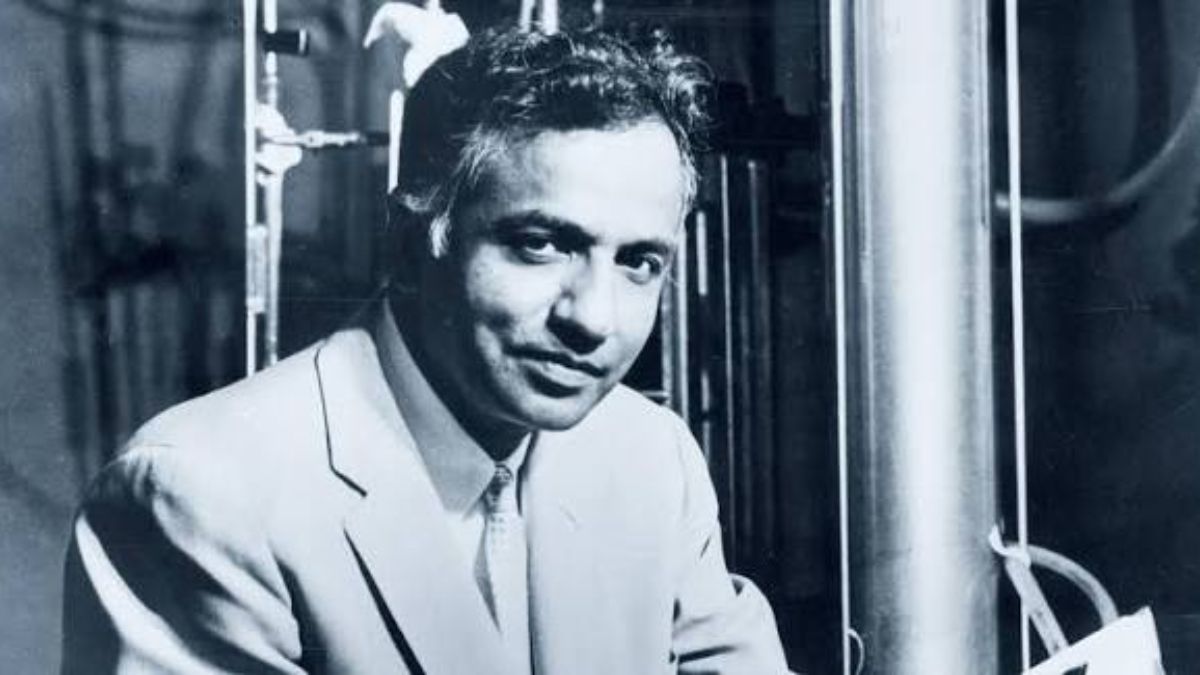
In July 1930, 19-year-old Indian student Subrahmanyan Chandrasekhar boarded a ship to England and calculated the fate of dying stars. Though his theory faced public attacks, he kept working hard. He finally got the Nobel Prize 53 years later, changing how many scientists understood the universe and its black holes.
In July 1930, a 19-year-old Indian student boarded a ship bound for England. He had a government scholarship, interest in physics and several days at sea to fill. He spent much of the journey reading scientific papers. In the middle of that journey, he made a calculation that would take the scientific world decades to fully accept. He was right. However, he had to wait 53 years to receive the Nobel Prize for work that had begun during that voyage.
The young man was Subrahmanyan Chandrasekhar, known to everyone as Chandra. His calculation showed that a dying star above a certain mass could not end its life as a stable object. It would have to collapse further into something much stranger. This limit, now known as the Chandrasekhar limit, became an important part of our understanding of neutron stars and black holes.
Five years later, one of the world's most respected astronomers stood up at a meeting in London and publicly attacked Chandra's theory. The incident hurt the young scientist. He never forgot what happened, but he did not allow the humiliation to end his career.
His life was not only about scientific discoveries. It was also a story of personal struggles, racial discrimination, a relationship that almost ended before it began, and a long career built through patience and hard work. Chandra spent much of his life pursuing ideas that others did not immediately accept. In the end, his work changed how scientists understood the universe.
Early education: From home tutoring to Presidency College
Chandra was born in Lahore in 1910, when the city was part of British India. It is now in Pakistan. According to the Nobel Prize biography he wrote himself, he was the first son and the third child in a family of four sons and six daughters. His father worked in the government's audits and accounts service. His mother, Sita, was highly educated and interested in literature. She translated Ibsen'sA Doll's House into Tamil.
His mother played an important role in shaping his future. Chandra later described her as "intensely ambitious for them" and "passionately devoted" to her children, in his Nobel Prize biography. She wanted them to do well in life, but she also supported their individual interests.
The support became especially important when Chandra had to choose between a conventional career and his interest in science. His father wanted him to join the civil service, but his mother encouraged him to follow his passion for scientific research.
The family moved to Madras in 1918. Chandra did not attend a regular school until he was around 11 or 12. Until then, he studied at home with the help of tutors. He was free to explore subjects that interested him rather than follow a fixed school curriculum.
In his Nobel biography, he explained, "My early education, till I was twelve, was at home." His biographer, physicist Kameshwar C. Wali, described him as a mischievous child who showed an early talent for numbers.
When Chandra finally entered high school, he was already ahead of many students his age. He was placed directly into the third form. At just 15, he entered Presidency College in Madras.
He initially planned to study mathematics. One of the reasons was his admiration for Srinivasa Ramanujan, the celebrated Indian mathematician. However, his interests gradually moved towards physics.
He also had an important example within his own family. His uncle, Chandrasekhara Venkata Raman, had given up a senior government position to pursue scientific research. In 1930, Raman won the Nobel Prize in Physics. Science was becoming more than a subject to study. It was a path he wanted to follow, even if it meant moving away from the secure career his family had imagined for him.
The summer of the broken equipment
In 1928, Chandra spent the summer in Calcutta, working in the laboratory where his uncle Raman had made his famous discovery about how light changes when it scatters off molecules. The experience did not go particularly well.
During an interview given to University of Chicago Magazine, Chandra "broke a crucial piece of equipment" early in his stay. The incident stated that experimental physics, which involved conducting laboratory experiments, might not be the right path for him. His strengths lay elsewhere, particularly in mathematics and theoretical physics. The same year, however, brought an experience that changed his scientific interests.
The German physicist Arnold Sommerfeld visited Presidency College during a lecture tour. Chandra had already read extensively beyond his college syllabus, including Sommerfeld's famous book on atomic structure. He managed to meet the visiting scientist.
During their conversation, Sommerfeld told him something surprising. The quantum theory explained in his book was already out of date. New developments by scientists such as Schrödinger, Heisenberg, Dirac and Pauli had changed the field.
Sommerfeld then gave Chandra the proofs of a scientific paper that had not yet been published. The paper used a new type of statistics to explain how electrons behave in metals.
The same statistical approach had also helped Cambridge astrophysicist Ralph Fowler explain white dwarfs. These are the remains of stars that have exhausted their nuclear fuel. They are roughly the size of a planet but can contain as much mass as the Sun.
The subject immediately caught Chandra's attention. He began exploring how this new understanding of electrons could explain the behaviour of these extremely dense stars. At just 18, he wrote his first scientific paper while still an undergraduate.
Fowler helped submit the paper to the 'Proceedings of the Royal Society'. It marked the beginning of a long scientific career. According to the 'University of Chicago Magazine', Chandra would eventually write around 400 scientific articles. His early work had already attracted attention. It also opened the door to an opportunity that would take him far beyond India.
The breakthrough at sea: Rethinking quantum mechanics and white dwarfs
Chandra's research earned him a special three-year scholarship from the Indian government. At the end of July 1930, he left India to study at Trinity College, Cambridge, where Fowler would supervise his work. The journey gave him time to think. As the ship travelled towards England, he continued reading scientific papers and returned repeatedly to the problem of white dwarfs.
Fowler's earlier research had explained why these stars did not collapse further. Their electrons were packed so tightly together that the pressure they produced helped support the star against gravity. His calculations also showed that the more massive a white dwarf became, the smaller it would be.
Chandra began asking a question that had not received a satisfactory answer: was there a limit to how massive a white dwarf could become before it could no longer remain stable? According to Luisa Bonolis's profile for the Lindau Nobel Laureate Meetings, he asked himself, "Is there any upper limit to how massive a white dwarf can be".
To find the answer, Chandra repeated Fowler's calculations but included a crucial factor. He considered what happened when electrons moved at speeds close to the speed of light, as described by Einstein's special theory of relativity. This changed the result. As a white dwarf became more massive, its matter became increasingly difficult to support. Under these conditions, the star could not remain stable beyond a particular mass. Its density would continue rising, and it would eventually collapse further.
Today, scientists place the Chandrasekhar limit at approximately 1.4 times the mass of the Sun. The exact figure is commonly given as about 1.44 solar masses. The discovery had enormous implications. A smaller star could end its life as a white dwarf. A star with a mass above the limit could not follow the same path.
In his paper, Chandra explained that the life history of a small star must be "essentially different" from that of a large one. For massive stars, he wrote, "one is left speculating on other possibilities." Those possibilities would later become central to the study of neutron stars and black holes.
Chandra had made a remarkable discovery while travelling across the sea. However, reaching the right answer was only the beginning of his struggle. He now had to convince other scientists that his calculations were correct.
Clash of titans: Arthur Eddington and the public rejection
Chandra's scientific work moved during his early years in Europe. His supervisor, Fowler, was puzzled by his second paper and sent it to astronomer Edward Arthur Milne for consideration. Months passed without an answer. In November 1930, Chandra decided to submit the paper directly to the Astrophysical Journal. He continued his studies and spent his third graduate year at Niels Bohr's institute in Copenhagen, following advice from his mentor Paul Dirac. He completed his PhD in 1933.
In October, he was elected to a prize fellowship at Trinity College, Cambridge. It was a rare achievement. According to Bonolis, the only other Indian to have received the honour was Ramanujan.
Chandra continued developing his theory of white dwarfs. He carried out long and demanding numerical calculations to make his findings more precise. By the end of 1934, he had prepared two papers for the Royal Astronomical Society. He was invited to present them at a meeting in January 1935.
One of the most important people in the audience would be Sir Arthur Eddington, the leading astronomer of the time. Eddington believed that stars eventually ended their lives as white dwarfs. Chandra's theory challenged this belief by suggesting that massive stars could collapse beyond that stage.
Eddington had followed Chandra's work for several years and had regularly visited him to discuss his progress. He even arranged for Chandra to receive twice the usual speaking time at the meeting.
However, Eddington scheduled his own presentation immediately afterwards. When Chandra finished presenting his research, Eddington stood up and attacked his conclusions in front of the audience. The 'University of Chicago Magazine' described the incident as one in which Chandra was "publicly humiliating him," in its account of the event.
Bonolis reports that Eddington called the theory "a stellar buffoonery" and declared that there was "no such thing as relativistic degeneracy."
Eddington could not accept the idea that a massive star might collapse in the way Chandra's calculations suggested. His criticism carried enormous weight because of his reputation within the scientific community.
The incident was devastating for Chandra. He was a young researcher challenging an established authority, and that authority had dismissed his work in public. Some scientists privately told Chandra that his calculations were correct. However, they did not openly defend him at the meeting. He was left facing the criticism largely on his own.
Chandra later spoke about the incident with a sense of acceptance. "If I was right, then it would be known as right," he said in Nobel Prize biography. He added: "I didn't see a need to stay there, so I just left it." He continued working, but the experience changed his relationship with the scientific community in England.
What the defeat took, and what it gave
The consequences of the confrontation were significant. Chandra's standing in England suffered, and his future there became uncertain. Eugene Parker, a colleague at the University of Chicago, later described the effect of the episode as "closing the doors in England," according to the University of Chicago Magazine.
Chandra's father suggested that he return to India. However, Chandra felt that the academic environment there would not suit him, particularly because he did not want to become involved in the politics of academic life.
He eventually began considering opportunities in the United States. Years later, Chandra offered a surprising perspective on his rejection by Eddington. He suggested that immediate acceptance might not necessarily have been better for his scientific career.
If Eddington had praised his work, Chandra said, "Given Eddington's reputation, he could have made me instantly a very well-known person." He then explained why that might have been a problem. "You lose your motivation to continue doing science."
His relationship with Eddington also remained more complicated than the public confrontation might suggest. Despite what happened at the meeting, Chandra continued to regard him as a friend. In his Nobel biography, he wrote that during his fellowship years he formed "lasting friendships with several, including Sir Arthur Eddington."
By 1944, Eddington was firmly supporting Chandra's election to the Royal Society. Meanwhile, the scientific evidence increasingly supported Chandra's original theory. In 1939, J. Robert Oppenheimer and his student Hartland Snyder accepted the significance of the limit. They showed that a star above it could enter what Bonolis describes as "a state of permanent free fall." This helped establish the theoretical basis for understanding black holes.
The scientific community took much longer to accept Chandra's work. According to the University of Chicago Magazine, more than 20 years passed before his limit became widely accepted.
His experience demonstrated how difficult it could be for a young scientist to challenge established ideas, especially when those ideas were defended by respected figures. Chandra's work had been right, but recognition did not come quickly.
Personal life: A shared physics notebook and partnership
Chandra was struggling to establish himself as a scientist, another important part of his life was taking shape. It involved a young woman named Doraiswamy Lalithambal, known as Lalitha.
The two had met at Presidency College in Madras, where they studied in an honours physics course. Lalitha came from a family of educated women, which was unusual in India at the time. Her interest in physics had developed partly through her admiration for Marie Curie and the excitement surrounding Raman's Nobel Prize.
According to an account in the University of Chicago Magazine, Lalitha had "noticed with interest" a young man with a crew cut who always sat behind her in the second row. She asked Chandra if she could see his laboratory notebook. He agreed, and they began sharing it. Their connection grew gradually. At one party, Chandra gave her a rose.
Then he left for England. Before his departure, he visited Lalitha's home and brought her some books she had requested. The meeting was awkward. The two sat in silence until the rest of her family joined them.
At Cambridge, Chandra eventually found the courage to write to her. His first letter began formally: "Dear Miss Lalitha," he wrote, explaining that he was "anxious not to displease you in any manner possible."
The nervous opening soon gave way to a more affectionate relationship. Their letters became warmer, and discussions about physics turned into conversations about their feelings for each other.
They became engaged. However, Chandra was going through a difficult period in 1935. Eddington's public criticism had shaken him, and he was considering leaving England for the United States. During this period of uncertainty, he began questioning his relationship with Lalitha.
He wrote to his father that he believed his bond with her was "purely illusionary." He ended the engagement, saying that he "really had not known her at all," according to Wali's account.
The separation did not last. In 1936, Chandra returned to India before moving to Chicago. During this visit, his doubts about Lalitha disappeared. Wali describes his decision to postpone marriage as something that "wilted away rather suddenly."
Chandra eventually understood his feelings differently. "She was more than a dream, she was quite real."
They married in September 1936, within a month of his return. It was a love marriage at a time when such marriages were relatively uncommon.
Chandra later described his early life in two sentences, one of which ended with the words "lived happily thereafter," as the University of Chicago Magazine recalls.
In his Nobel biography, he gave Lalitha special credit for the role she played in his life. He wrote that her patient understanding, support and encouragement "have been the central facts of my life."
Their marriage also involved personal sacrifices. Lalitha was a trained physicist who enjoyed research. Chandra encouraged her to continue working in the field, but she chose not to pursue her own research career because she could not give it the time she believed it required.
She explained her decision to Wali by saying, "Chandra had to give most of his time to his science," adding, "That is the way a scientist is made."
Lalitha supported Chandra throughout his career. Their relationship became one of the most stable parts of a life marked by professional setbacks, difficult decisions and years of demanding work.
The small town at the end of the world
In January 1937, Chandra joined the University of Chicago. He had turned down an offer from Harvard University before accepting the position.
The Chicago opportunity came through Otto Struve, the director of Yerkes Observatory. Struve was looking for theoretical astrophysicists, whom Chandra's student Donald Osterbrock described as "a very rare breed in the United States."
The observatory was located in Williams Bay, Wisconsin, far from the busy life of a major city. Chandra and Lalitha lived there for 27 years. The place was isolated. Peter Vandervoort, one of Chandra's students, joked in a 2017 interview that if you were in Williams Bay, "you might as well be at the South Pole."
Vandervoort also observed that small towns in southern Wisconsin "are not exactly the natural homes of academicians." However the location suited Chandra's lifestyle. He was deeply focused on his work and preferred an environment that allowed him to concentrate.
His teaching was highly regarded. Osterbrock described his lectures as "formal and highly mathematical." Vandervoort remembered the way Chandra spoke about science as having "a kind of cadence, a rhythm and music."
Chandra expected a great deal from his students. He was not particularly patient with questions he considered pointless. Carl Sagan, who studied under him, recalled that frivolous questions were handled "in the manner of a summary execution."
His own work routine was demanding. Chandra often began his day at five in the morning and worked for around 13 hours. He maintained this schedule even while managing the Astrophysical Journal.
John Friedman, a colleague, remembered that Chandra was already working long before most professors arrived. By the time they reached their offices, Chandra "had already put in half as many hours" as they would work all day.
His discipline became a defining feature of his career. He spent years studying difficult scientific problems, carefully checking his calculations and developing his ideas into complete bodies of work. However, his professional life at Chicago was not free from discrimination or disappointment.
Systemic obstacles: Overcoming discrimination at Chicago
When Chandra joined the University of Chicago, he did not receive the same treatment as some of the other scientists recruited around the same time. According to the University of Chicago Magazine, his colleagues were appointed assistant professors immediately and received tenure the following year. Chandra, however, began as a research associate and remained an assistant professor for four years without a salary increase.
He also received fewer financial resources and less institutional support than some of his colleagues. For years, Chandra did not fully understand why he was being treated differently.
The reason emerged much later. Chandra once observed that his original appointment had come directly from university president Robert Maynard Hutchins. He noted that "Such an appointment," he said, "does not normally need the intervention of the president of the university."
Years later, Hutchins discussed racial discrimination at the university during a lecture. According to Wali's account, he explained that a leading theoretical astronomer had opposed Chandra's appointment "because he was an Indian, and black."
The discrimination went beyond his appointment. In 1938, Henry Gale, the dean of the physical sciences, tried to prevent Chandra from lecturing on campus. Hutchins intervened again to protect his position.
Hutchins later said that hiring Chandra had been the best thing he had done for the university. Chandra himself admitted that he had not understood what was happening at the time. He told Wali that he had not realised "something impolite, something improper had been done to me." Another difficult incident occurred in 1952. The astronomy department revised its curriculum, effectively removing Chandra from teaching a course that he had largely designed.
It was another blow to his standing within the department. Wali described it as the second time Chandra felt humiliated. Vandervoort believed that many astronomers did not fully appreciate the importance of theoretical work. He observed that Chandra "had a sense of being largely rejected by the astronomical community."
However, this setback also opened a new door. The physicist Enrico Fermi invited Chandra to join the physics department. Chandra accepted the opportunity and moved away from the astronomy department's conflicts. He continued his research at Chicago, building a career that would eventually bring him international recognition.
Seven lives in science
Chandra approached scientific research differently from many of his colleagues. Rather than working on the same subject throughout his career, he preferred to study one area in great depth before moving on to another. In his Nobel biography, he explained that he chose subjects suited to his "taste, abilities, and temperament."
He would spend a year becoming familiar with a subject, followed by several years writing research papers. He would then produce a complete book that brought together what was known about the field before moving to a new topic.
Bonolis describes this as a cycle of learning, research and writing a "definitive book" for future scientists. Chandra counted seven major periods in his scientific career. They covered stellar structure, stellar dynamics, radiative transfer, hydrodynamic stability, ellipsoidal figures of equilibrium, general relativity and, finally, the mathematical theory of black holes.
Each period resulted in important research and publications. His book 'An Introduction to the Study of Stellar Structure' appeared in 1939. 'Principles of Stellar Dynamics' followed in 1942, and 'Radiative Transfer' was published in 1950.
His later books explored stability, rotating bodies and black holes. Chandra's contributions extended beyond his own research. From 1952 to 1971, he served as managing editor of the 'Astrophysical Journal'. Under his leadership, the publication grew into one of the leading journals in astronomy.
He also trained generations of scientists. According to the University of Chicago Magazine, he advised at least 46 doctoral students and received 20 honorary degrees.
His research found applications in areas beyond astronomy. His work on radiative transfer, for example, later helped scientists studying neutron diffusion in nuclear power. It also became relevant to research into the faint radiation left over from the Big Bang. In 1983, mathematician and physicist Roger Penrose described Chandra's book on black holes as "a masterpiece."
By then, Chandra had spent decades building a reputation through careful research and a willingness to explore new subjects. His career showed that scientific achievement did not always require working on the same problem for an entire lifetime. For him, the process of understanding one subject fully before moving on was itself a way of making lasting contributions.
Delayed recognition: 1983 Nobel Prize in Physics
In 1983, Chandra received the Nobel Prize in Physics, sharing the award with William Fowler. The Nobel citation recognised "his theoretical studies of the physical processes of importance to the structure and evolution of the stars." The prize honoured research that Chandra had begun more than five decades earlier, when he was a 19-year-old student travelling to England.
The University of Chicago Magazine points out that 53 years had passed between his original discovery and the award. At the Nobel banquet in Stockholm on December 10, Chandra did not focus on stars or scientific calculations. Instead, he spoke about beauty and the meaning of intellectual work.
He quoted Virginia Woolf's novel 'The Waves' and a poem by Rabindranath Tagore. He had learned Tagore's poem when he was 12 and remembered it for more than 60 years. Chandra also noted that Tagore had received his own Nobel Prize on the same date, exactly 70 years earlier.
In his speech, Chandra showed the responsibility that came with receiving such an honour. He described the prize as having "a sobering effect." He thanked the Nobel Foundation on behalf of himself and his wife for "this noble reception in this noble city."
He also expressed the hope that his recognition would encourage other scientists who, like him, had spent their lives exploring difficult questions away from the centre of attention. He referred to those who wandered "in the lonely byways of Science."
The last book
Even in his later years, Chandra did not stop exploring difficult intellectual questions. He developed an interest in literature and music and gave lectures on Shakespeare, Beethoven and Shelley. A collection of his public lectures was published in 1987 under the title Truth and Beaut.
During retirement, he took on another major project that is a detailed study of Isaac Newton's 'Principi, one of the most important works in the history of science.
Chandra followed a demanding method. He would read a proposition from Newton's book and try to prove it himself before looking at Newton's original proof. He worked through each step and translated Newton's geometrical arguments into the language of algebra used by modern scientists. The result was Newton's Principia for the Common Reader, published in 1995, shortly before his death.
Chandra believed that studying Newton's work was essential to a complete understanding of science. He explained that a person's knowledge of science is "incomplete without a study of the Principia," just as knowledge of literature is incomplete without Shakespeare.
Chandra died in Chicago on August 21, 1995, from heart failure. He was 84 years old. He had spent nearly 60 years as a professor at the University of Chicago, building a career that combined scientific research, teaching and writing.
His life had taken him from a childhood in British India to Cambridge, Copenhagen and the United States. Along the way, he experienced professional rejection, discrimination and years of waiting for recognition. However, he never abandoned the careful, methodical work that had defined him from the beginning.
In 1999, a powerful X-ray telescope was launched into space aboard the space shuttle Columbia. NASA had organised a naming contest that attracted more than 6,000 entries from 61 countries.
Two people, a high school student from Idaho and a teacher from California, independently suggested the same name. The telescope was named the Chandra X-ray Observatory. The Harvard Chandra X-ray Center describes Chandra as "widely regarded as one of the foremost astrophysicists of the twentieth century."
NASA notes that the word Chandra means "moon" or "luminous" in Sanskrit. The observatory studies some of the universe's most energetic objects, including neutron stars and black holes. These were the very objects that Chandra's early calculations had helped scientists begin to understand.
The evidence for the existence and behaviour of black holes has continued to grow. In 2015, the LIGO detectors recorded gravitational waves produced by colliding black holes. In 2020, Andrea Ghez shared the Nobel Prize in Physics for discovering a giant black hole by tracking the movements of nearby stars. The Event Horizon Telescope has also produced images of black holes.
The 'University of Chicago Magazine' describes these developments as making Chandra's once "unimaginable abstraction now plain to see." The scientific ideas he developed as a young man had become part of the foundation of modern astrophysics.
Tributes from his colleagues also reflected the respect he had earned. Nobel laureate Hans Bethe called him "a first-rate astrophysicist and a beautiful and warm human being." Martin Rees, Britain's Astronomer Royal, said Chandra probably thought longer and deeper about the universe "than anyone since Einstein."
Perhaps the clearest summary of Chandra's life came from the scientist himself. In his Nobel biography, he described his work as a "quest after perspectives."
It was a lifelong search for order, form and structure in the universe. He pursued that search through mathematics, scientific research, teaching and writing, often continuing even when others doubted his conclusions.
His journey began with a young student reading scientific papers on a ship crossing the sea. It continued through years of work, rejection and eventual recognition.
He found beauty and meaning not only in the stars he studied, but also in literature, music, a rose, a shared notebook and the woman who supported him throughout his life. He found it, one star at a time. Then he found it again, in a rose, in a letter, in a notebook shared across a classroom, and in a girl who had been waiting for years.