
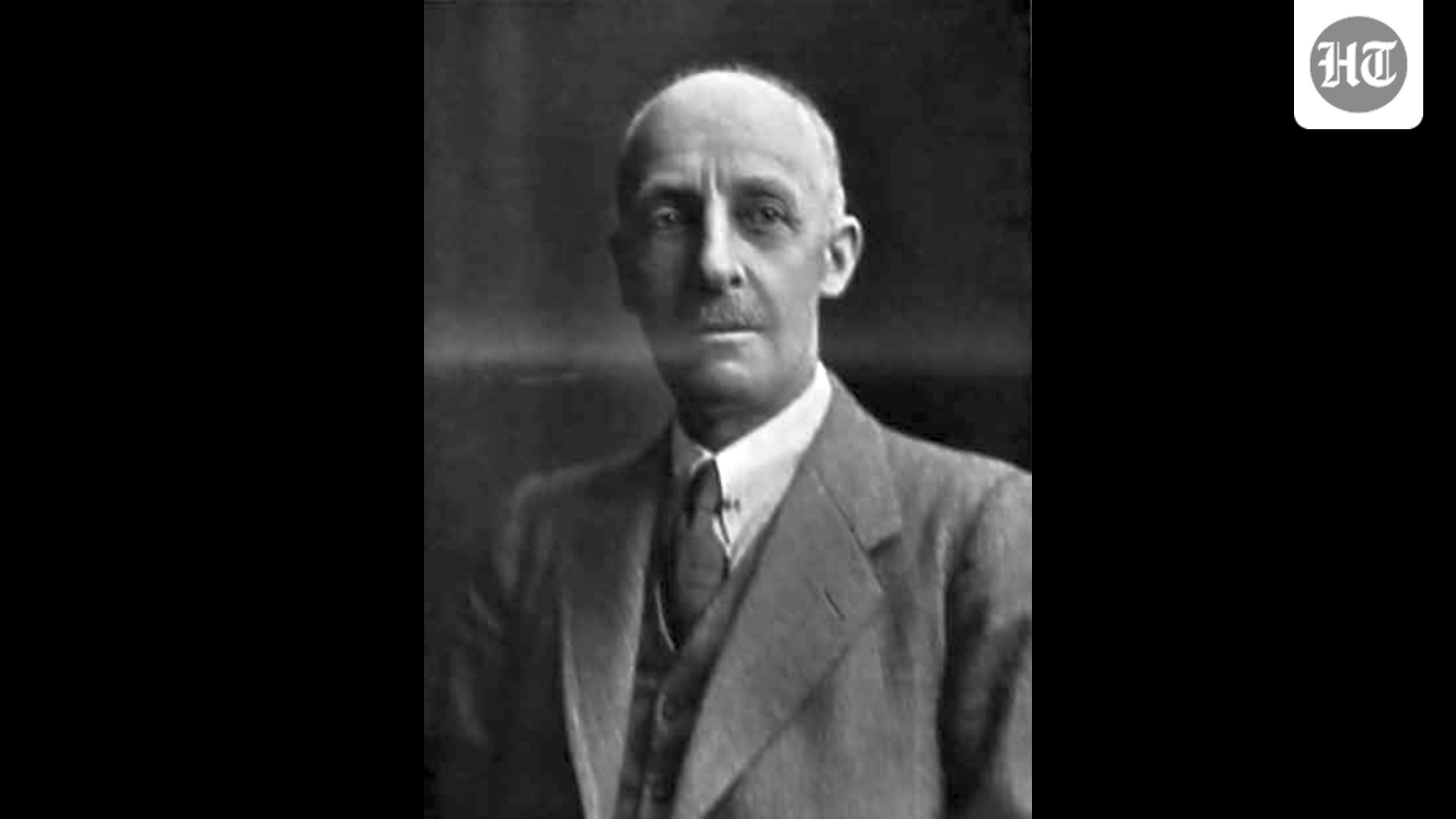
Gilbert Thomas Walker moved the India Meteorological Department from Simla to Pune in 1928. He used his mathematical skills to study the monsoon as a global system rather than just a local one. Many clerks helped him calculate records by hand, turning the office into a hub for weather science.
In Pune's Shivajinagar stands an imposing stone building with a central observation tower and arched corridors. For nearly a century, it has housed the India Meteorological Department's central offices. Known locally as the Simla Office, the building owes its presence to decisions taken in the early 1920s under Gilbert Thomas Walker (June 14, 1868 - November 4, 1958), when he recognised the limitations of Simla as the department's headquarters. The government approved the transfer to Poona in 1926, and the official relocation of the offices took place in 1928.
In the closing decades of the nineteenth century, recurring famines across the Indian subcontinent made the prediction of summer monsoon rainfall an imperial priority. The disastrous failures of the monsoon in 1877 and 1899 caused mass starvation, exposing the limitations of early meteorological attempts to anticipate seasonal rainfall.
Under Henry Francis Blanford, appointed Meteorological Reporter to the Government of India in 1875, India began issuing routine seasonal forecasts by 1886. Blanford relied heavily on Himalayan winter snowfall, while his successor, John Eliot, added local pre-monsoon conditions and observations from the Indian Ocean and Australia. Eliot had predicted better-than-normal rainfall for 1899, and the ensuing famine provoked severe public criticism. In 1904, the administration appointed Walker as Director General of Observatories to head the India Meteorological Department.
Walker came to the post from Cambridge, where he was a fellow of Trinity College and had earned the distinction of Senior Wrangler. Unlike his predecessors, he was not a career meteorologist, but an applied mathematician and physicist. His mathematical training led him to study the monsoon as part of a worldwide atmospheric system.
When Walker took charge, the prevailing assumption was that local factors, such as Indian land heating or Himalayan snow, were the primary controls on seasonal rainfall. Walker recognised that physical equations could not solve seasonal weather in advance. Instead, he calculated statistical correlations across global records to identify dependable predictors for objective forecasting models.
Walker turned the Simla offices into a centre for large-scale statistical calculations. Long before digital computers, Indian assistants and clerks carried out the labour of compiling, standardising, and tabulating records for decades. Among them, Rai Bahadur Hem Raj became a crucial collaborator, assisting Walker in calculating correlations across global variables and later rising to the position of imperial meteorologist. The department collected monthly pressure, temperature, rainfall, and wind records from the Indian Ocean, Australia, Africa, and the Americas.
Walker and his staff calculated thousands of correlations across different time lags. In his 1909 paper, "Correlation in Seasonal Variation of Climate", Walker introduced a linear regression equation based on four predictors. These were Himalayan snow accumulation at the end of May, South American pressure during March to May, Mauritius pressure in May, and Zanzibar rainfall during April to May.
The early performance of Walker's formulae was encouraging, but subsequent verification exposed the instability of these empirical links. An assessment by RB Montgomery, examining data up to 1936, found that the operational forecasting formulae had largely broken down during the period from 1921 to 1936. Most of the original predictors had lost their statistical dependability, though South American pressure retained a more persistent relationship with monsoon rainfall than the others. Because these correlations came from historical records, relationships held during one period often failed in later decades. While the forecasting utility of the formulas deteriorated, the large-scale circulation patterns Walker had identified continued to be observed.
Through these correlation studies, Walker identified large-scale swings in surface atmospheric pressure across the planet. His work on these patterns developed through a series of studies, beginning with "Correlation in Seasonal Variation of Climate" in 1909. The eighth instalment, "A Preliminary Study of World Weather", appeared in 1923, followed by "A Further Study of World Weather" in 1924.
Walker continued this work into the 1930s with Edward W Bliss. The most prominent pattern was what Walker termed the Southern Oscillation, an extensive atmospheric pressure seesaw primarily operating between South America and the Indo-Australian region. Earlier work by Hugo Hildebrand Hildebrandsson in 1897, comparing pressure variations between Sydney and Córdoba, and by Norman Lockyer and William JS Lockyer in 1902 between South America and the East Indies, had noted these regional contrasts. Walker mapped these relationships statistically.
Walker demonstrated that when atmospheric pressure was high over South America and the eastern Pacific, it tended to be low over the Indian Ocean and northern Australia, and vice versa. He found that these broad swings were statistically linked to variations in Indian monsoon rainfall. Alongside this southern pattern, he documented two northern pressure variations, the North Atlantic Oscillation and the North Pacific Oscillation. Walker devised several complex mathematical formulas using multiple stations to track the Southern Oscillation. Today, one widely used modern Southern Oscillation Index tracks this atmospheric fluctuation by measuring the difference in sea-level barometric pressure between Tahiti in the central Pacific and Darwin in northern Australia.
Walker's statistical findings raised a difficult question regarding how pressure variations across distant regions could be related to changes in Indian rainfall. Although his correlations revealed consistent relationships, he could not establish the physical mechanism behind them. He explored the possibility that variations in polar circulation and Antarctic sea ice might influence pressure patterns over South America, but later studies did not support this proposed explanation. The physical relationship between the ocean and atmosphere that underlay these patterns would be investigated more fully by later generations of meteorologists.
A physical explanation for the relationships Walker had identified began to emerge in the 1960s. Following the 1957 to 1958 Pacific warming, Jacob Bjerknes proposed an air-sea interaction theory in 1966. In his 1969 paper, "Atmospheric Teleconnections from the Equatorial Pacific", Bjerknes developed this explanation further using observations from the warmings of 1963 to 1964 and 1965 to 1966. Bjerknes demonstrated that the Southern Oscillation was coupled with El Niño, the periodic warming of the tropical Pacific, describing the ocean-atmosphere interaction now known as the El Niño-Southern Oscillation.
He also showed that an east-west atmospheric circulation cell spanned the equatorial Pacific, with air rising over the warm western Pacific and sinking over cooler eastern waters. This circulation later came to be known as the Walker Circulation, in recognition of Walker's pioneering identification of the underlying pressure patterns.
Walker also played an important part in the history of mathematics. While on an inspection tour in South India in February 1913, Francis Spring showed Walker some mathematical work by Srinivasa Ramanujan, then a clerk at the Madras Port Trust. Walker recognised the originality of Ramanujan's mathematical work and recommended him to the University of Madras, which awarded Ramanujan a two-year research scholarship.
Walker retired from the India Meteorological Department in November 1924 to join Imperial College London. His work showed that Indian monsoon rainfall was connected to atmospheric pressure changes across distant parts of the world, extending the study of seasonal weather beyond the Indian subcontinent. The Simla Office in Pune stands as a reminder of his contribution to Indian meteorology.