
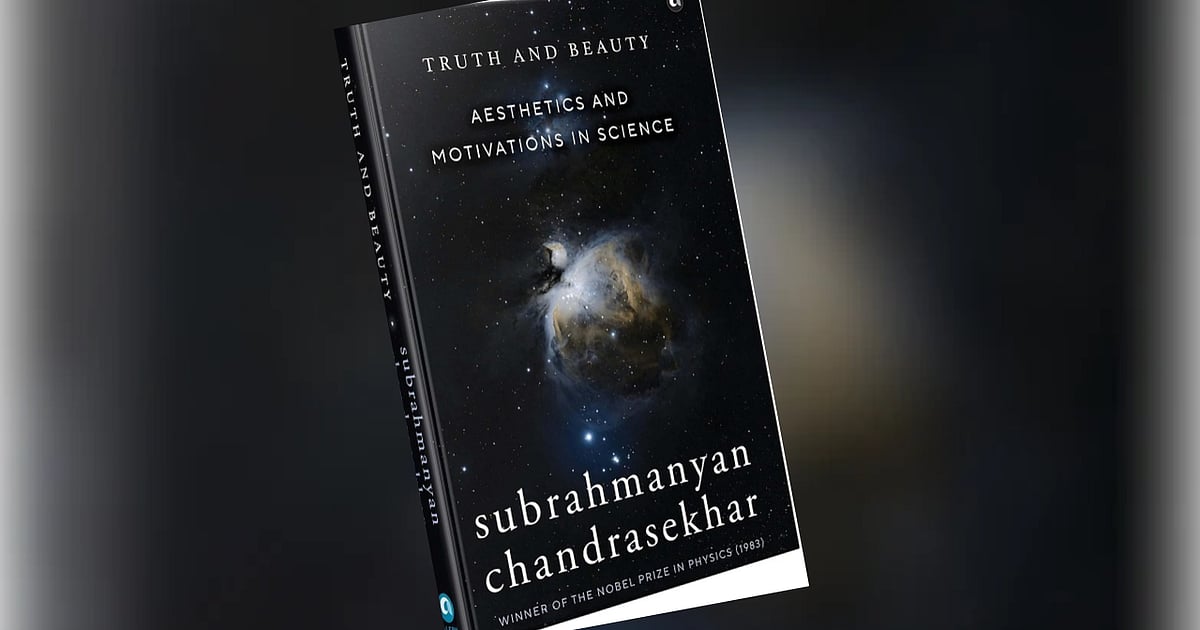
Indian Nobel Prize winner Subrahmanyan Chandrasekhar explores the link between science and aesthetics in his book, Truth and Beauty. He shows how beauty and symmetry guided his work on black holes and stellar structure. The physicist, who lived from 1910 to 1995, used art and literature to explain scientific truth.
In Truth and Beauty : Aesthetics and Motivations in Science, Indian Nobel Prize winner Subrahmanyan Chandrasekhar takes readers on a rather unconventional journey into the world of scientific enquiry, but this time through the lens of beauty, elegance, and aesthetics. Across essays and lectures spanning 40 years, Chandrasekhar explores how principles of beauty can influence scientific judgement. Consider black holes, once regarded as mathematical oddities, that revealed symmetry and simplicity upon further study. Chandrasekhar's own work on their stability offers a striking example of how an aesthetic sense can shape the search for scientific truth.
.Read of the Week | Stories that queer the rules: Inside 'A Queer Shade of Saffron'.Read of the Week: The Assault on Truth. Drawing on examples from the works by Shakespeare, Beethoven, Newton, Einstein, and more, Chandrasekhar shows how some of the most consequential ideas in science resemble great works of art and literature in their simplicity, balance, and elegance. Beauty moves scientists no less than it does artists. Truth and Beauty is a testament to Chandrasekhar's devotion to approaching subjects like stellar structure and black hole theory. Subrahmanyan Chandrasekhar (1910-1995) was awarded the Nobel Prize in Physics, with William A Fowler, in 1983 'for his theoretical studies of the physical processes of importance to the structure and evolution of the stars'.