
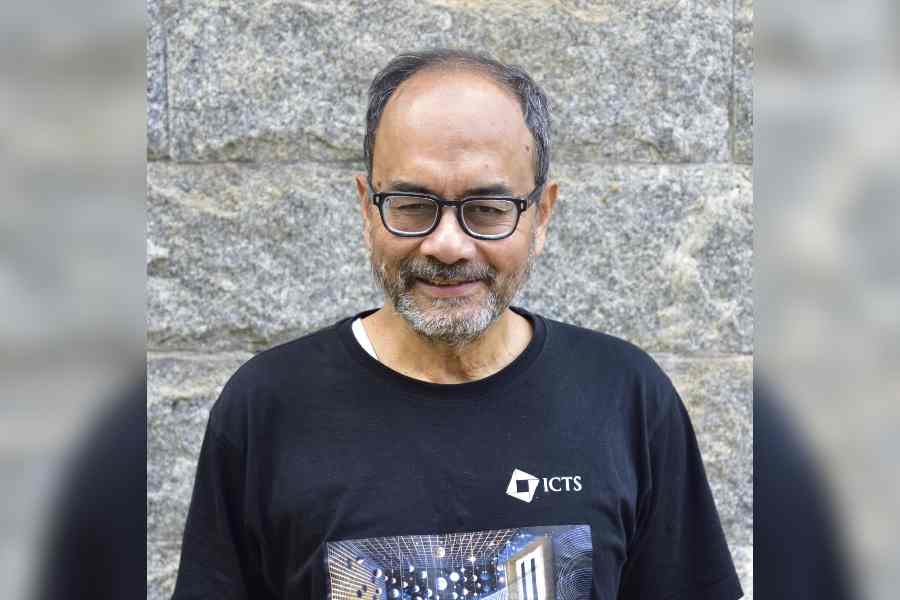
Physicist Ashoke Sen became the first Indian to receive the Oskar Klein Medal this week. The award honours his work on string theory and quantum gravity. ICTS director Rajesh Gopakumar said, "The medal recognises his cumulative contributions -- Ashoke has done seminal work on quantum gravity." He delivered his lecture Friday.
Physicist Ashoke Sen, an architect of modern string theory, which seeks to unify all known fundamental forces and constituents of the universe, has become the first Indian to receive the prestigious Oskar Klein Medal.
Sen, currently an Infosys Madhava Chair professor at the International Centre for Theoretical Sciences (ICTS) in Bangalore, has made pioneering contributions to advancing scientists' understanding of modern string theory, the ICTS said this week while announcing the award.
The annual Oskar Klein Medal has been jointly awarded by Stockholm University and the Royal Swedish Academy of Sciences since 1988.
Past recipients of the medal have included some of the world's top physicists, Alan Guth and Stephen Hawking, and Nobel laureates Peter Higgs, Kip Thorne, and Steven Weinberg, among others.
Sen, an alumnus of Calcutta's Presidency College and IIT Kanpur who completed his PhD in the US, has worked on ideas that seek to reconcile gravity, which governs the large-scale structure of the universe, with quantum mechanics, which describes the subatomic world.
"The medal recognises his cumulative contributions -- Ashoke has done seminal work on quantum gravity," ICTS director Rajesh Gopakumar told The Telegraph. "His contributions to this topic have broader validity than just string theory, leading to a better understanding of the microscopic description of black holes."
Black holes are objects whose gravity is so strong that nothing, not even light, can escape from within a boundary around them. Earlier theoretical work by Stephen Hawking and others had established that black holes behave like hot objects.
"Ashoke has helped explain the microscopic origin of this thermal behaviour," Gopakumar said.
String theory is a complex mathematical endeavour to understand the rules that govern the universe pursued largely through pen-and-paper calculations. Scientists say testing its predictions experimentally will require technologies beyond current human capabilities.
Sen, who delivered the Oskar Klein Memorial Lecture titled "Gravity from strings and strings from gravity", in Stockholm on Friday, among other honours, had received the Infosys Prize in Mathematical Sciences in 2009, and the Breakthrough Prize in Fundamental Physics in 2012.
Fellow physicists also know Sen for his willingness to have a little fun with science.
That inclination, his colleagues say, was evident in a research paper -- peppered with words such as "catastrophe", "doomsday", and "end of our species" -- that Sen wrote in 2015 exploring how humanity might survive the destruction of the universe.
Drawing on ideas from string theory, Sen described how a transition from one phase of the universe to another could trigger the formation of a "killer bubble", expanding at the speed of light and destroying everything in its path.
His proposed escape strategy was to spread human civilisation across distant regions of the expanding universe, beyond the reach of the killer bubbles.
"As in most adventures, we need to leave home," Sen said during a follow-up talk on the topic in 2022.
While that scenario might appear like science fiction, Gopakumar said, both the paper and the talk were grounded in physics, drawing on the principles of quantum mechanics and general relativity.