
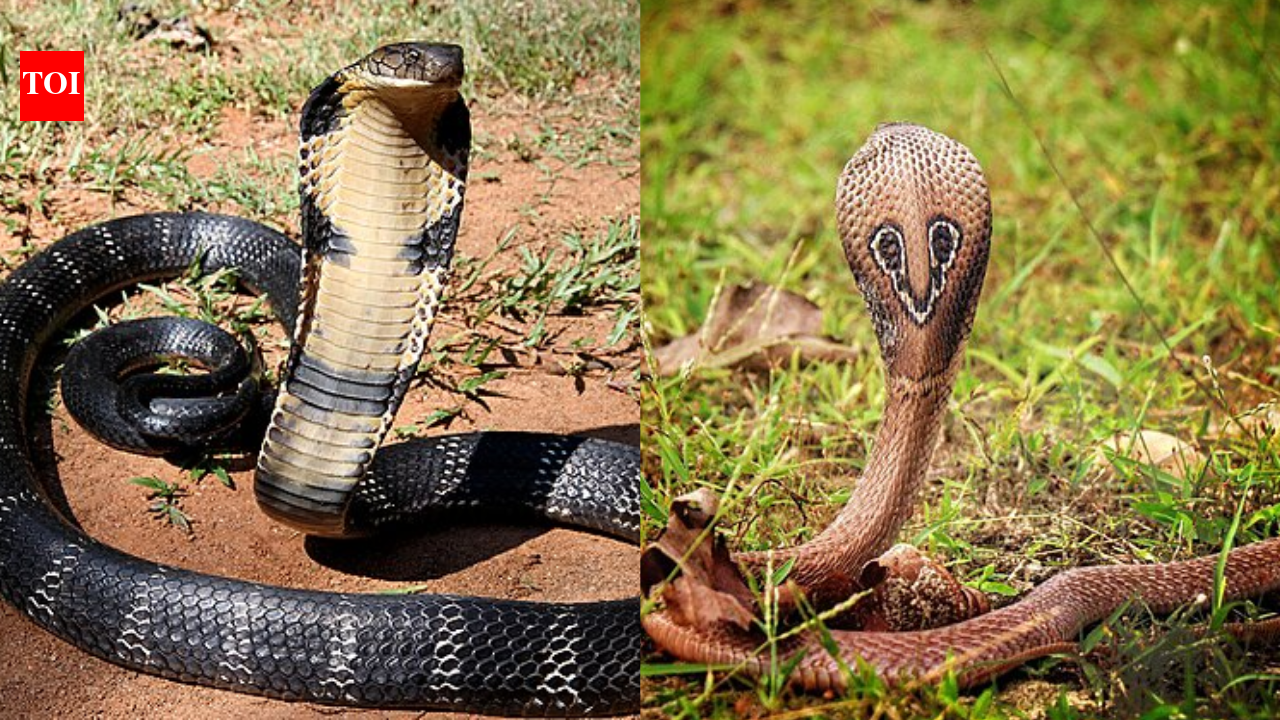
Sri Lanka's spectacled cobra split from Indian populations around 2 million years ago. A study in Molecular Phylogenetics and Evolution showed that these snakes formed a genetically distinct group. Researchers said, "historical sea-level fluctuations may have contributed to the split." This isolation created a unique evolutionary path for the island cobras.
A cobra found across the Indian subcontinent carries an evolutionary mystery that stretches back around two million years. Sri Lanka's spectacled cobras belong to a genetically distinct lineage, according to a study published in Molecular Phylogenetics and Evolution. The research, titled '
Spectacular Saga: Phylogenetics and phylogeography of the Indian spectacled cobra (Naja naja Linnaeus, 1758),' analysed DNA from 67 cobras across the region using nine genetic markers. Researchers found little genetic separation among mainland Indian populations, but a clear distinction between those populations and cobras in Sri Lanka. The findings suggest that historical sea-level fluctuations may have contributed to the split, reviving a long-running debate about whether the island's cobras should be classified as a separate species.
How genetic analysis reveals a distinct lineage of spectacled cobras in Sri Lanka
The study, led by Paulomi Dam Kanunjna, Prasad Gopalkrishna Gond, Ajinkya Unawane and Kartik Sunagar, examined mitochondrial and nuclear DNA from 67 spectacled cobras across major biogeographical regions of the Indian subcontinent. In the journal "Molecular Phylogenetics and Evolution," the study utilised nine different genetic markers in order to determine the evolutionary history and genetic differences between populations.
However, the findings of the study showed a surprising trend. Genetic variations within mainland Indian cobras were found to be quite high, without any geographical distinction among groups. On the other hand, Sri Lankan cobras formed a genetically different group from their counterparts living on the mainland. To identify the relationships among these snakes, the authors conducted phylogenetic analysis, genetic distance estimation, and species delimitation. This suggests that the population of Sri Lanka has an evolutionarily different past compared to that of mainland cobras.
Why ancient sea-level changes may have separated Sri Lankan and Indian cobra populations
The researchers estimate that Sri Lankan and mainland Indian spectacled cobras diverged around two million years ago, during the late Pliocene to early Pleistocene. Their study suggests that changes in sea levels may have contributed to this separation by altering the land connection between India and Sri Lanka.During periods of lower sea levels, land connections could have enabled animals to move between the areas. As sea levels rose, the connection became submerged, potentially restricting movement and isolating populations on the island. Over time, isolation can lead to genetic differences accumulating between populations. The study's divergence estimates are consistent with this broad explanation, although they do not prove that sea-level changes alone caused the split. The researchers place the finding within a longer history of geographical change and species dispersal in South Asia. Their results illustrate how geological events can influence the distribution and evolutionary trajectories of wildlife, even when populations belong to the same widely distributed species.
What the genetic differences reveal about the spectacled cobra's species classification
The distinct genetic lineage has revived a taxonomic question that dates back to 1939, when Sri Lankan zoologist P. E. P. Deraniyagala described an unusual form of spectacled cobra with additional eye-like markings on its hood. He named it Naja naja polyocellata. Later research grouped the island and mainland populations under Naja naja, but the question of whether Sri Lankan cobras represent a separate species resurfaced in 2022.That year, a genetic study proposed recognising the Sri Lankan population as Naja polyocellata. Herpetologists Wolfgang Wüster and Frank Tillack challenged the proposal in 2023, arguing that the evidence was insufficient to support a species-level separation. The latest research strengthens the case for recognising the island population as genetically distinct, but it does not formally establish it as a separate species. Genetic divergence is an important part of taxonomic assessment, yet researchers must consider additional evidence before revising a species classification. Further investigation will be needed to determine whether Sri Lanka's spectacled cobras warrant separate species status.
How the study traces the spectacled cobra's evolutionary journey from Africa to Asia
In addition to this study, the research explored the deeper evolution of the Naja genus, which comprises the cobras in both Africa and Asia. Using the phylogeny and ancestral area estimation techniques, the scientists found evidence that suggests the African origin of this genus, followed by the spread of Naja naja into the south Asian region during the Miocene epoch.The evolutionary history mentioned above explains the divergence of Sri Lankan and mainland Indian cobras. Thus, it appears that the present day geographical distribution of the spectacled cobra is determined by several phases of migration and isolation of the species during millions of years. Additionally, this research proves the importance of collecting samples from species distributed on a large geographic territory, as without this approach one may not reveal distinct lineages within a single seemingly genetically homogenous species on the mainland. While there is still a question regarding the taxonomic position of Sri Lankan cobras, the obtained results create a good genetic background for further study of these creatures.