
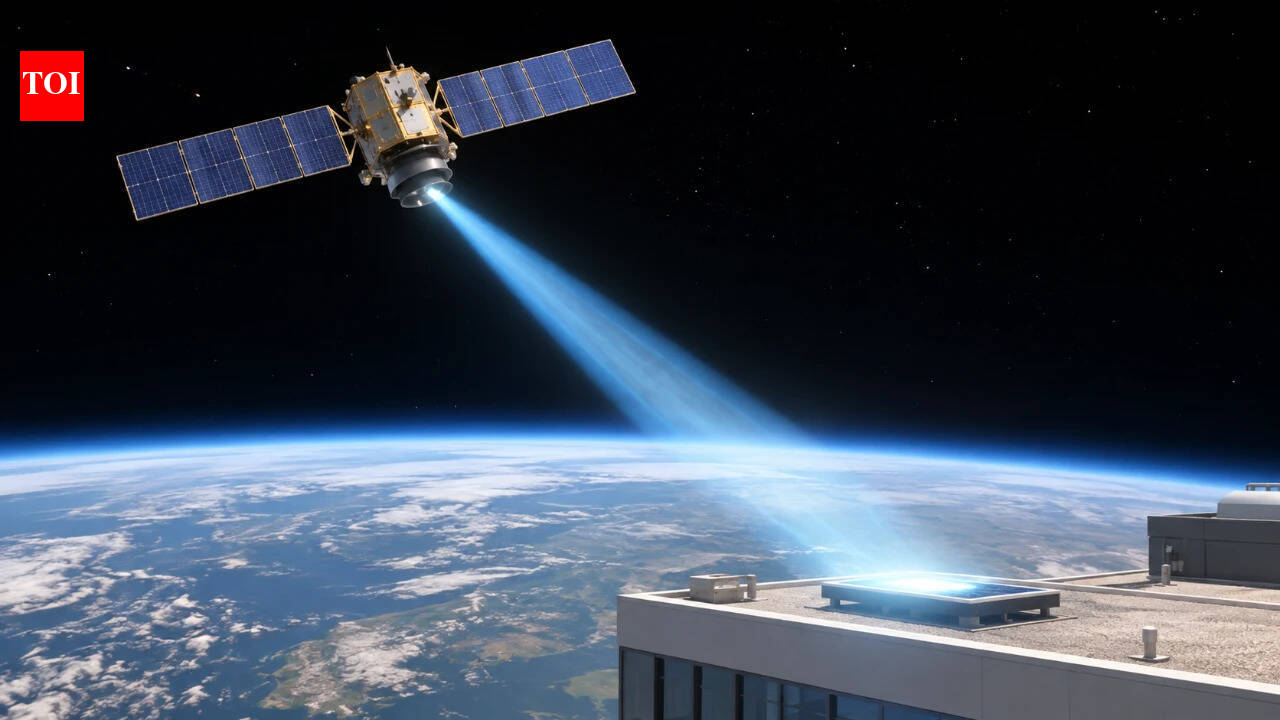
In 2023, Caltech scientists beamed a microwave signal from a satellite in orbit to a rooftop on Earth. The team launched the SSPD-1 satellite on January 3, 2023. While the experiment showed wireless power transmission from space is possible, the energy received was not enough for any practical use.
For years, scientists have explored whether satellites could collect sunlight in space and send the energy wirelessly to Earth. In 2023, researchers at the California Institute of Technology (Caltech) tested an important part of that area. Solar energy was harvested by their spacecraft and turned into electrical energy, which was then transferred to Earth using a microwave beam. They also had an energy receiver set up on the roof of a laboratory building in Pasadena that would receive the beam. The experiment proved that there was a way to get energy from space using a prototype, but the energy could not be used for any practical purpose.
Caltech launched its solar power demonstrator in January 2023The SSPD-1 satellite, developed by Caltech, launched on January 3, 2023, on a SpaceX Falcon 9 rocket as part of the Transporter-6 rideshare mission, according to Caltech. It was carried to orbit aboard Momentus's Vigoride-5 orbital transfer vehicle, which hosted three experimental payloads for a future solar power station. The first payload was MAPLE (Microwave Array for Power-transfer Low-orbit Experiment). It was created by the research team led by Caltech's professor Ali Hajimiri. The MAPLE technology transmitter operated using custom-built chips. They enabled power transfer without any mechanical movement of the elements.
DOLCE was used for testing the lightweight expandable space structure. ALBA had 32 types of photovoltaic cells.
MAPLE transmitted power inside the spacecraft and towards EarthAccording to Caltech, MAPLE first achieved wireless power transmission on March 3, 2023. MAPLE transmitted microwave energy to two receiving arrays situated roughly a foot apart within the craft. The energy was then transformed into direct current electricity, which powered two small light-emitting diodes. The timing of the signals from MAPLE's transmitter made the electromagnetic waves interfere constructively, forming a beam that could be steered electronically in the desired direction.According to Caltech, receiving equipment on the roof of the Gordon and Betty Moore Laboratory of Engineering in Pasadena picked up a microwave signal from the spacecraft on May 22, 2023. The signal arrived at the expected time and frequency and the frequency shifted just as the researchers had predicted from the Doppler effect caused by the satellite's motion in orbit. Caltech announced the result on June 1, 2023. The detected power was not enough for practical electricity generation, but it confirmed that MAPLE could transmit a signal from orbit and that researchers could detect it on the ground.Why collect solar energy in space?Solar cells on Earth need light as well as good weather conditions. In the designs Caltech envisions, a solar power system in space would not be affected by nighttime, seasons or clouds. The SSPD-1 demonstrator itself flew in low-Earth orbit, where it regularly passes through Earth's shadow. Caltech's future perspective is based on spacecraft that gather sunlight, convert it to electricity and send microwaves to the receiver on Earth.
MAPLE experiments continued for eight months after the initial demonstrations, according to Caltech. Caltech later stated that some transmitter elements were subject to failure under stress conditions, resulting in the reduction of transmission power.
In its January 16, 2024, mission report, Caltech described the mission's successes and technical lessons. Commercial-scale solar power from space remains a future goal. The 2023 prototype was not built to generate electricity for homes or businesses, but the experiment showed that it could transmit microwave power from orbit and direct a detectable signal toward Earth.