
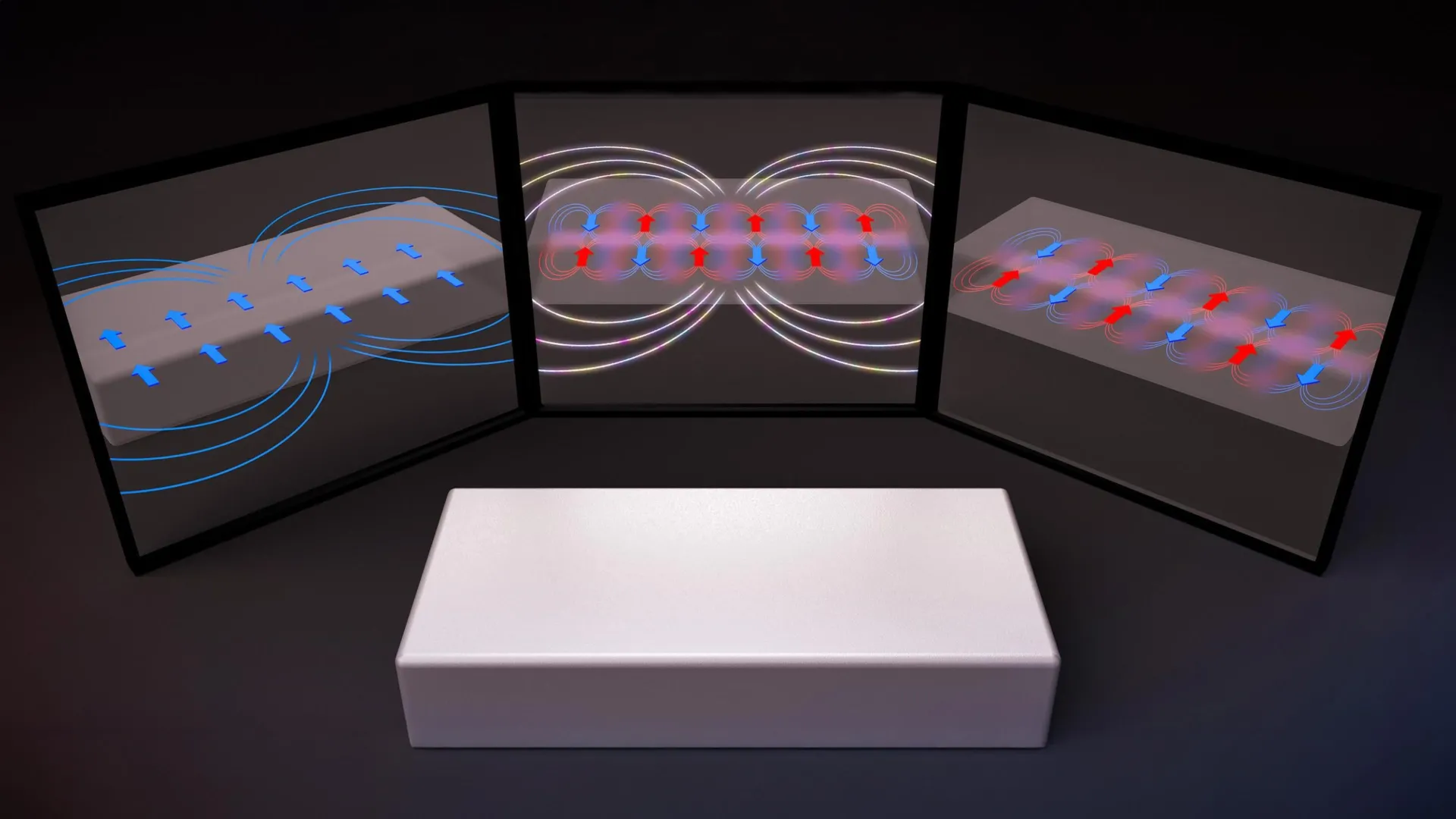
SLAC scientists found proof of altermagnetism, a third type of magnetism. Lead author Daniel Jost said, "We believe our results provide robust experimental confirmation that this third phase -- altermagnetism -- is real." The team studied manganese telluride to show how this phase bridges the qualities of two traditional magnetic classes.
The breakthrough comes from a research team led by the U.S. Department of Energy's SLAC National Accelerator Laboratory. In a study published in Science, the researchers presented compelling experimental evidence for altermagnetism, a distinct magnetic phase that combines important characteristics of the two traditionally recognized types.
"In the past few years, scientists have observed phenomena that don't fit neatly into the ferromagnetism-antiferromagnetism dichotomy," explained lead author Daniel Jost, associate scientist at SLAC and Stanford Institute for Materials and Energy Sciences. "Researchers have been compiling evidence of a third type of magnetism that bridges the qualities of these two classes. We believe our results provide robust experimental confirmation that this third phase -- altermagnetism -- is real."
The team focused on manganese telluride (MnTe), a material that had long been classified as an antiferromagnet. Building on earlier research, the scientists identified direct evidence of chirality, a distinctive asymmetry in the material's magnetic structure. This property resembles the way a spiral staircase or screw twists in a particular direction and provides a crucial signature of altermagnetism.
Beyond its importance for fundamental physics, the finding could help researchers develop magnetic materials with properties suited to future technologies, including advanced memory systems, quantum devices, and more energy-efficient data centers.
Understanding the Two Traditional Types of Magnetism
Magnetism is familiar from everyday experiences, whether it is a refrigerator magnet holding up a photograph or a compass aligning with Earth's magnetic field. But the physics behind these effects is far more complicated than it appears.
At the atomic level, magnetism is connected to a quantum property of electrons known as spin. Although spin is not literally an electron rotating like a tiny ball, it behaves in certain ways as though the electron has its own angular momentum. Scientists commonly describe the two possible spin orientations as "up" and "down."
When these spins become organized into particular patterns, a material can exhibit magnetic properties. However, that does not necessarily mean it will produce an externally detectable magnetic field.
In ferromagnetic materials, electron spins align in the same direction (up-up-up or down-down-down). Their combined effect produces the familiar magnetic field associated with ordinary magnets. People have used materials with this behavior for thousands of years.
A second category, identified in 1933, works differently. In antiferromagnets, neighboring electron spins point in opposite directions (up-down-up-down). Because the magnetic contributions oppose one another, they cancel out, leaving no overall magnetization.
A Third Type of Magnetism Challenges the Old Rules
For almost nine decades, these two categories provided the basic framework for understanding how magnetic order arises in materials. However, experimental observations in recent years began revealing behavior that neither category could fully explain.
Some materials displayed alternating electron spins and no overall magnetization, just like antiferromagnets. Yet they could also support useful spin currents, a property associated with ferromagnetic behavior. Spin currents allow information to be carried through the spin properties of electrons rather than relying entirely on their electrical charge.
The unusual combination suggested that scientists were dealing with something fundamentally different. In 2022, researchers introduced the term "altermagnets" for materials belonging to this proposed third magnetic class.
The key difference lies in the arrangement of atoms within the material. Altermagnets have alternating spin orientations (up-down-up-down), but the crystal structures surrounding the oppositely aligned spins are rotated relative to one another.
This rotation breaks a form of symmetry that exists in conventional antiferromagnets. Although the distinction is subtle, it can dramatically change how electrons behave, allowing altermagnets to combine properties once considered incompatible.
Scientists Find the Missing Evidence for Altermagnetism
Even as experimental support for altermagnetism accumulated, researchers still needed a decisive way to establish that it represented a genuinely distinct magnetic phase.
"By 2024, there were some factors that spoke strongly in favor of altermagnetism being real," Jost said, "but there was still a missing piece to the puzzle."
That missing evidence involved chirality, a property sometimes described as "handedness." An object is chiral when its mirror image cannot be perfectly aligned with the original. Human hands provide a simple example: Your left and right hands are mirror images, but a left hand cannot fit properly into a right-handed glove.
In an altermagnet, the unusual arrangement of atoms and electron spins can create this kind of handedness in the material's electronic and magnetic structure. Conventional antiferromagnets do not exhibit the same characteristic chiral signature.
Detecting that difference would provide a powerful way to distinguish a true altermagnet from a material that merely resembles one.
The researchers selected manganese telluride as their test material. For decades, scientists considered it an ordinary antiferromagnet, but more recent studies had raised the possibility that it belonged to the newly proposed category.
Powerful X-Rays Reveal a Hidden Magnetic Signature
To investigate the material's unusual properties, the team conducted experiments at the European Synchrotron Radiation Facility (ESRF) in France. The facility's ID32 beamline produces precisely controlled polarized X-rays, allowing scientists to examine subtle magnetic structures that are otherwise extremely difficult to detect.
The researchers used circularly polarized X-rays, which have electric fields that rotate in either a left-handed or right-handed direction as the light travels. By measuring how the material scattered these two forms of light, they could search for evidence of chirality.
"Chiral materials scatter left-handed polarized X-ray beams differently than they do right-handed beams," explained Jost. "Non-chiral materials would scatter each beam of light the same way."
The experiment revealed a clear difference in the way manganese telluride interacted with the two X-ray polarizations. This distinctive chiral response was precisely the kind of signal expected from altermagnetism and would not be present in a conventional antiferromagnet.
"This chiral signature gave us the solid experimental ground to say altermagnetism stands in a class of its own," Jost said.
The researchers first performed the experiment in 2024. They returned in early 2025 and repeated the measurements, successfully reproducing the results and strengthening the evidence for the new magnetic phase.
"This technique helped us confirm that manganese telluride was really exhibiting altermagnetic properties," said Rachel Nickel, postdoctoral scientist with ESRF, a co-author who helped design and conduct the experiment on the ID32 beamline. "Altermagnetism was only proposed a few years ago, and the rapid progress in confirming these models is incredible."
Why Altermagnetism Could Transform Future Computers
The discovery could have important consequences for spintronics, a growing field that seeks to use electron spin to develop more capable electronic devices.
Conventional electronics store and process information primarily by controlling the electrical charge of electrons. Spintronics adds another way to work with information by taking advantage of electron spin as well.
This extra capability could enable devices that operate faster, withstand interference more effectively, and consume substantially less electricity. Such improvements would be especially valuable in computer memory, large data centers, and other technologies that require enormous amounts of information processing.
However, the two traditional types of magnetism present different obstacles that have limited the development of spintronic systems.
"Ferromagnets are too easily influenced by magnetic fields," Jost explained. "If you have a permanent magnet in your pocket and walk by a spintronic device built with ferromagnets, you could start flipping the bits, scrambling the information stored there. Antiferromagnets fix that problem, but they are practically invisible -- so you can't easily read the data stored in them or use them to drive efficient spin currents."
Altermagnets offer a potentially valuable alternative. Like antiferromagnets, their opposing spins produce no overall magnetization, helping protect them against unwanted magnetic interference. At the same time, their unusual electronic structure allows them to generate spin-polarized currents that can be used to retrieve information.
"Altermagnets combine the best of both," Jost said. "They have zero net magnetization, so they're stable, but they still have the capability to generate spin-polarized currents needed to easily extract information. That gives you an additional degree of freedom to work with."
A New Frontier for Quantum Technology and Electronics
Confirming altermagnetism gives scientists a new class of materials to investigate and potentially engineer for technological applications. By combining magnetic stability with the ability to manipulate spin-based information, these materials could help overcome challenges that have held back conventional spintronic devices.
The next step will be learning how to control altermagnetic states using external influences such as light and electricity. Researchers hope that mastering this control will make it possible to design practical devices that take advantage of the unusual magnetic properties.
Although significant development is still needed before these materials can be widely used, the findings establish a stronger experimental foundation for future work on quantum technologies, computer memory, and more efficient data centers.
The research received partial funding from the DOE Office of Science.