
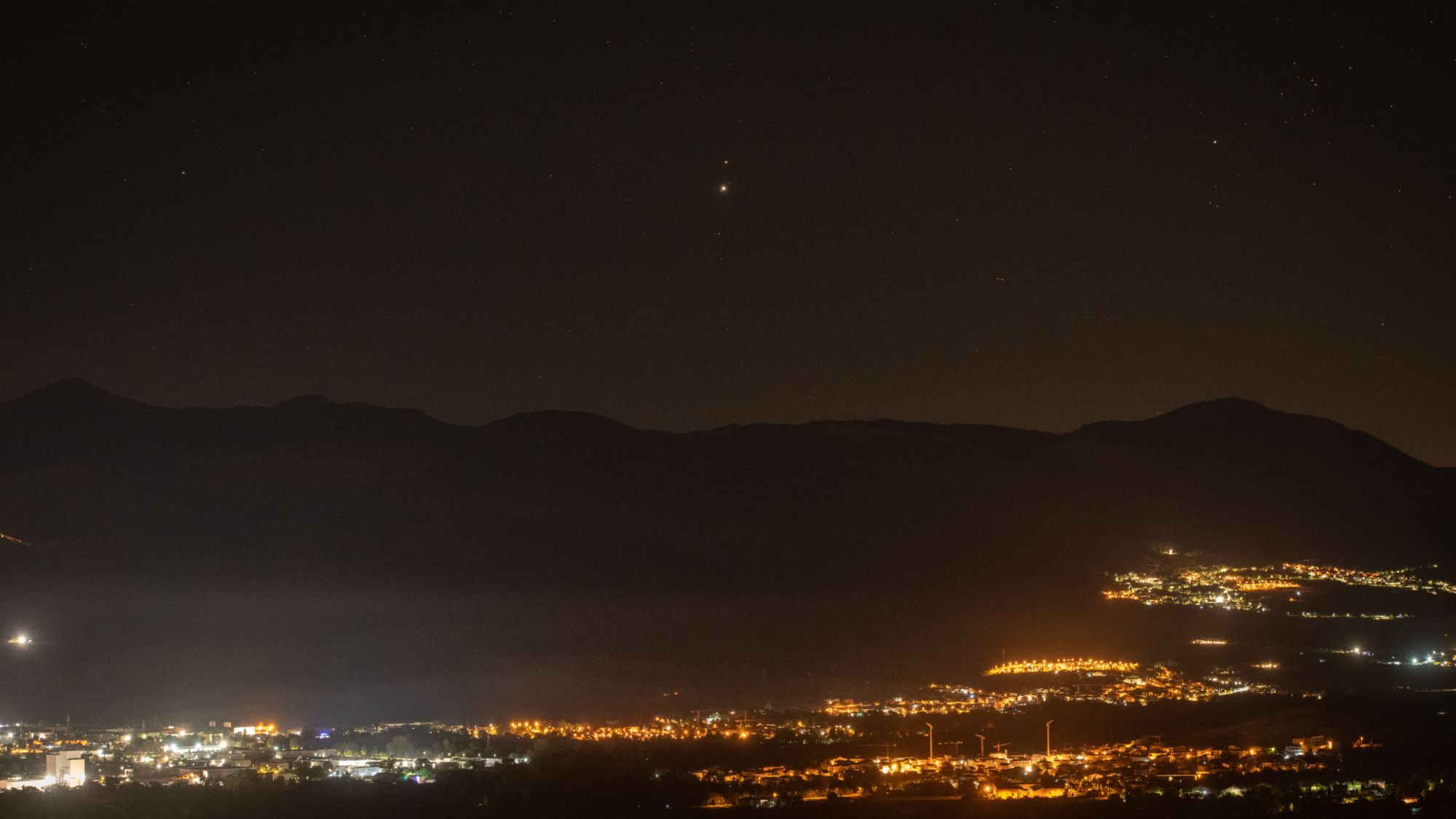
Mars and Jupiter will meet for a spectacular rendezvous in the constellation Leo on the night of Nov. 15-16. The planets will appear just over 1 degree apart as they rise around midnight. This rare display happens every few years, though they remain millions of miles apart in deep space.
Heads up stargazers! Mars meets Jupiter for a spectacular rendezvous in the heart of the constellation Leo on the night of Nov. 15-16, and they won't be this close again until July 2029.
Jupiter and Mars will appear a little over 1 degree from each other as they rise over the eastern horizon around midnight for viewers in the U.S., as the blue-white light of the main-sequence star Regulus glows below, according to In-The-Sky.
It's all a trick of perspective, but spectacular nonetheless. In reality Mars and Jupiter are separated by a gulf of over 368 million miles (592 million kilometers), while the light from Regulus has travelled for some 79 light-years before reaching Earth.
The spectacular display occurs just once every 2-2.5 years, when Mars catches up to Jupiter as it plies its more distant orbit, making the pair appear side by side from our Earthly vantage point — an event known to astronomers as an appulse.
Both Mars and Jupiter are "superior planets" whose orbits exist beyond that of Earth. As a result their disks always appear full to us through the eyepiece of a telescope, unlike the inner planets Mercury and Venus, which exhibit moon-like phases as they circle the sun.
A 6-inch telescope can reveal the wildly differing natures of the solar system worlds. Slew your scope to Jupiter to spot the gargantuan cloud bands (and zones) that ring the gas giant, formed from masses of ammonia and water that travel in different directions through Jupiter's hydrogen and helium atmosphere, driven by powerful jet streams.
Mars, meanwhile, appears as a reddish, ochre disk complete with dark surface features, where basaltic rock has been scoured clean of the iron-rich dust that covers much of its surface, according to NASA.
Interested in seeing and capturing the planets for yourself? Then be sure to read our guide on everything you need to observe and photograph the planets of the solar system, along with our picks of the top telescopes, cameras and lenses for exploring the night sky in 2026.