
Researchers from the University of Gothenburg, Chalmers University of Technology and Stockholm University synthesised diamondiyne, a 3D carbon material proposed 35 years ago. Published in Angewandte Chemie International Edition on September 14, 2026, the study showed the team used a liquid-liquid interface to create this porous, diamond-like carbon structure.
Diamond and graphite are the 2 forms of carbon most people know, but carbon atoms can arrange themselves into many different structures. Researchers from the University of Gothenburg, Chalmers University of Technology and Stockholm University have now synthesised diamondiyne, a 3D carbon material proposed decades ago. In
Diamondiyne: A 3D Carbon Allotrope With Mixed sp-sp³ Hybridization, published in Angewandte Chemie International Edition on September 14, 2026, the team reports a porous, diamond-topology network containing both single and triple carbon-carbon bonds. The material forms as crystalline regions within amorphous carbon films, rather than as a completely crystalline bulk solid. The researchers produced the film through a controlled reaction at the boundary between 2 liquids. Their findings establish a route to making this previously elusive carbon structure, while leaving its practical uses to be explored.
Diamondiyne explained: how triple bonds create a porous diamond-like structure
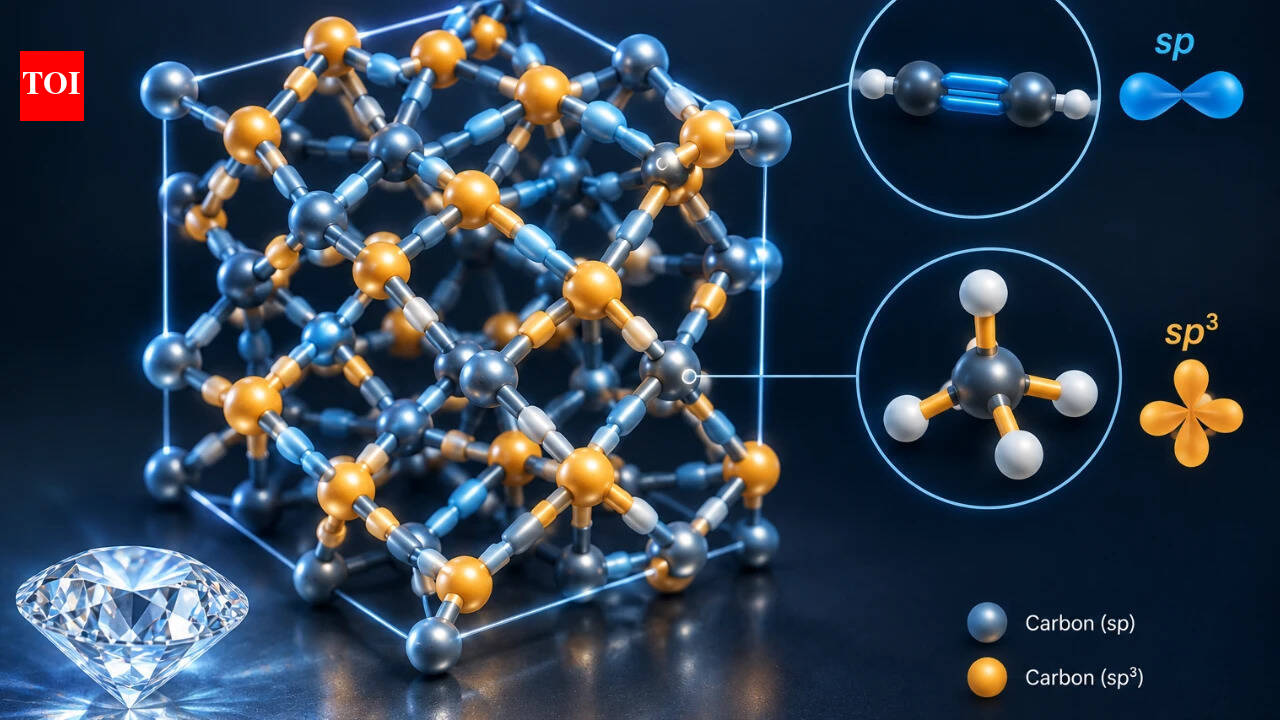
An allotrope is a structural form of an element. Diamond and graphite are familiar examples of carbon allotropes, alongside materials such as graphene, fullerenes and carbon nanotubes. In diamond, carbon atoms form a rigid, 3D network through single bonds. Diamondiyne preserves the overall diamond-like topology but incorporates carbon atoms with different bonding arrangements.
The structure combines sp-hybridised carbon atoms, which participate in triple bonds, with sp³-hybridised carbon atoms connected through single bonds. The resulting diyne groups expand the repeating network compared with diamond, creating more space within the structure.The researchers describe diamondiyne as a carbo-mer of diamond: diyne units are inserted between carbon centres in the diamond-topology network, expanding the structure.
The paper distinguishes between the ideal theoretical structure and the structure inferred from the experimental material. The ideal diamondiyne model has a face-centred cubic crystal structure, with sp and sp³ carbon in an 8-to-1 ratio. The authors also discuss an interpenetrated arrangement, in which multiple networks pass through one another. The published paper describes the nanoscopic structure as 2 asymmetrically interpenetrated 3D networks, assigned to the tetragonal space group I41/amd. The film contains crystalline regions within an amorphous carbon matrix, so the structure should not be described as a uniformly crystalline bulk material.
How researchers made diamondiyne at a liquid-liquid interface
The structure was first described theoretically 35 years ago. Earlier work by Ken S. Feldman and colleagues on tetraethynylmethane is relevant to the chemistry of the building block, but it should not be presented as evidence that researchers had been trying to synthesise diamondiyne for 30 years. The new team addressed that problem with a cascade reaction at the interface between 2 liquids. Their method uses the protected precursor tetra(triethylsilylethynyl)methane and copper(II) fluoride (CuF₂). Deprotection and coupling take place at the liquid-liquid interface, where the carbon-containing building blocks form the extended network. Keeping the reactions localised at the interface allows the active building block to be released and consumed gradually.
This controlled process helps limit unwanted reactions and encourages the molecules to attach sequentially to the growing carbon film. The researchers report films up to 2.5 centimetres in diameter. By changing the reaction time, they could also control film thickness, producing films ranging from a few nanometres to tens of nanometres. The team used electron microscopy to examine the film's structure and spectroscopy to investigate its chemical composition. The microscopy revealed small regions with well-defined lattice patterns. Spectroscopic measurements also detected signals consistent with diyne bonds and sp-hybridised carbon. Together, these results support the identification of diamondiyne within the film, although the researchers acknowledge that its crystalline structure is not uniform across the entire material.
Diamondiyne's properties and possible uses: what is known so far?
The porous structure makes diamondiyne scientifically interesting, but its practical performance should not be confused with predictions based on theoretical models. This is a measurement of the film's stiffness, not proof that isolated diamondiyne crystals have the same mechanical properties. A separate computational study calculated Young's moduli for several theoretical diamondiyne structures. For the 2f-unsym phase, which that study identifies as experimentally realised, the predicted values are 19.1 GPa along the x and y directions and 75.5 GPa along the z direction. These are theoretical calculations, not measurements of the experimental film. Further work is needed to determine the material's properties more fully and establish how its structure affects performance.
One possibility raised by the researchers is that multiple diamondiyne networks could interpenetrate, forming structures within the available voids. Its porous framework and the ability to make films of different thicknesses could make it worth investigating for future materials applications. However, uses in electronics, filtration, energy storage or other technologies have not been demonstrated by this study. Covalent organic frameworks provide a useful comparison because they also consist of connected molecular building blocks arranged into extended structures. Diamondiyne differs in being an all-carbon network with covalent bonds extending in 3 dimensions. Whether this new material becomes useful in practical devices will depend on further characterisation, improved control over its crystalline structure and tests of its performance. For now, the achievement is a synthesis milestone: researchers have produced carbon films containing crystallites consistent with a long-sought 3D diamond-like carbon network. The next challenge is to establish how reliably the structure can be made and what its measured properties could make possible.