
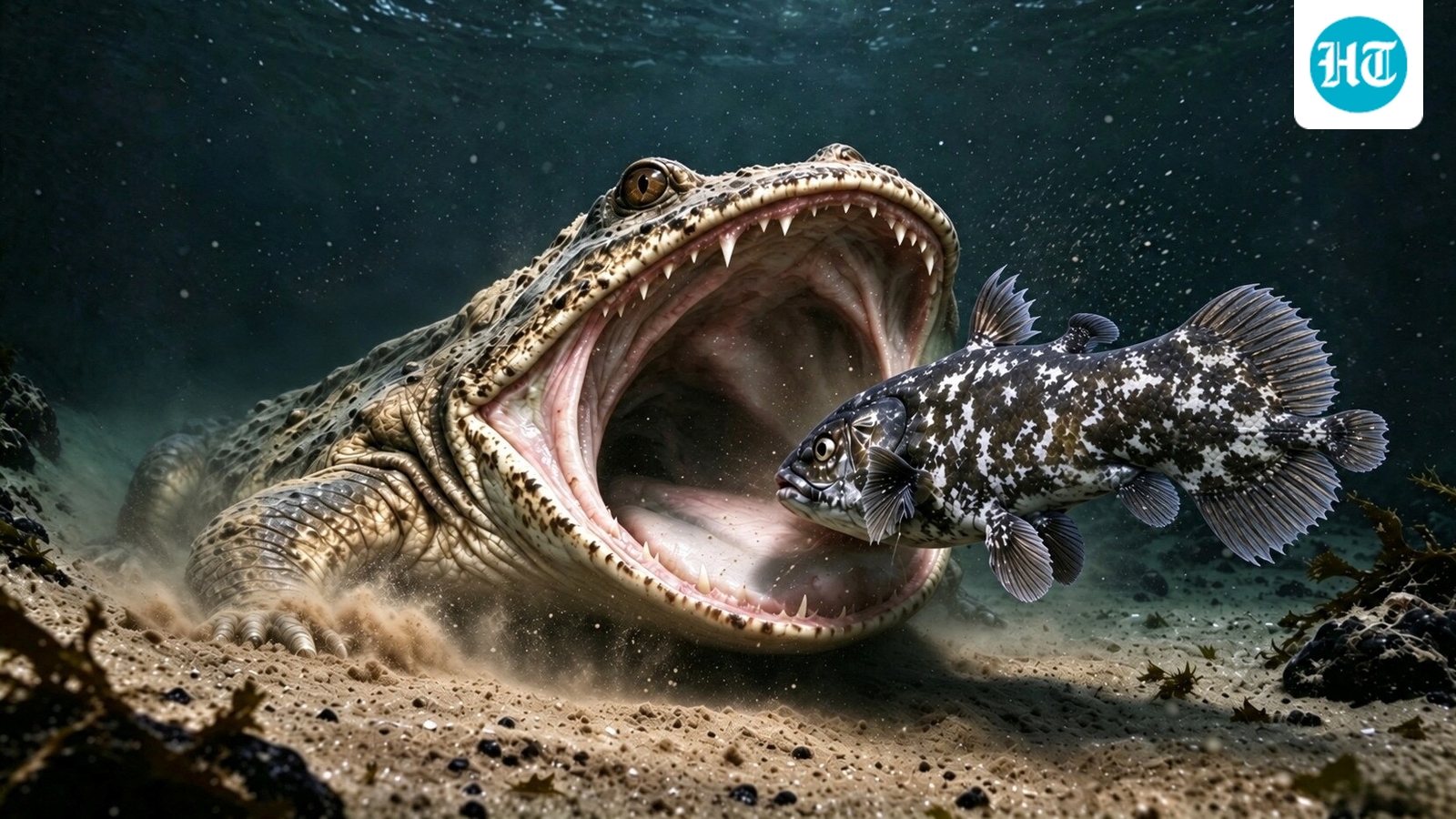
Scientists discovered 237-million-year-old fossils of the first known amphibian to live entirely in the ocean. Named Gerrothorax maritimus, the creature lived during the Late Triassic period in China. Ryosuke Motani said, "It's probably, body mass-wise, about the same as the giant salamander, but what's different is that this animal is chunky."
Scientists have discovered fossil evidence of what could be the first known amphibian to have lived entirely in the ocean, challenging long-held assumptions about the evolutionary history of these animals.
Named Gerrothorax maritimus, the heavily armoured creature lived approximately 237 million years ago during the Late Triassic period, according to The Independent.
The findings, published in Nature Ecology & Evolution, are based on two nearly complete skeletons discovered in China's Guizhou Province.
Measuring approximately 75cm in length, the creature had a flattened, disc-shaped body covered in protective bony armour. Researchers believe this armour may have helped it survive attacks from marine predators, including ichthyosaurs.
"If you think about today's amphibians, this animal is unusual because it's big," said Ryosuke Motani, a professor at the University of California, Davis.
"It's probably, body mass-wise, about the same as the giant salamander, but what's different is that giant salamanders are elongated whereas this animal is really chunky."
Scientists suspect the animal lived on the seabed, waiting for unsuspecting prey before capturing it through suction.
"They would probably just wait at the bottom and then when prey comes around, they would just suck it in," Motani explained, comparing its feeding technique to that of modern wobbegong sharks.
Unlike marine reptiles and mammals, modern amphibians cannot survive permanently in seawater because their permeable skin makes regulating salt levels difficult.
Of the more than 8,000 amphibian species alive today, none inhabits exclusively marine environments.
According to UC Davis, researchers believe the ancient creature's bony armour may have restricted water exchange through its skin.
Its digestive system and gills could also have helped it absorb water and manage excess salt, although these explanations remain hypotheses.
Both skeletons were discovered in ancient marine sediments, with even delicate finger bones remarkably well preserved.
"But these animals had their fingers preserved, so that means they probably died near where they lived," Motani said.
Further analysis revealed that strontium isotope signatures in the fossils closely matched those of Late Triassic seawater.
Together, the evidence suggests the animals lived in the ocean rather than being washed into it after death.
The discovery offers fresh insights into how ancient amphibians may have adapted to environments that remain largely inaccessible to their modern relatives.