
Scientists at the Large Hadron Collider detected signals from a beauty particle 100 billion times smaller than an atom. This discovery in the zeptoverse could help experts find dark matter. While 28 countries agreed to fund the project, the UKRI pulled out of its financial commitment to the research effort.
Scientists at the Large Hadron Collider detected signals at the ultra-small "zeptoverse" scale, where decaying beauty quarks could help unveil mysterious dark matter.
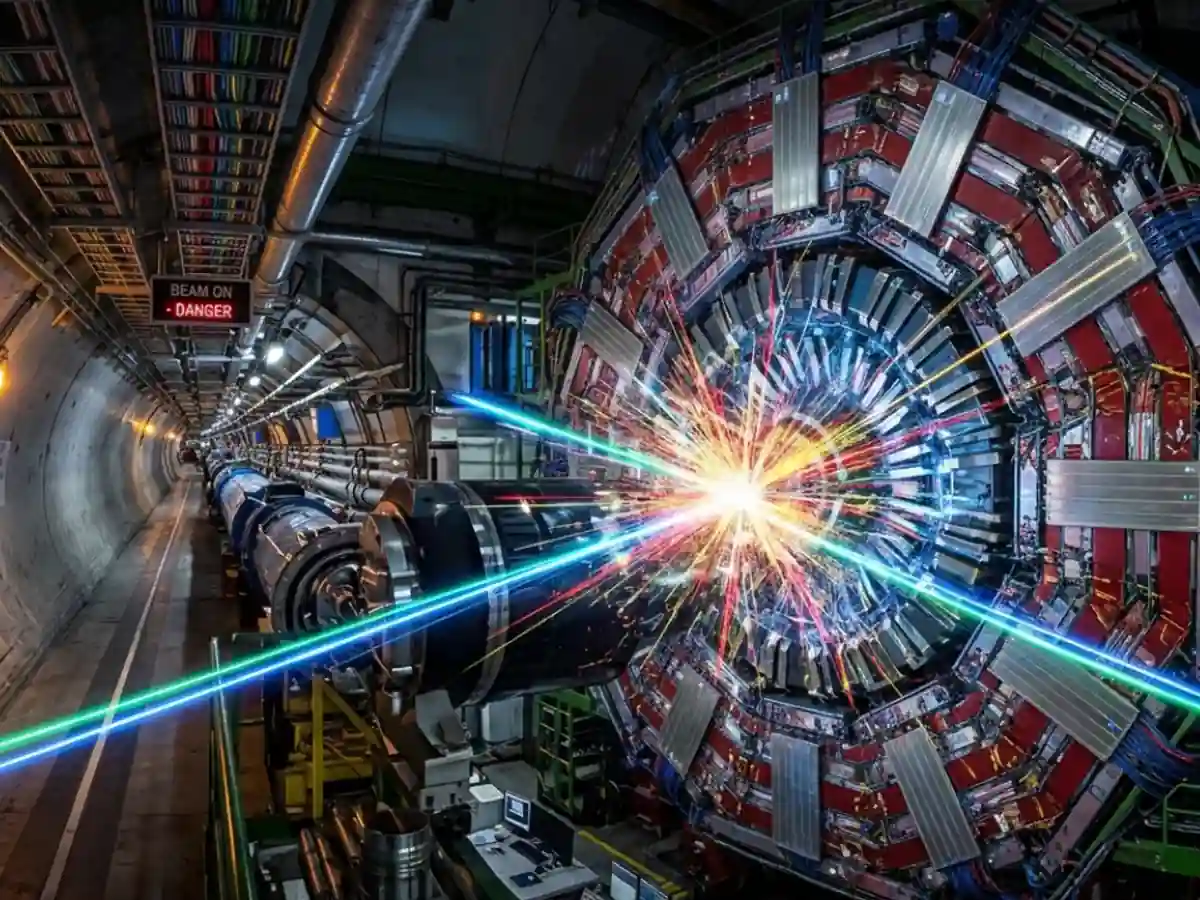
Experiments at the Large Hadron Collider have led scientists to stumble upon signals from a particle which is 100 billion times smaller than an atom. This small size has led some scientists to dub it the zeptoverse. The word zeptoverse refers to the realm of ultra-small distance scales, around a zeptometre or a trillionth of a billionth of a metre. It could prove crucial in the discovery of dark matter, as scientists think that this subatomic particle interacts with this invisible force. The LHC is located at the European Laboratory for Particle Physics (Cern), and inside it, atoms are smashed together to see what lies inside them.
In one such experiment, particles were smashed together at high energy and the fragments of this collision were scientists studied in detail. One such particle was the beauty quark, much, much smaller than even the atom. It exists for only one and a half trillionths of a second before breaking down. This decay process occurs in only 1 out of every 10 billion beauty particles. But this small timespan was enough to see what it was doing. The quark was noticed interacting with other tiny particles at a scale of a billion-trillionth of a metre.
Previous theories suggest that some particles are more sensitive to dark matter at this scale. Dark matter could also be affecting beauty quarks and deciding how they break down. This could lead scientists to finally detect dark matter. Scientists want to explore this possibly new particle and see what could be inside the zeptoverse.
The Large Hadron Collider is being upgraded to increase the frequency of these decays tenfold. Twenty-eight countries involved in the project have agreed to contribute a total of £150m towards it. However, the UK Research and Innovation (UKRI) agency has pulled out of the financial commitment, including cuts to several other particle physics and astronomy projects. This despite the fact that scientists based in Cambridge were leading the research.