
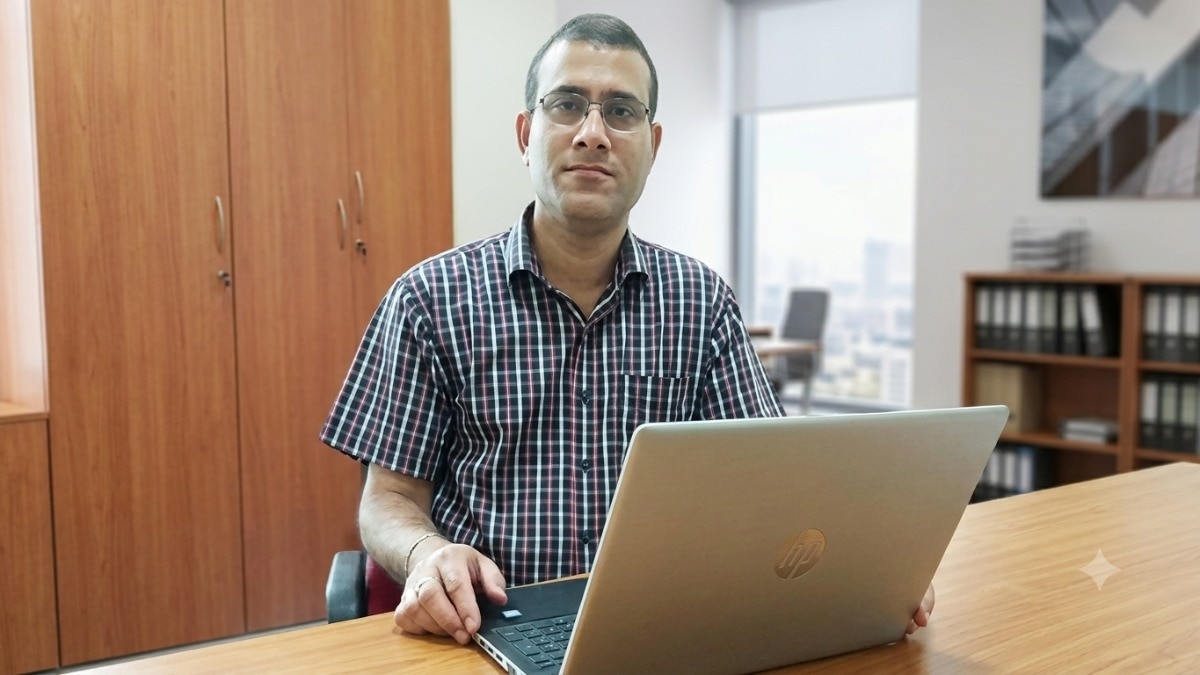
Professor Ashwini K. Phukan of Tezpur University helped solve a chemistry puzzle that baffled scientists for over 60 years. His team provided computational support to German researchers who successfully isolated stable oxoboranes. The discovery, published in Nature Chemistry on October 27, could help scientists explore new types of chemical bonds.
An Assam professor has helped solve a chemistry puzzle that baffled scientists for over 60 years. Professor Ashwini K Phukan of Tezpur University and his team provided computational support to German researchers who successfully isolated stable oxoboranes, molecules that chemists had struggled to produce for decades.
Some chemistry puzzles take years to solve. This one kept scientists guessing for more than 60 years. Now, an Assam professor has helped researchers crack it.
Professor Ashwini K. Phukan of Tezpur University and his team provided computational support to scientists at Germany's University of Wrzburg, who have successfully isolated stable oxoboranes. These are unusual molecules that chemists had tried to produce for decades but could never isolate in a stable form.
The discovery, published in Nature Chemistry on October 27, 2026, could help scientists explore new types of chemical bonds and make other hard-to-create molecules.
WHY DID THIS MOLECULE TAKE 60 YEARS TO FIND?
Oxoboranes contain a triple bond between two elements, boron and oxygen. While triple bonds are common in some molecules, getting boron to form one is particularly difficult.
Since the early 1960s, chemists around the world had tried to make and isolate oxoboranes. They had detected these molecules under extreme conditions and found evidence that they could exist. But getting them to stay stable long enough to study in a laboratory was another challenge.
The discovery is also the latest achievement in a long research journey by Professor Holger Braunschweig's team at the University of Wrzburg. In 2012, the group reported the first molecule with a boron-boron triple bond. In 2025, it reported the first neutral molecule with a boron-carbon triple bond.
A SURPRISE IN THE LAB CHANGED EVERYTHING
The breakthrough came from an experiment involving a compound called diboracumulene and ketones, chemicals commonly used in laboratories.
Two doctoral researchers, Lukas Lubczyk and Christian Markl, separately noticed something unusual during their experiments. Their reactions produced orange and yellow solids.
When the team studied these solids, they discovered that they were oxoboranes.
The result was unexpected. The researchers had not set out to produce these molecules in this particular way, and other outcomes had seemed more likely.
Even more surprising, the molecules did not break down quickly. The team managed to prepare three different oxoboranes that remained stable as crystals at room temperature.
HOW AN ASSAM UNIVERSITY HELPED
Professor Ashwini K Phukan and his team at Tezpur University supported the German researchers through computational chemistry.
In simple terms, computational chemistry uses computers and mathematical models to understand how molecules are built, how their atoms bond and how they behave. This helped the researchers study the properties and unusual stability of the newly prepared oxoboranes.
The project brought together laboratory experiments in Germany and computational research from India.
The work was supported by the German Research Foundation, the German Academic Exchange Service and India's Department of Science and Technology.
WHAT COULD THIS MEAN FOR SCIENCE?
The researchers are now testing whether the same method can help them create other molecules that have been difficult to produce.
The discovery does not mean that these molecules will immediately have everyday applications. However, it gives chemists a new way to study unusual bonds and explore compounds that were once considered too unstable to isolate.
For a chemistry puzzle that lasted more than six decades, getting three stable oxoboranes into a laboratory is a major achievement.