
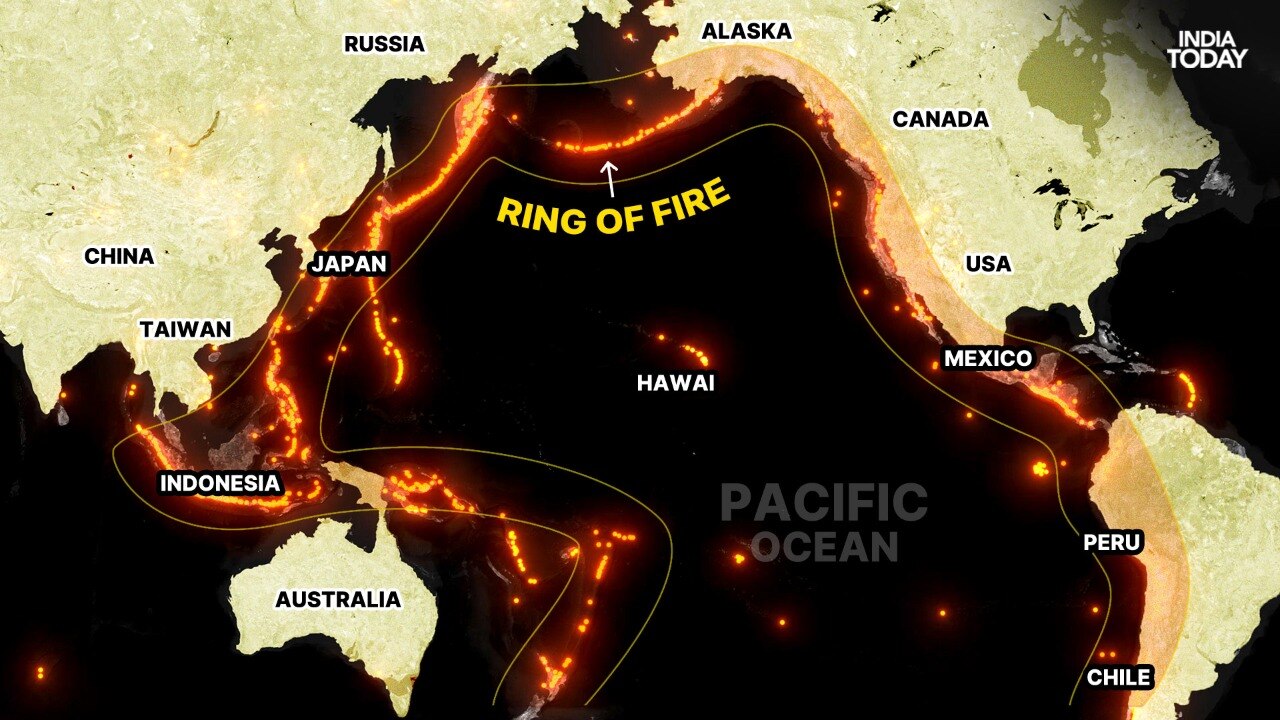
A magnitude 7 earthquake struck the Kamchatka Peninsula region of Russia on Friday, the European-Mediterranean Seismological Centre said. The region sits on the Pacific Ring of Fire, where tectonic plates collide. This deep quake occurred within the descending Pacific Plate, reminding many how restless this volcanic area remains today.
A magnitude 7 earthquake struck the Kamchatka Peninsula region of Russia on Friday, the European-Mediterranean Seismological Centre (EMSC) said.
The powerful earthquake points to one of the most geologically restless regions on Earth, that sits directly above a vast, constantly moving tectonic system.
Beneath the surface, enormous slabs of Earth's crust are colliding, sliding and building up stress that can be released suddenly as earthquakes.
TWO TECTONIC PLATES ARE LOCKED IN A SLOW-MOTION COLLISION
Kamchatka lies along the Kuril-Kamchatka Trench, where the Pacific Plate is moving northwestwards and diving beneath the Okhotsk microplate, commonly associated with the North American Plate system. This process is called subduction.
The Pacific Plate moves at roughly 8 centimetres per year relative to the overriding plate. That may sound slow, but over decades it amounts to metres of movement.
The two plates do not always slide smoothly past each other. Friction can lock sections of their boundary, allowing stress to accumulate. When the stress exceeds the strength of the locked rocks, the fault suddenly slips, releasing energy as seismic waves. That is what causes an earthquake.
WHY IS THE REGION EXPERIENCING POWERFUL EARTHQUAKES?
Kamchatka sits on the Pacific Ring of Fire, a roughly 40,000-kilometre belt around the Pacific Ocean marked by frequent earthquakes and volcanic activity. The subduction of oceanic plates also helps generate magma, feeding the region's active volcanoes.
The peninsula's seismic history demonstrates just how powerful this system can be. On July 30, 2025, a magnitude 8.8 earthquake struck offshore Kamchatka, generating tsunami warnings across the Pacific. The event was followed by numerous aftershocks.
The latest magnitude 7 earthquake, reported at a depth of approximately 140 kilometres, is different from a shallow rupture along the offshore plate boundary. Its depth suggests it occurred within the descending Pacific Plate or in the surrounding subduction-zone system.
IS THE 2026 EARTHQUAKE PART OF THE SAME SEQUENCE?
That remains uncertain. Earthquakes can trigger changes in stress around nearby faults, sometimes producing aftershocks or additional seismic activity. The effects depend on the location, depth and geometry of the rupture.
The major 2025 earthquake and its aftershocks are important context for understanding Kamchatka's recent seismic history.
However, the occurrence of another magnitude 7 earthquake does not, by itself, establish that the 2025 event caused it. Scientists would need to compare their locations, depths, fault mechanisms and timing to establish a connection.
Nor does a cluster of earthquakes necessarily mean that a still larger earthquake is imminent. Earthquake sequences can evolve in different ways, and scientists cannot reliably predict the exact timing or magnitude of the next major event.
WHAT HAPPENS NEXT?
The immediate priorities are to assess damage, monitor aftershocks and determine whether the earthquake generated any tsunami threat.
At 140 kilometres deep, a quake generally produces less seafloor displacement than a comparable shallow offshore rupture, although its actual effects depend on its mechanism and location.
For Kamchatka, the bigger story lies beneath the surface: the Pacific Plate continues its relentless descent into Earth's interior, maintaining one of the planet's most active earthquake zones.